A founder sits across from someone who feels like the answer. The person is charming, rehearsed, credible. They lean forward at exactly the right moments. They say things that land like validation. Within ninety minutes, the founder feels chosen, understood, finally paired with someone who gets it. They exchange equity. They celebrate. Eighteen months later, they’re in a lawyer’s office trying to untangle a partnership that was never built to survive past the dopamine hit of being approved.
This happens every single day in boardrooms across the country.
The founder will blame the person. Bad judgment. Wrong timing. Incompatible work styles. But the person was never the problem. The infrastructure was. The founder had no structured layer of clarity between intuition and commitment. No way to separate the feeling of being chosen from the reality of being aligned. No system that could stop the oldest part of their nervous system from running the show.
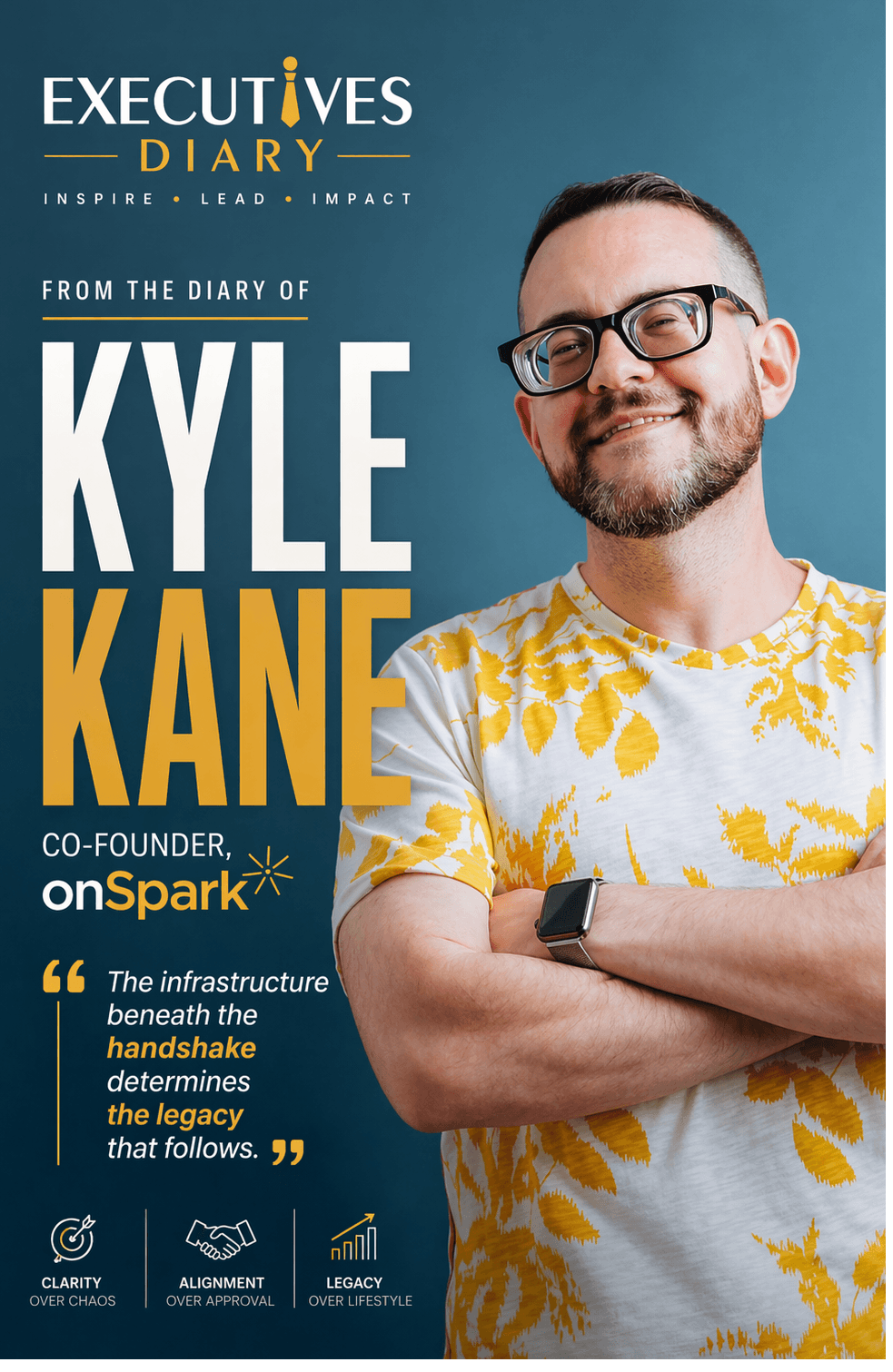
Kyle Kane has watched this pattern repeat for two decades. He has driven two billion dollars in partnership revenue for global brands. He has seen the wound destroy companies from the inside out. And he has built something to prevent it.
Meet Kyle Kane
Kyle Kane is the co-founder of onSpark, an AI-powered partnership engine that has fundamentally changed how founders approach one of their most consequential decisions. But the title alone misses the point. Kane is a student of the founder’s nervous system. He understands that most partnership failures are not business failures. They are failures of the human being making the decision, working from a place of need instead of strength, choosing the familiar instead of the aligned.
His work has been featured in Forbes, Entrepreneur, and the Wall Street Journal. He is an Emmy-award winning producer and content creator who speaks at TEDx, and he has been named a contributor to Entrepreneur Magazine. But the credential that matters most is the one no magazine can verify: Kane has spent enough time inside the psychology of founders to see what they cannot see about themselves.
The Path That Built Clarity
Kyle Kane did not start by studying partnership psychology. He started by making music. For twenty-one years, Kane worked as a songwriter and producer for ASCAP and Universal Music Group. He spent time in studios where the best ideas had to exist before the instruments could amplify them. That discipline shaped how he thinks. You do your own work first. You form your own thoughts. Only then do you bring in the tools.
He moved through roles that taught him how value gets built at scale. This included founding a previous company that was ranked #13 on the Inc. 500 list of Fastest Growing companies and #24 in Global Marketing and Advertising. He served as Chief Strategy Officer at Beyond Pacific, where he coordinated global entertainment and live events. He was Chief Marketing Officer at Nobody Studios, a venture studio backed by some of the most accomplished investors in the country. Each role deposited a layer of understanding about how businesses grow, how partnerships form, and why most of them fail.
But the insight came from agency work. Kane spent years generating ideas that ultimately built someone else’s moat, someone else’s enterprise value, someone else’s balance sheet. Every campaign was brilliant. Every result was impressive. And none of it was his. He realized that service revenue funds a lifestyle while equity builds a legacy. The gap between those two outcomes compounds across a career, and he was choosing the wrong side. That realization changed everything about how he chose his next move.
The Operating System for Founder Decisions
onSpark exists because Kane saw a gap that no one else was solving. Founders fail at partnerships not because they lack value. They fail because the process is broken. Manual partnership strategies route decisions through the exact part of the founder most vulnerable to distortion, which is intuition shaped by old patterns. Kane calls this the infrastructure gap. It is not really about software. It is about what happens inside a founder’s nervous system the moment a credible partner walks into the room.
“The wound that destroyed most partnerships was never in the contract,” Kane explains. “It predated the contract by decades of lived experience.” Founders raised in environments where love was conditional, where approval had to be earned and could always be revoked, spend their adult careers unconsciously recreating that dynamic in their business relationships. They call it chemistry. What they are actually experiencing is a neural echo of approval-seeking, the same reward pathway lighting up for charm, rehearsed enthusiasm, and the quiet relief of being chosen.
The deeper question underneath every partnership decision is whether you are choosing from strength or from hunger. The answer determines everything that follows. onSpark scans more than eight million external partner records, 150,000 internal records, and 24,000 CRM profiles to produce trust-scored matches based on fit, collaboration DNA, and revenue potential rather than gut feeling. HubSpot’s GTM Partnerships team reported a tenfold lift in qualified leads through the network, outperforming every other partnership resource they tested. This is what happens when intuition steps aside and infrastructure takes over.
But Kane’s real insight goes deeper than the algorithm. He understands that founders deserve to choose their next partnership from clarity rather than need. That distinction changes everything. A founder choosing from strength can say no. A founder choosing from hunger cannot. One builds a business. The other builds a repeat pattern.
“You don’t get invited back to the room because you’re liked,” Kane posted recently. “You get invited back because you bring value, clarity, and character.” This is not motivational fluff. This is how networks actually work. Connectors can feel within the first ninety seconds whether you brought all three into the room. Founders who mishandle borrowed trust treat the introduction as the finish line rather than a loan carrying interest. They almost never receive a second one.
The Kane Playbook: 5 Lessons
- Lesson 1: Choose from strength, not hunger, and the partnership survives the first difficult decision.
- Lesson 2: Treat every introduction as borrowed trust, and show up prepared with context, point of view, and something to offer before asking for anything in return.
- Lesson 3: Build systems that automate low-value decisions so your original judgment stays sharp for decisions that matter.
- Lesson 4: Protect your own IP and equity over a career, because service revenue funds a lifestyle while ownership builds a legacy.
- Lesson 5: Keep your own thoughts alive by forming them before you bring in any tool, whether that tool is AI, a consultant, or a supposed expert.
The Thought That Stays
The handshake looks the same whether it comes from strength or hunger. The smile reads the same. The words land the same. But underneath, in the infrastructure no one can see, everything is different. One partnership compounds. The other collapses. Kane built onSpark to make the invisible visible. To give founders a structured layer of clarity before their oldest patterns enter the room. To prove that the partner was never the problem. The infrastructure was.
That is what separates the founders who build empires from the ones who rebuild the same broken pattern with new faces and new cap tables.