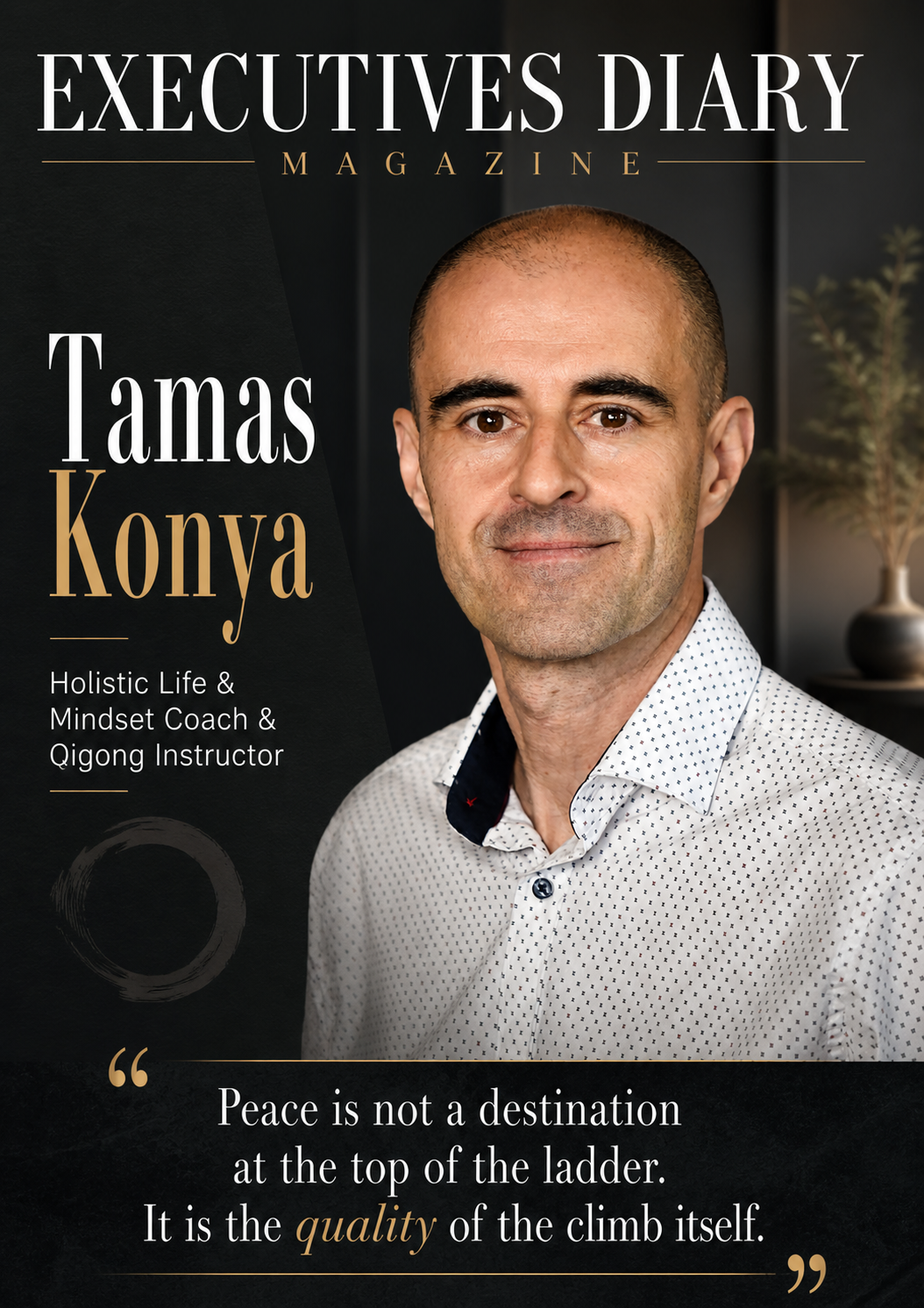
Who is Tamas Konya?
Tamas Konya is a London-based holistic life and mindset coach and Qigong instructor who helps midlife professionals transition from burnout and internal misalignment to a state of clarity, energy, and balance. With nearly a decade of experience in high-pressure corporate environments, he understands the hidden toll of external success without inner alignment. Today, he combines practices like Qigong, mindset work, and emotional techniques to guide individuals toward sustainable performance, emphasizing that true leadership and fulfillment begin with mastering one’s internal state.
The house is quiet, the kind of stillness that usually guarantees a deep, restorative sleep. But at 3:00 AM, Tamas Konya finds himself awake. He navigates the hallway in a semi-autopilot haze, yet as he slips back under the duvet, a strange thing happens. He smiles.
It is a quiet, private victory. Years ago, these midnight hours were a descent into a downward spiral of stress and anxiety, a time when sleep was a desperate hope rather than a natural state. Today, the wakefulness is just a side effect of too much herbal tea. It is a small moment, but it represents the most significant pivot a professional can make: the shift from life as a series of maintenance tasks to life as a lived experience.
The High-Achiever’s Quiet Tragedy
Most high-achievers are masters of the external world. They build careers that look like dreams from the outside, complete with the house, the title, and the growing family. They are the reliable ones, the capable ones, the people who tick every box on the list of traditional success. Yet, there is a common, quiet tragedy in this achievement. As the ladder rises, the internal light often fades. The fire that fueled the climb is replaced by a heavy sense of autopilot, where energy drops and joy becomes a distant memory.
This is the tension of the modern professional: doing everything right while nothing feels right. We are taught to manage our calendars, our teams, and our portfolios, but we are rarely taught to manage our alignment. For Konya, this wasn’t just a coaching theory; it was his reality. He spent nearly a decade in the high-pressure world of conference services management, earning accolades as a customer service champion and managing complex logistics in London. On paper, he was stable. Internally, he was drifting.
The Corporate Arc and the Weight of Adaptation
The corporate arc is often a marathon of adaptation. Professionals learn to say yes when they mean no, to set aside personal boundaries for the sake of responsibilities, and to follow paths that belong to someone else’s expectations. Konya lived this version of success, relying on coping mechanisms like smoking and alcohol to bridge the gap between his external performance and internal exhaustion. He was climbing a ladder, but as he eventually realized, it was leaning against the wrong wall.
True change rarely comes from a sudden explosion; it comes from the exhaustion of the old way. For Konya, the turning point was a decision to take full responsibility for his own wellbeing. He stepped away from the habits that served as buffers and began investigating the deeper underlying factors of his stress. This was not a quick fix or a weekend retreat. It was an identity shift, a move from self-criticism toward a relationship with himself built on awareness and acceptance.
A Return to Natural Rhythm
He traded the frantic pace of the conference floor for the 4,000-year-old practice of Qigong. This transition was more than a career change; it was a return to a natural rhythm. Qigong offered a way to calm the nervous system and restore energy without the need for pushing or forcing. It became the foundation of his new philosophy: that leadership is not about doing more or pushing harder, but about leading from a place of internal clarity.
When a leader is out of alignment, the friction is felt by everyone. It shows up in poor decisions, strained communication, and a presence that drains rather than inspires. Konya’s work now centers on the belief that energy and clarity set the tone for everything an individual does. He helps busy professionals reconnect with their natural energy, teaching them to release stress instead of carrying it like a badge of honor.
Redefining Midlife Performance
The midlife alignment he speaks of is a feedback system, not a breakdown. It is an invitation to stop functioning and start living. In his coaching, he uses a blend of mindset work, Qigong, and Emotional Freedom Technique to address both the mind and the body. The goal is to move from being tired but wired to a state that is calm, present, and genuinely alive. It is about creating a life that doesn’t just look good on a LinkedIn profile but actually feels right at 3:00 AM.
Success in the next decade will likely be defined by this integration. High performance without wellbeing is no longer a sustainable model; the cost to the individual and the organization is simply too high. Practices that regulate the nervous system and deepen self-awareness are moving from the periphery of wellness to the core of essential leadership skills. Konya represents this new guard, leaders who understand that meaningful change in the world must start with an individual’s inner balance.
Listening Before the Shout
His message to those currently in the thick of the corporate climb is one of caution and hope. It is a reminder not to lose oneself in the process of building a career. The expectations of the world are loud, but the signals of our own energy are often quiet. If we ignore them long enough, life eventually starts to shout. Alignment is the practice of listening before that shout becomes necessary.
Every paragraph of a career is written by the choices made in the quiet moments between meetings. We often assume that the next promotion or the next milestone will be the thing that finally brings peace. But peace is not a destination at the top of the ladder. It is the quality of the climb itself.
The Konya Playbook: 5 Lessons
- Check the wall before the climb: Ensure the goals you are pursuing are actually your own and not just a collection of societal expectations.
- Self-mastery precedes life mastery: You cannot sustainably lead others or manage a complex life if you are internally disconnected and out of alignment.
- Identity drives behavior: Lasting change requires shifting how you see yourself, not just changing a few habits or using new coping mechanisms.
- Action trumps theory: Real transformation comes from small, consistent actions taken over time rather than waiting for a moment of inspiration.
- Leading is not pushing: True influence comes from a grounded, present state of being rather than through force, pressure, or sheer volume.
Life is lighter when you stop trying to fix yourself and start trying to hear yourself.
Editorial Note: Tamas Konya is a Holistic Life & Mindset Coach and Qigong Instructor based in London. He specializes in helping midlife professionals move from burnout and misalignment to a state of being “Awake, Alive, and Aligned.”