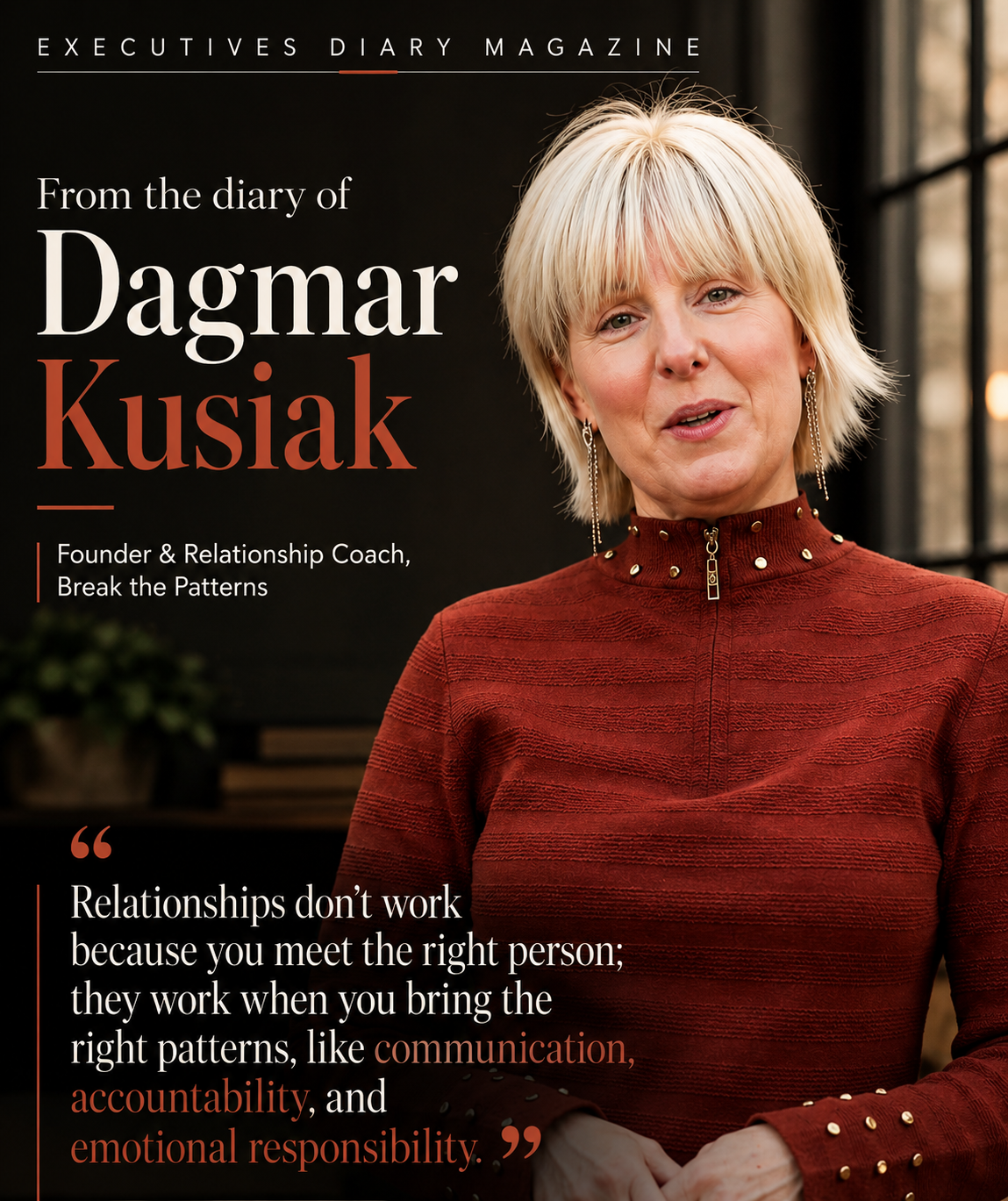
Meet Dagmar Kusiak
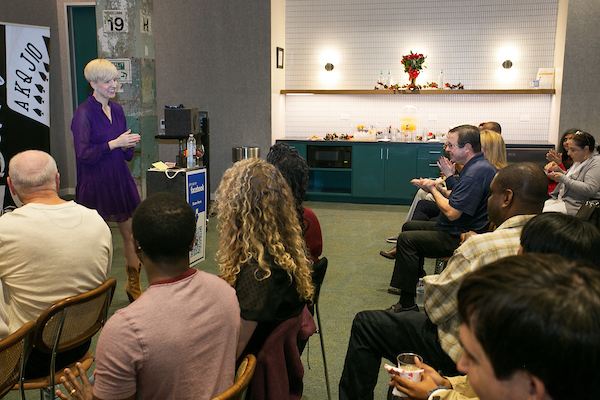
Dagmar Kusiak is the Founder and Relationship Coach at Break the Patterns, a firm dedicated to helping high-achieving professionals dismantle the sabotaging behaviors that stall their personal and professional lives. Based in Iowa City, she operates at the intersection of behavioral psychology and systems design. While many in her field focus on vague affirmations, Kusiak approaches the human heart with the precision of the computer scientist she once was. She does not just offer advice. She provides a foundational roadmap for emotionally mature, grounded relationships. She is a woman who has walked the road of wreckage to find the architecture of true connection.
A quiet office glows late into the evening. On the desk, a high-end smartphone vibrates with a notification that the owner refuses to touch. It is a message from a partner or perhaps a close friend, asking a simple question about a missed connection. The professional sitting there can draft a million-dollar proposal in twenty minutes. They can manage a global team across three time zones without breaking a sweat. Yet, staring at that small glowing screen, they feel a familiar paralysis.
The words required to answer that message feel heavy and dangerous. To respond honestly would mean admitting a mistake or revealing a need. Instead, the professional closes the laptop, leaves the phone face down, and walks away. They call it setting a boundary. They tell themselves they are too busy for drama. In reality, they are navigating a structural collapse of intimacy. They have all the success in the world, but they lack the blueprint for repair. The silence in the room is not peace. It is the sound of an invisible anchor holding them in place.

The Logic of the Heart: A Systems Approach
Kusiak often refers to herself as a geek at heart. Her early career was not spent in a therapist’s chair, but in the structured worlds of Microsoft and Chevron. She built a career on logic, earning a background in Computer Science and Math followed by an MBA. These years were defined by building, creating, and solving complex organizational puzzles. She understood how systems worked, how data flowed, and how to optimize processes for global corporations. On paper, her life was a series of successful deployments.
However, a system is only as strong as its hidden vulnerabilities. At twenty-nine, Kusiak pivoted, returning to school for a degree in Curriculum Design with a focus on Behavioral Psychology. This move was not random. It was a response to a growing realization that while she could navigate corporate hierarchies, her internal world was in a state of misalignment. She was a professional writer and contributor who could articulate complex strategies for others but struggled to communicate her own needs in the relationships that mattered most.
The turning point arrived in 2014 with the end of an engagement. The loss was a catalyst that forced her to look at the patterns she had been running for decades. She recognized that she did not know how to handle conflict or how to stay present when things became uncomfortable. This realization led to years of therapy and recovery for codependency. She began to see that her tendency to bottle things up and please others was not a personality trait. It was a faulty script that could be rewritten.
Each role in her past served as a layer of preparation. Her time as an instructional designer taught her how to extract knowledge and turn it into actionable capabilities. Her work in organizational development taught her how to lead change management.
Readers can explore more of her personal reflections in her article on Tiny Buddha titled “I Spent Years Chasing Love Until I Finally Chose Myself”.
When she founded her company in 2021, it began as Insides Match, a platform rooted in helping individuals better understand themselves in relationships. As her work deepened, a clearer truth emerged. The real challenge was not choosing the right person, but recognizing and changing the patterns we bring into connection.
In 2026, she rebranded the company to Break the Patterns, reflecting both her own evolution and the transformation she was guiding in others. The new name captured what her clients were experiencing firsthand: meaningful change does not come from external fixes, but from internal awareness and practiced behavior.
She was not just building a coaching business. She was applying a lifetime of systems thinking to the most complex system of all: the human relationship.
Patterns Over Personalities: The New Executive Skill
In the world of high achievement, we are taught that results are the only metric that matters. Kusiak argues that for many leaders, those results come at the cost of genuine connection. She believes that many professionals are intellectually aware of their issues but functionally illiterate when it comes to change. In her view, knowing you have an attachment style is not the same as knowing how to speak during a disagreement. This gap between awareness and action is where her current work lives.
Kusiak builds her philosophy on a core belief that principles must always come over personalities. She rejects the idea that relationships are a matter of luck or finding the perfect person.
“Relationships don’t work because you meet the right person; they work when you bring the right patterns, like communication, accountability, and emotional responsibility.”
This perspective shifts the power back to the individual. It removes the excuse of “bad chemistry” and replaces it with the requirement of skill acquisition.
She identifies four core values that serve as the pillars of her coaching: clarity, accountability, growth, and authenticity. For Kusiak, clarity is the antidote to the guessing games that plague most modern relationships. It is the practice of knowing exactly where you stand and what you need. Accountability is the refusal to blame circumstances or partners for your own reactions.
“Not blaming, but reflecting and adjusting,” she explains when discussing how leaders must own their behavior.
One of the most significant challenges she faces in the industry is the normalization of the “exit” strategy. Social media is flooded with advice about red flags and cutting people off. Kusiak sees this as a dangerous trend that prevents people from learning how to repair what feels uncomfortable. She observes that people often associate discomfort with a need to get rid of the person. She counters this by teaching people how to stay present.
“Repair is a skill, it can be learned, and it doesn’t take years.”
Her work often involves working with what she calls “mislabeled children” who grew up to be high achievers. These are individuals who were told they were too intense, too sensitive, or too distracted. They spent their lives building identities around proving those labels wrong. Kusiak helps them realize that those labels were actually someone else’s limitation.
“The titles didn’t fix it. The credentials didn’t fix it. The achievements didn’t fix it.” She guides them back to the original wound to stop the cycle of performing for external validation.
Her methods and philosophy have also been featured in publications such as Beverly Hills Magazine, The Women’s Insider and Influential Women.
Kusiak’s approach is notably rigorous. She uses role plays and healthy communication drills to ensure her clients aren’t just thinking about change, but practicing it. She understands that the tendency to question direction or overthink is a common hurdle for the brilliant minds she coaches. By focusing on conviction and commitment, she pushes her clients to stay in the discomfort long enough to see the peace on the other side. She treats emotional maturity as a non-negotiable leadership requirement.
The results of this work extend far beyond the home. A leader who cannot handle an uncomfortable conversation with a spouse will eventually hit a ceiling in the boardroom. Trust is chipped away not by big betrayals, but by the quiet avoidance of tension. Kusiak insists that who you are in conversation is the real test of leadership.
“Owning your part isn’t easy, but it’s non-negotiable if you actually want to grow.” This is the hard truth she delivers to those used to being the smartest person in the room.
The Kusiak Playbook: 5 Lessons
- Stop grieving for the fictional characters you scripted and start accepting people for who they actually are.
- Recognize that potential is a debt you are asking someone else to pay rather than a reality you can rely on.
- Distinguish between depth of conversation and emotional availability to avoid being an option in someone else’s life.
- Treat repair as a technical skill that requires consistent practice rather than an innate personality trait.
- Shift from performing for validation to leading with authenticity by identifying the early labels you are still trying to outrun.
The Courage to Stay
We return to the professional in the quiet office, still staring at the phone. The urge to walk away is strong because the exit feels like safety. But as Dagmar Kusiak has proven through her life and her work, the exit is where growth goes to die. The real achievement is not in the avoidance of the conflict, but in the willingness to sit in the heat of the moment and water the garden before it withers. It is about realizing that a plant dying does not make you a bad gardener, but it does mean you missed a cycle.

The architecture of a great life is built on the quality of its repairs. When we stop writing stories for people they never agreed to star in, we finally become free to build something real. We stop being addicted to potential and start becoming accountable for our own presence. The work of coming home to oneself is the most difficult project an executive will ever manage. Yet, it is the only one that yields a return of true, lasting peace.
Relationships are not checklists to be completed, but living structures that require constant attention and follow-through.
Podcasts, Interviews, and Media Features
Dagmar Kusiak’s work has expanded across books, podcasts, interviews, and relationship-focused platforms. Readers interested in exploring her broader insights can visit the following resources:
- The Soulmate Strategy Book Feature
- Becoming Emotionally Available Podcast on Apple Podcasts
- Spotify Episode Appearance
- Acast Podcast Episode
- Rock That Relationship Podcast
- YouTube Interview
- Clay Bridges Press Author Profile
- SlideShare Contributions
- This Too Shall Pass Book Listing
Dagmar Kusiak is the Founder and Relationship Coach of Break the Patterns based in Iowa City, Iowa. She helps high-achieving professionals break free from toxic patterns and build the skills for emotionally mature, grounded relationships. To connect with Dagmar or learn more, visit her LinkedIn profile.