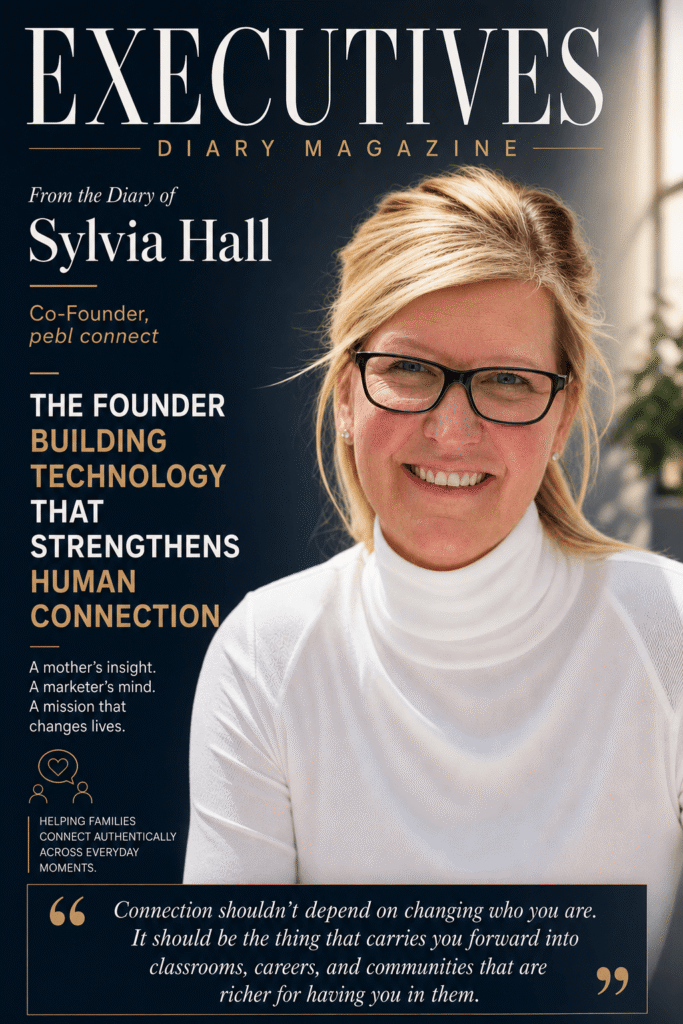
Who is Sylvia Hall?
Sylvia Hall knows exactly what that moment feels like. She has lived it. She has sat at that table, asked those questions, and felt the weight of silence settling between people who deeply love each other. And instead of accepting that disconnection was inevitable, she built something to change it.
Hall is the co-founder of pebl connect, a platform designed to spark real conversations between parents and neurodivergent children. She is also a 50 on Fire honoree, a contributing author, and a mother of a unique learner. But the title that matters most is the one she gave herself through lived experience: someone who refused to believe that authentic connection had to come at the cost of her child being himself.
A parent sits at the kitchen table on a Tuesday evening. Dinner is on the table. Their child, who has spent the entire day at school, in therapy, navigating social dynamics that don’t come naturally, sits quietly beside them. The parent asks questions gently, hoping for a glimpse into the day.
“How was school?”
“Fine.”
“What did you do today?”
“I don’t know.”
The conversation stalls almost as quickly as it begins. Silence settles back over the table.
The parent knows better. They know their child has thoughts, feelings, observations, small victories buried inside. But the neurological architecture that makes retrieval possible for other kids simply works differently here. Working memory doesn’t cooperate. Processing takes longer. Stories come out fragmented, like pieces from different puzzles forced together into something that almost makes sense but not quite.
The parent feels it then: the slow creep of disconnection. Not from lack of love. From lack of access.
The Path That Built Her
Sylvia’s professional life before pebl connect was accomplished but conventional. She spent nearly a decade in marketing roles, moving through Bausch + Lomb, Timex Group, and eventually into brand management at BMO Harris Bank. She understood markets, consumer behavior, product positioning. She could read a room and identify what people needed before they named it themselves.
But none of that work was about her.
That changed the moment her son was born.
The early years brought the kind of ordinary struggles many families navigate: developmental milestones that arrived differently, learning patterns that didn’t match the standard timeline, a child whose mind worked in ways that required translation. Over time, the translation became harder. Teachers flagged concerns. Assessments were recommended. The path forward seemed to be a well-worn one: diagnosis, intervention, therapy, management.
Then came the realization that shifted everything. Sylvia and her husband, Jarrid, stopped asking “What’s wrong?” and started asking “How does he experience the world?” That question opened a completely different door.
The moment crystallized during a family conversation. Her son couldn’t easily retrieve the details of his day, couldn’t seamlessly retrace his steps, couldn’t do what neurotypical children seemed to do naturally. But when given the right prompt, the right structure, the right kind of space to think, he could share. He had stories. He had observations. He had a voice that had been there all along, waiting for someone to ask the right way.
That’s when they built their first tool. Not a product. Not something with a name. Just something for their family. A way of talking and feeling connected that worked.
Years later, when her son was older and the tool had become a practice woven into their daily life, Sylvia realized something else: they had stumbled onto something that changed how their family connected. And they weren’t the only family who needed this. They were just the first ones bold enough to ask for it.
In 2018, she and Jarrid officially co-founded GAB-on!, the precursor to pebl connect. The mission was simple: create a platform centered on guided conversation that helped families connect authentically. By 2022, GAB-on! had won a CODiE Award and earned recognition across the education landscape. By 2026, the vision had expanded into pebl connect, a broader platform serving families navigating neurodivergence, learning differences, and the quiet isolation that comes when traditional support systems assume your child needs to be fixed.
What matters most is this: Sylvia didn’t leave her marketing expertise at the door when she became an entrepreneur. She brought it. But she inverted it entirely. Instead of asking “How do we get people to use our app more?” she asked “How do we build something so simple and effective that families stop needing to use it?”
That inversion defines everything.
The Conviction That Drives Her
Sylvia speaks about her work with a clarity that comes only from having lived the problem she’s solving. When she talks about pebl connect, she isn’t discussing a feature set or a user acquisition strategy. She’s describing a belief system.
“Connection shouldn’t depend on changing who you are. It should be the thing that carries you forward into classrooms, careers, and communities that are richer for having you in them.”
That sentence contains the whole philosophy. Not accommodation. Not normalization. Not adaptation. Belonging as you are.
The education and support systems she has navigated as a mother are well-intentioned, she says. But they operate from a deficit model. Disability. Disorder. Dysfunction. The language itself carries the message: something is wrong. Something needs to be corrected.
She refuses that framing entirely.
“Why do we lead with ‘dis’? Dis-ability. Dis-order. Dys-lexia. What if we stopped defining kids by what they can’t do and started naming them by how they think?”
This isn’t semantic reframing for its own sake. It is a complete restructuring of how we understand neurodiversity. And Sylvia has become one of the clearest voices articulating why that shift matters.
The research backs her conviction. Leading neuroscientists and child psychiatrists are increasingly arguing that the world’s most complex problems will not be solved by conventional thinking. They will be solved by unique thinkers. By minds that see patterns others miss. By people who approach problems sideways because their brains are built that way.
Which means that how we raise, support, and champion neurodiverse children today directly determines what problems get solved tomorrow.
Sylvia has internalized this completely. “The future will be rooted in neurodiverse thinking. That reframes everything. It moves us from a conversation about accommodation to a conversation about necessity.”
Her leadership reflects this conviction. She builds with empathy first, not as a soft skill but as strategy. She creates psychological safety deliberately, knowing that families and team members who have spent years feeling misunderstood need environments where being fully themselves is not just allowed but essential. She measures success through impact and trust, not just growth metrics.
And she has proven something that many believe impossible: that mission and margin can coexist. pebl connect is a profitable business because she never chased revenue at the expense of trust. When families feel genuinely seen, they stay. They grow with you. They tell other families.
The Paradox That Defines Her
Here is the contradiction that makes Sylvia’s approach so compelling: she is a technology founder whose deepest conviction is that technology should fade into the background, making room for what matters most — relationships, understanding, collaboration, and human connection.
The world is drowning in apps. Children are more digitally connected than ever before, yet loneliness is rising. Isolation is deepening. The tools designed to bring us together often push us further apart.
Sylvia has watched this carefully. She sees the danger. And instead of building another platform that demands more screen time, more engagement metrics, more addiction-by-design, she built something deliberately simple.
pebl connect is not designed to be scrolled endlessly. It is not built to compete for attention. It exists for one purpose: to spark a real conversation, and then get out of the way. The goal was never time spent on the platform. The goal was always the moment after it, when a child tells their parent something true, and a family feels a little more connected than they did before.
“In a world of endlessly complex platforms, we believe simplicity is one of the most radical things we can offer.”
That is a technology founder saying something that should make every other technology founder uncomfortable. She is arguing that less is actually more. That the best outcome is when people use your product less, not more. That success means facilitating moments that happen completely outside your platform.
This is the opposite of how Silicon Valley thinks. And it is precisely why what she is building matters.
The Hall Playbook: 5 Lessons
Lesson 1: Lead with strengths first, and the foundation for everything else becomes possible.
Before anything else is discussed in a conversation, meeting, or relationship, establish what is real and good about the person. Assets first. Challenges after. This sets the tone for every interaction that follows.
Lesson 2: Diagnosis is a light switch, not a label.
Understanding how your child’s brain is built is not pathologizing them. It is refusing to let the system pathologize them through neglect. The absence of a label follows them further than the presence of one ever will.
Lesson 3: Build with people who are equally all-in, personally and professionally.
Your co-founders, advisors, and early team are everything. You need people whose belief in what you’re building is so strong they already see the outcome as reality, and who simply will not give up until you get there.
Lesson 4: Measure impact through connection, not just consumption.
Success is not how much time people spend with your product. Success is what happens when they step away from it. Build for trust and genuine human outcomes, and the business follows naturally.
Lesson 5: Speak first, lead with what’s true, and trust that mission finds the people who believe in it too.
The most meaningful connections Sylvia has built have come from simply being honest about her purpose. When your mission is real, it has a way of finding the people aligned with it.
The Conversation That Changes Everything
A family sits at a kitchen table. Dinner is nearly finished. The conversation has been quiet, filled with short answers, pauses, and moments where thoughts seemed impossible to untangle into words. Then comes a different kind of prompt. A question designed not to demand perfect recall, but to spark connection. Not to test memory, but to invite sharing.
The child answers differently when the structure shifts. Not because they have changed. Because the conditions around them have changed.
That conversation happens thousands of times now, in homes across the country. And Sylvia knows something most technology founders never learn: the best moment in that family’s day has nothing to do with her platform.
She built it precisely for that to be true.
In an age when every company insists on keeping you engaged, addicted, subscribed, and coming back for more, Sylvia Hall built a business around making families less dependent on her. She created a technology designed to make technology less necessary. She designed for the moment after, not the moment during.
That is radical. That is the opposite of everything Silicon Valley teaches. And that is exactly why it works.
Sylvia Hall is the co-founder of pebl connect, based in Providence, Rhode Island. She builds platforms designed to help neurodivergent families connect authentically, giving unique learners a voice and creating pathways to belonging.