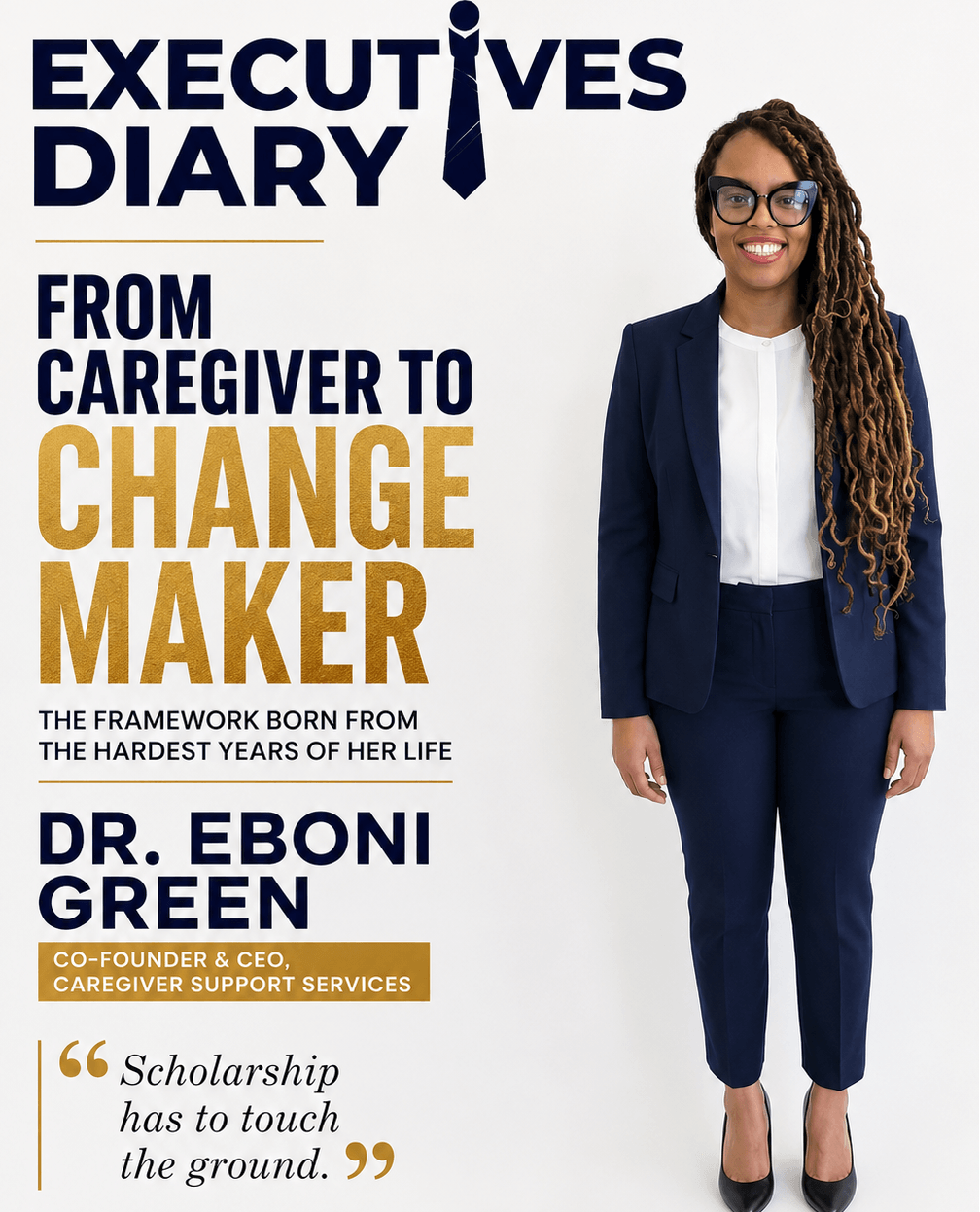
Dr. Eboni Green
She Was Living Her Own Research: Dr. Eboni Green and the Framework Born From the Hardest Years of Her Life.She was midway through her PhD dissertation when the distance between researcher and subject quietly disappeared. Dr. Eboni Green had been studying caregiver wellness for months, analyzing survey data from hundreds of frontline workers, reading literature about stress and resilience, asking hard questions about what it truly means to sustain your own health while holding up someone else’s life. The work felt important, but it also felt safely academic.
Then her teenage daughter was diagnosed with a brain tumor. At the same time, her paternal grandmother’s memory was dissolving under Alzheimer’s disease, and her uncle was carrying the daily weight of that care with the quiet determination so many caregivers carry and so few people acknowledge. Suddenly, Dr. Green was not studying exhaustion from a comfortable distance. She was living inside it. The frameworks she was reading in the literature were not enough. They did not capture what she was experiencing, and they certainly did not capture what millions of other caregivers were living through either.
That collision between academic inquiry and unbearable personal reality became the foundation for everything she has built since.
Dr. Eboni Green is the Co-Founder and CEO of Caregiver Support Services, creator of the Caregiver Wellness U-Model™, and Academic Program Coordinator for PhD and DHA programs at Walden University. She stands at an uncommon intersection where frontline caregiving, executive leadership, and academic rigor meet. What defines her is not just her clinical expertise or research credentials, but her refusal to let the people holding the healthcare system together remain invisible and unsupported.
Long before the national speaking invitations and bestselling books, there was a young nurse in Omaha who noticed something others routinely missed. She saw families gathered at bedsides, holding it together for a parent, spouse, or child. She also saw what happened when the medical team left the room. The shoulders that finally dropped. The whispered questions about who would miss work, who would pay, who would sleep at the hospital that night.
That observation followed her through healthcare administration roles and into graduate school. Her master’s in Healthcare Administration at Bellevue University taught her how systems worked. Her doctoral work at Capella University taught her how to study them. Her personal life forced her to confront what those systems felt like from the inside.
Her dissertation research drew responses from more than 515 frontline direct caregivers across the United States, examining relationships among mental and physical health risks, social networks, stress, and job satisfaction. The quantitative data told one story about turnover and burnout. But what stayed with her were the written comments at the end of surveys, the late-night emails, the caregivers who said no one had ever asked how they were holding up.
That research, combined with the strain of caring for her daughter through cancer treatment and supporting her uncle through her grandmother’s decline, led to a question that would not let her go: What would a true, practical model of wellness look like for caregivers whose lives are organized around someone else’s needs?
The answer became the Caregiver Wellness U-Model™. Not a wellness checklist or hospital discharge pamphlet, but a structured, evidence-informed framework addressing caregiver wellness across seven dimensions: social, psychological, physical, intellectual, spiritual, occupational, and financial, with empowerment and resilience woven through all of it.
“Caregivers were often expected to be resilient without being given the tools to build resilience,” she explains. “They were encouraged to ‘take care of themselves’ without any framework for what that actually meant.”
What began as Caregiver Support Services in 1998 has evolved into a national platform. The U-Model has been published in partnership with the Alzheimer’s Foundation of America and adopted by organizations across the country. Her books, including 7 Pillars of Successful Caregiving and Caregiving: Things You Need to Know, serve as practical companions through the caregiving process. The monthly radio show she co-hosts with her husband and co-founder, Terrence, has run since 2011, creating consistent national dialogue about issues the broader healthcare system rarely prioritizes.
But it is her current work that carries the sharpest business edge. Through Caregiver Training International, a division of Caregiver Support Services, Dr. Green is addressing something the caregiver workforce has needed for decades: accredited, standardized training that treats caregiving as skilled professional work, not informal help that magically appears around the edges of the healthcare system.
“For too long, caregivers have been expected to perform complex, emotionally demanding work without a consistent system that prepares, supports, or empowers them,” she explains. “Accredited training changes that. It creates a national foundation of competency, confidence, and resilience.”
The numbers support the urgency. Recent research shows family caregivers who manage complex care coordination average 62 hours per week of non-reimbursed work, valued at approximately $1.58 million over a lifetime. The formal caregiver workforce experiences chronic turnover, with burnout rates that destabilize entire care systems. Standardized training addresses both problems simultaneously.
For individual caregivers, accredited education converts guesswork into competence. They learn not only clinical tasks but how to recognize their own limits, manage stress, and practice sustainable wellness. “You cannot pour from an empty cup, and you also cannot keep pretending the cup is full when it is not,” Dr. Green notes.
For families navigating health crises, it provides something they rarely have: confidence in the person walking into their home or taking responsibility for their loved one’s care. For employers and health systems, trained caregivers represent a retention strategy, not just a compliance requirement. They make fewer errors, stay longer, and strengthen the entire care continuum.
Dr. Green is currently focused on securing strategic partnerships and funding to scale Caregiver Training International nationally and advance the rollout of a Caregiver Wellness App, a digital extension of the U-Model™ designed to put evidence-based tools directly into caregivers’ hands at any hour.
Scholarship Touching the Ground
Her academic role at Walden University runs parallel to this work, not as a separate career track but as deliberate continuation of the same mission. As Academic Program Coordinator for PhD and DHA programs, she shapes future healthcare leaders while serving as lead faculty for the School of Health Sciences. “Scholarship has to touch the ground,” she says. “If research cannot change what happens in a caregiver’s living room or at a client’s bedside, then we have missed the point.”
Walden’s focus on applying doctoral work to real community problems mirrors how she has built her entire career. Her courses range from healthcare policy to stress management, and she contributed as content expert to the development of Walden’s bachelor’s in healthcare sciences program. The classroom and the organization feed each other. Research informs the tools. The tools reveal new questions for research.
Her published work carries the same practical tone. She writes about complex grief and power of attorney in the same volume because that is how real caregiving looks. Paperwork next to tissues on the same kitchen table. “Resilience and empowerment are not traits you’re born with,” she emphasizes. “They are skills you can build, strengthen, and return to every single day.”
That philosophy treats boundaries not as weakness but as survival mechanisms. It moves the conversation from sacrifice to sustainability. When executives discuss the caregiver crisis, they typically focus on staffing shortages, wage pressure, and hospital throughput. Dr. Green hears all of that, but she also hears something underneath: a workforce holding up two systems at once, healthcare and family life, with almost no net beneath them.
Her work, from the first diagram of the U-Model™ to the latest accredited training course, represents an attempt to build that net at scale. She understood the stakes long before the research confirmed them, because she was living them. And she has spent every year since ensuring no caregiver has to figure it out alone.
In the hardest years of her life, she realized that wellness for caregivers could not remain an abstract concept, and she has been turning that realization into systematic support ever since.
Key Takeaways / Playbook
- 1. The Caregiver Wellness U-Model™: An evidence-informed framework addressing caregiver wellness across seven critical dimensions: social, psychological, physical, intellectual, spiritual, occupational, and financial.
- 2. Accredited, Standardized Training: Shifting the industry mindset to treat caregiving as skilled professional work, establishing a national foundation of competency, confidence, and resilience.
- 3. Sustainable Systems over Sacrifice: Moving the executive healthcare dialogue from mere staffing metrics to building macro-level support nets for a workforce managing both health and family systems.