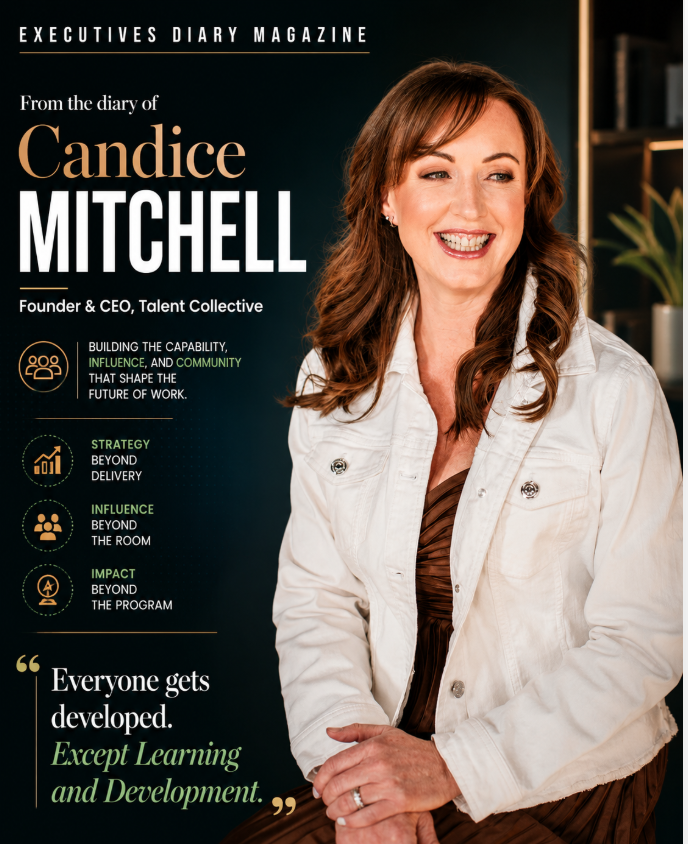

Candice Mitchell Is Building a Home for the People Who Build Everyone Else
The People Everyone Depends OnMost organizations have no trouble explaining why leadership matters.
They invest heavily in managers. They fund executive coaching. They build succession plans, leadership academies, mentorship programs, and capability frameworks designed to prepare people for the future.
Yet hidden inside almost every one of those investments is a question few executives ever stop to ask.
Who develops the people responsible for developing everyone else?
For nearly twenty years, Candice Mitchell has watched organizations rely on Learning and Development professionals to guide transformation, strengthen leadership, support growth, and prepare workforces for change. She has also watched those same professionals become some of the most overlooked people in the business. The contradiction has followed her across industries, continents, and leadership roles. Eventually, it became impossible to ignore.
Today, as Founder and CEO of Talent Collective, Mitchell has built her career around solving a problem most organizations do not realize they have.
The Invisible Weight of Developing Everyone Else
Learning and Development occupies a strange position inside modern business.
When a company wants stronger leaders, Learning and Development is called.
When a merger creates uncertainty, Learning and Development is called.
When technology changes how people work, when culture needs strengthening, when performance stalls, when employees need new skills, Learning and Development is expected to provide answers.
The function sits at the center of nearly every major business challenge, yet often remains on the edge of the conversations that shape those challenges in the first place.
Mitchell has spent much of her career observing that disconnect.
The issue, she argues, has never been capability.
The issue is that many Learning and Development professionals were never taught how to position themselves as strategic contributors rather than service providers.
It is an observation she returns to often because she has seen it play out repeatedly. Talented professionals become consumed by requests, deadlines, and delivery. They spend so much time helping others grow that their own development quietly stalls.
Twenty Years of Watching the Same Pattern
Mitchell did not arrive at this conclusion from a conference stage or a consulting framework.
She arrived there through experience.

Her career began in recruitment and human resources before evolving into Learning and Development leadership roles inside increasingly complex organizations. Over time, she worked across capability building, talent management, leadership development, organizational transformation, and performance enablement. She helped build learning functions, develop capability strategies, and support business leaders facing significant operational change.
Every role expanded her understanding of how organizations function.
Every role reinforced the same lesson.
Businesses consistently underestimated the people responsible for preparing their workforce for the future.
The frustration was not that Learning and Development lacked talent. Quite the opposite. Mitchell found herself surrounded by intelligent, committed professionals who deeply understood how people learn, change, and perform. What they often lacked was a roadmap for influencing the decisions that determined organizational direction.
That realization became the foundation for everything that followed.
Why AI Is Exposing an Existing Problem
Few topics dominate business conversations today more than artificial intelligence.
Mitchell talks about AI frequently. She studies it, discusses it with industry leaders, and explores its implications with the community she has built around Talent Collective.
Yet she believes AI is not creating a new challenge for Learning and Development.
It is exposing an old one.
For years, many functions were measured by activity. Programs launched. Courses delivered. Attendance numbers. Completion rates. Those metrics were often enough to justify the work.
Today, executives want something different.
They want evidence.
How did capability improve? What business outcome changed? How did the investment create measurable value?
These are not technology questions. They are credibility questions.
“Most L&D teams are feeling overwhelmed because the noise is deafening and everyone is figuring it out.”
Mitchell understands the anxiety because she sees it every day. Professionals who entered the field because they wanted to help people now find themselves trying to explain their relevance in a rapidly changing environment.
The strongest functions are adapting.
Others are discovering that being busy and being valuable are not always the same thing.
Building the Capability Engine the Profession Never Had
Talent Collective was born from a simple observation.
Everyone gets developed.
Except Learning and Development.
The statement has become something of a rallying cry within Mitchell’s community because it captures a reality many professionals immediately recognize. Organizations routinely invest in executives, managers, sales teams, and technical specialists. Meanwhile, the people responsible for architecting those development experiences often receive little structured support themselves.
Mitchell wanted to change that.
Through the Talent Development Academy, strategic workshops, advisory services, coaching programs, and professional communities, Talent Collective focuses on developing the people responsible for developing everyone else. The goal is not simply to make Learning and Development better at delivering training. It is to help practitioners become more influential, more credible, and more closely connected to the outcomes business leaders care about most.
The work extends beyond capability building.
It is also about belonging.
One of the fastest-growing parts of Talent Collective is a weekly community gathering known as the L&D Lounge. There, professionals discuss challenges, share experiences, and often discover something many have been missing for years.
Peers who understand.
A Place to Grow
Not long ago, someone inside that community shared a comment that stayed with Mitchell.
“I’ve been in L&D for 11 years and this is the first time I’ve talked to people who actually get what I’m going through.”
The statement resonated because it revealed something larger than professional development.
People can spend years helping others succeed while quietly feeling alone themselves.
Mitchell understands that reality better than most. It is the reason Talent Collective exists. It is the reason she speaks, writes, coaches, and advocates so relentlessly for the profession.
From the outside, her work appears to focus on Learning and Development.
In reality, it focuses on something much deeper.
Confidence. Credibility. Community. Growth.
For years, organizations asked Learning and Development professionals to help everyone else reach their potential.
Candice Mitchell decided it was time someone invested in theirs.