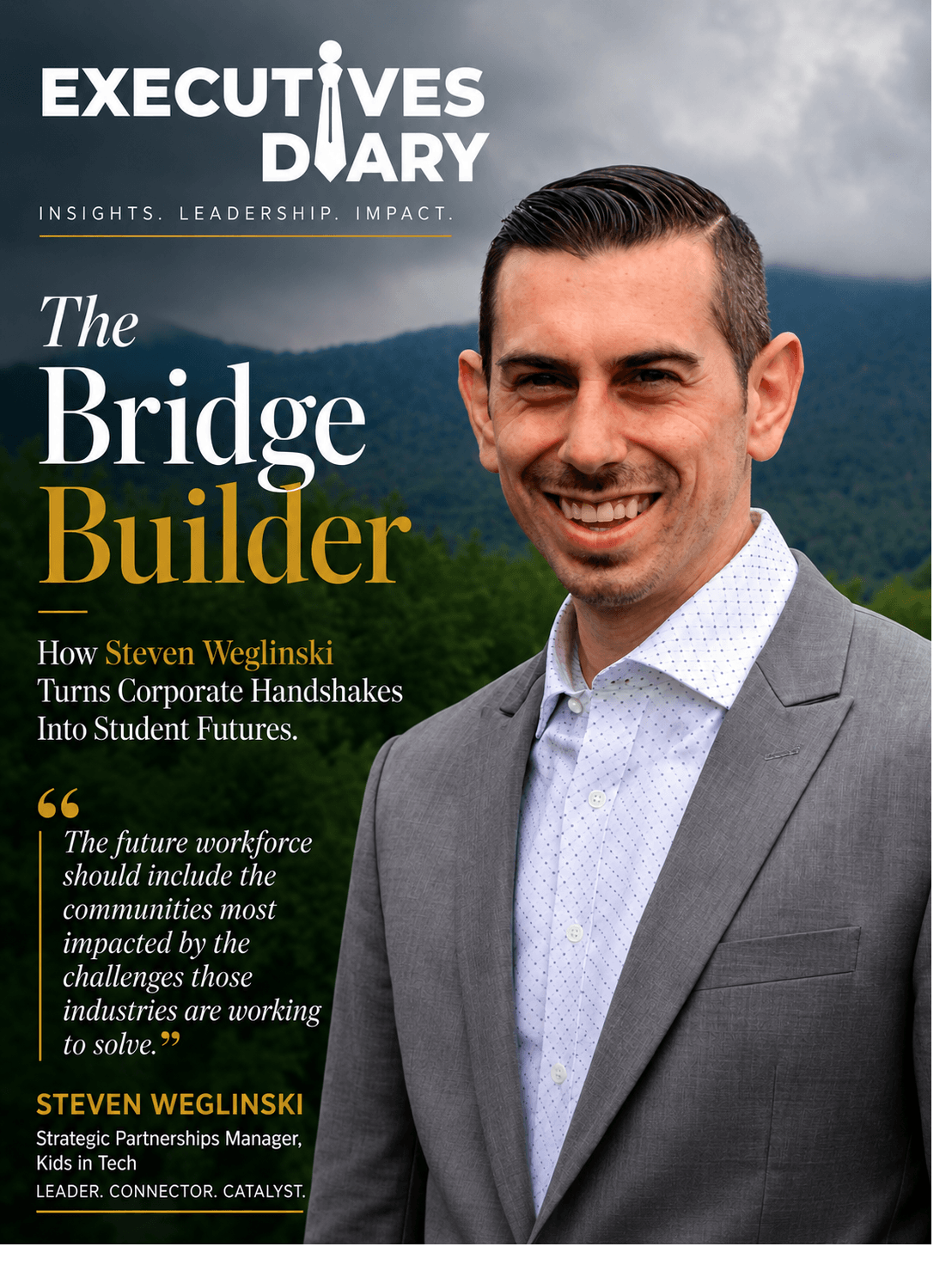
The Bridge Builder: How Steven Weglinski Turns Corporate Handshakes Into Student Futures.
When Access Requires Architecture
The debate was not whether Brandeis University needed a food pantry. The debate was about where to put it.
Institutional instinct pointed toward discretion. A basement location. A side hallway. Somewhere, students could access help without anyone noticing they needed it. Steven Weglinski pushed for the opposite. He wanted the pantry visible, accessible, positioned where students could walk in without mapping an apologetic route around their peers.
That choice was not about shelving or foot traffic. It was about dignity.
The pantry eventually distributed more than 200,000 pounds of food to over 3,000 community members. But the metric that mattered most to Steven was never the weight. It was the message sent by the door: resources are not charity when they are positioned as rights.
That philosophy travels with him into every corporate meeting, climate tech conference, and classroom he enters today.
The Bridge Builder of Greater Boston
Steven Weglinski is the Strategic Partnerships Manager at Kids in Tech, a Massachusetts-based nonprofit that expands STEM education access for underserved youth across the state. He manages strategic partnerships, develops corporate relationships, and builds the specific bridges that connect industry resources to the students who need them most. What defines his work is not the sector, but the pattern: he makes possibility visible to people who have been kept at the margins; serving as a catalyst for growth, opportunity, and access.
From Numbers to Networks to Stone
Steven built his foundation on precision. A mathematics degree from Eastern Connecticut State University gave him comfort with data and analytical thinking. A Master’s in Educational Leadership from the University of Nevada, Reno, where he maintained a 4.0 GPA while running a full-time residential life assistantship, added something more valuable: a close-up view of how students navigate systems that were rarely designed with them in mind.
His six-and-a-half years at Brandeis University as Assistant Director in the Office of Graduate Affairs became his laboratory for institutional change. He did not inherit a functioning service model for more than 2,000 graduate students. He built one. Over 100 new resources and initiatives. Coordination of more than 200 cross-campus collaborators. Complete a digital transformation and implement a free delivery service for the campus food pantry when remote learning arrived without warning. The food pantry, which he established through $50,000 in fundraising and a partnership with community organizations like the Greater Boston Food Bank and Healthy Waltham, became the clearest symbol of his approach to connect resources for collective impact.
When he left higher education for a role as Director of Operations at Raphael Stone Collection, a new regional quartz distributor in Worcester, colleagues were puzzled. Steven saw it as an opportunity to put his skills to work on a venture that was both challenging and full of potential.
Over nearly three years, he built a regional distribution operation covering six New England states. He grew active business-to-business accounts from 125 to over 600, a 480% increase. Gross sales climbed from $1.6 million to $3.2 million in a single year, a 200% jump. He designed operational procedures, managed staff, and built client relationships personally.
The warehouse taught him that access is not an abstract principle. It is an operational discipline. Trucks must arrive on time. Orders must be accurate. Relationships must be tracked, maintained, and honored. Trust builds in small, repetitive, unglamorous details repeated consistently.
Engineering Corporate Conscience
At Kids in Tech, Steven manages a prospect pipeline of over 400 potential corporate partners. His work is not traditional fundraising. He aligns corporate social responsibility goals with specific student needs, creating partnerships that serve both business objectives and community impact.
He starts with authentic fit, not funding requests. “I look for the overlap between what a company already cares about and what our students actually need,” he says. “If those two pieces are honest, the relationship can grow into a sustainable partnership.”
That approach produced Azenta Life Sciences, leading a Strawberry DNA Extraction Lab at the Cambodian Mutual Assistance Association in Lowell. Middle and high school students pulled genetic material from fruit while learning about careers in life sciences. Macy’s committed to 100 healthy snack bags for students and subsequently delivered 400, each packed with STEM-themed notes (This is in addition to a $5000 sponsorship and other volunteer commitments). A clean energy professional Steven met at ClimaTech 2026, Robert Donohue, committed on the spot to speak to Kids in Tech students about energy efficiency.
His partnership strategy extends beyond individual companies to entire ecosystems. He attends transit equity forums because reliable public transportation is a prerequisite to economic mobility. He tours logistics learning labs in Tewksbury because workforce development requires geographic access. He networks at climate tech conferences because the industries solving tomorrow’s challenges need the communities most affected by those problems.
Steven also serves as a Youth Instructor with the Massachusetts Council on Gaming and Health, teaching students aged 12 to 20 about online sports betting risks. He provides career coaching through Pay Forward Coaching for professionals in employment transition. Each role reflects the same belief: access to opportunity should not depend on existing networks or institutional knowledge.
The Door Stays Open
The food pantry at Brandeis remains exactly where Steven positioned it: visible, accessible, normalized. Students walk past it daily without shame or elaborate navigation. The visibility that once sparked internal debate now reads as obviously correct.
Steven Weglinski has spent his career making that same argument in different contexts. At Kids in Tech, it takes the form of a DNA lab in Lowell, a snack bag with a poem inside, and a climate scientist spending a morning with students who have never seen someone like themselves represented in that field. The mechanics change. The principle does not.
Resources hidden from the people who need them are not resources. Opportunities tucked away in existing networks are not opportunities. Systems that make people feel small while asking for help have already failed before the first conversation.
He is not waiting for institutions to make room. He is building the entrance himself, positioning it in plain sight, and making sure the students who need it most know exactly where to find it.