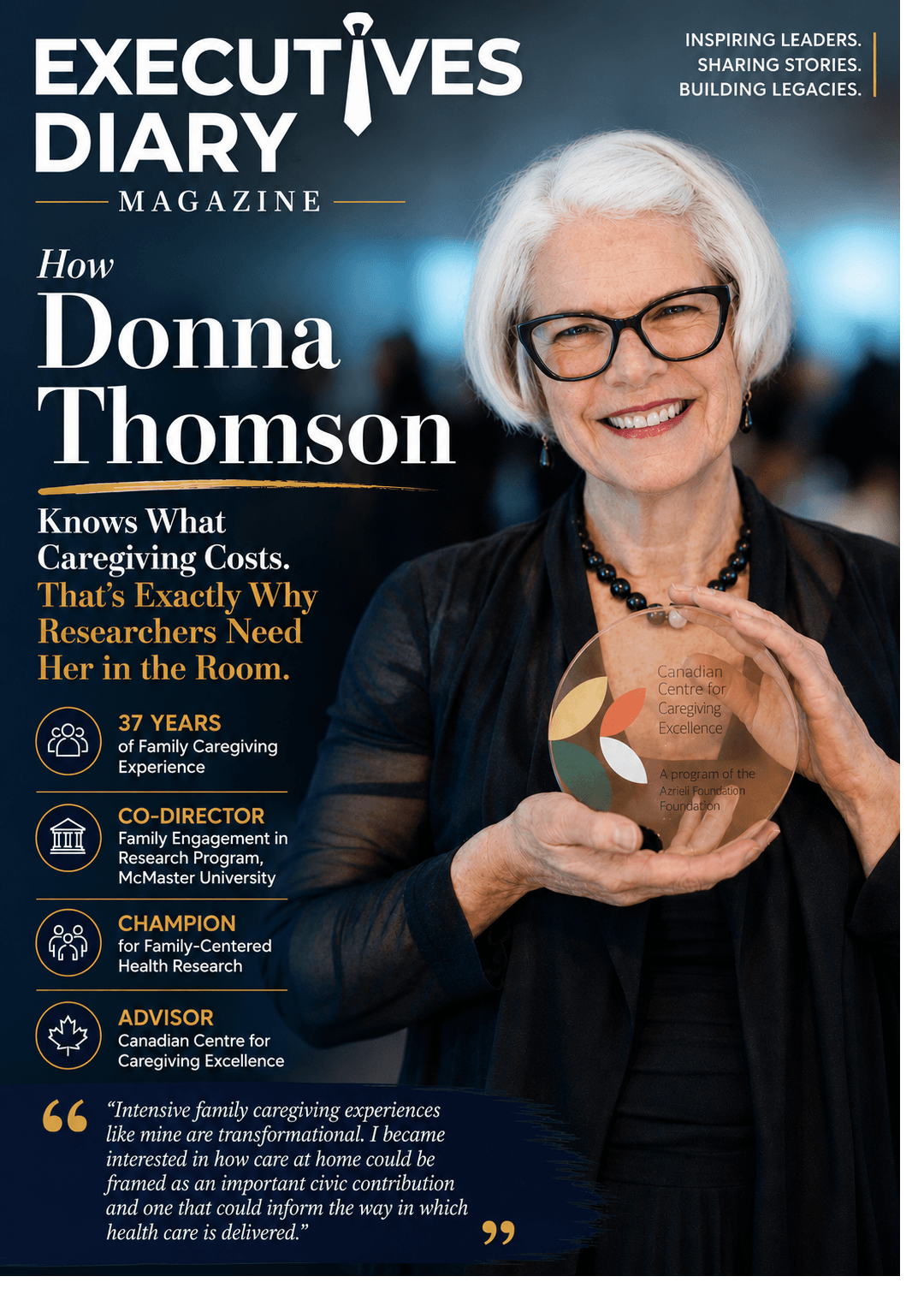
Donna Thomson Knows What Caregiving Costs. That’s Exactly Why Researchers Need Her in the Room. There is a particular kind of knowledge that no medical school teaches and no research grant can fund. It arrives at 2 a.m., when a child is screaming in pain and the hospital has sent you home with instructions that feel useless in the dark. It accumulates over years of appointments where you translate between what doctors say and what your family actually needs. It lives in the muscle memory of the person doing the caring, not in the databases that inform health policy.
For decades, medical research treated this knowledge as noise. Useful for patient satisfaction surveys, perhaps. Too emotional, too personal, too unscientific for the serious work of advancing medicine. Donna Thomson spent twenty-eight years acquiring exactly that knowledge, then spent the next chapter of her career making sure the academic establishment had no choice but to listen.
The Woman Who Changed the Room
Donna Thomson is an author, educator, and Co-Director of the Family Engagement in Research Program at McMaster University’s CanChild Centre for Childhood-Onset Disability Research, as well as a facilitator of Caregiving Essentials in McMaster’s Department of Continuing Education. She also serves on the Board of Advisors of the Canadian Centre for Caregiving Excellence. The line that connects all of her work is unforgiving: if you are doing health research and building health systems without the people who live care every day, you are building them wrong.
1990: The Year That Rewrote Everything
Her conviction did not begin in a conference room. It began in 1990, when her two-year-old son Nicholas was in severe distress with pain and vomiting. Hospital corridors, clinical language, and surgical decisions suddenly crashed into the intimate space of parenting. That crisis year did not just make her an experienced caregiver. It made her a critic of how systems see, or refuse to see, the families who hold everything together once medical institutions send patients home.
Her background in theatre and education, including training at The Royal Central School of Speech and Drama with expertise in ethics, disability rights, and Boal techniques, might seem disconnected from health research. In practice, it was perfect preparation. Theatre in education is fundamentally about power: who holds the script, who has a voice, and who is forced to sit silently in the audience. Once you understand power that way, it becomes impossible to ignore in other contexts.
When Thomson began working with researchers and disability communities, she refused to treat parents as grateful recipients of expert wisdom. She treated them as people whose lived experience carried knowledge that had to be structured, curated, and brought directly into the heart of research design. “Intensive family caregiving experiences like mine are transformational,” she explains. “I became interested in how care at home could be framed as an important civic contribution and one that could inform the way in which health care is delivered.”
That insight became the foundation of her mission. If caregiving is civic work, then caregivers are not just family members managing private tragedy. They are citizens whose expertise public systems ignore at their own peril. The questions that followed were sharp and unavoidable: If families know what actually matters to them, why are research priorities set without their input? If caregivers see exactly where hospital-to-home transitions fail, why are they absent when those systems are designed?
Textbooks Meet Storybooks
This is where Donna Thomson’s work stopped being personal advocacy and became structural change. At McMaster, she co-designed and now co-directs the Family Engagement in Research Program that includes two McMaster University Certificate of Completion courses (the Family Engagement in Research Course and Family Engagement in Research Leadership Academy). These are not feel-good awareness sessions that operate at the margins of academic programs. They are rigorous ten-week courses that pair researchers with parents of children with disabilities and other health conditions, trains both groups together, and then sends them back into the system with a fundamentally different understanding of who belongs on a research team.
Thomson is direct about the goal. “Knowing what matters to families and sharing that knowledge with research can influence both what is researched, how the research is conducted in more family-friendly ways and how new knowledge is communicated back to patient and family communities,” she says. The program operates on a simple principle borrowed from disability activists: nothing about us without us.
When Graduates Start Rewriting the Room
The results show up in ways that matter to skeptics. Graduates do not leave with certificates and good intentions. They leave and start co-authoring academic papers. They share conference stages with senior scientists. They are listed as co-investigators on grants. “The most significant impact I have seen is family research partners co-authoring academic papers and co-presenting at conferences alongside researchers,” Thomson notes. “When our team witnesses authentic relationships flourishing on research teams so that everyone feels confident and competent to act in partnership for the good of furthering knowledge in health sciences, that is the hallmark of the success of our training programs.”
The metric is not how many people complete the training. It is how many rooms change once those graduates walk back into them. Thomson is not interested in symbolic inclusion. She is interested in who gets to sign their name to the work.
Her theatre background provides the mechanism for this transformation. Role play and simulation exercises break down the massive power imbalances between exhausted parents and credentialed researchers. One parent in her program captured the dynamic with precision that no academic framework could match: “You have textbooks. We have storybooks.” That line has become central to Thomson’s approach. Textbooks contain structured, peer-reviewed knowledge. Storybooks contain the lived, chaotic, particular knowledge that only comes from decades of managing complex medical realities at home.
Theatre techniques allow those storybooks to enter rooms full of scientists without being dismissed as mere anecdotes. The exercises help both sides “curate the lived experiences that will be most important to a research project.” The word “curate” is crucial. Lived experience is not dumped unfiltered into studies. It is selected, structured, and aligned with research questions so it can change what gets measured and how.
Scaling What Works
The work is scaling rapidly, driven almost entirely by word of mouth across academic and disability networks. Thomson and her colleagues are preparing to expand beyond childhood disability into fields like Alzheimer’s and dementia, where families again carry most of the care burden and research often lags behind daily realities. Training materials are being translated into French, Brazilian Portuguese, and Dutch. A community of practice network for Leadership Academy graduates now provides extended learning and peer mentorship, ensuring the impact extends well beyond the initial ten-week course.
Thomson’s policy work operates on the same principle from a different angle. As a member of the advisory board at the Canadian Centre for Caregiving Excellence, a program of the Azrieli Foundation, she is pushing for implementation of a National Caregiver Strategy. “Our first goal is to see the implementation of a National Caregiver Strategy,” she explains. The federal government has included it in the budget, and a cross-party caregiver caucus in Parliament is working toward implementation. The pattern is identical to her research engagement work: get caregivers in the room, give them structure and data, then make it impossible for the system to look away.
The Answer Was Never Sentimental
The opening question was straightforward: Why should research institutions care about what caregiving costs families like Donna Thomson’s? Her answer is not sentimental. It is structural. If you want better data, you need the people who live the problem to shape the questions. If you want sustainable care systems, you need a policy that treats unpaid caregivers as essential infrastructure, not as an infinitely elastic resource that will somehow always be available.
Twenty-eight years of caregiving did not make Donna Thomson a policy advocate. It made her the person who understood, earlier than most, that the knowledge inside storybooks and the knowledge inside textbooks are not competing forms of expertise. They are incomplete without each other.