Jeremy Laight Wants Your Marketing to Finally Grow Up
The Fractional Operator Building a CategoryThere is a particular kind of conversation that happens behind closed doors in scaling businesses. The founder admits, quietly, that marketing feels like an expensive theater. Campaigns launch with fanfare, budgets disappear into digital channels, and at the end of each quarter, leadership stares at reports full of impressions and engagement rates that somehow never translate into the growth they were promised. The question hanging in the air is always the same: if we’re doing so much marketing, why does it feel like nothing is working?
Jeremy Laight has spent the better part of two decades in those rooms, and he has a theory about what’s really happening. Most businesses don’t need more marketing. They need marketing to finally grow up.
The Fractional Operator Building a Category
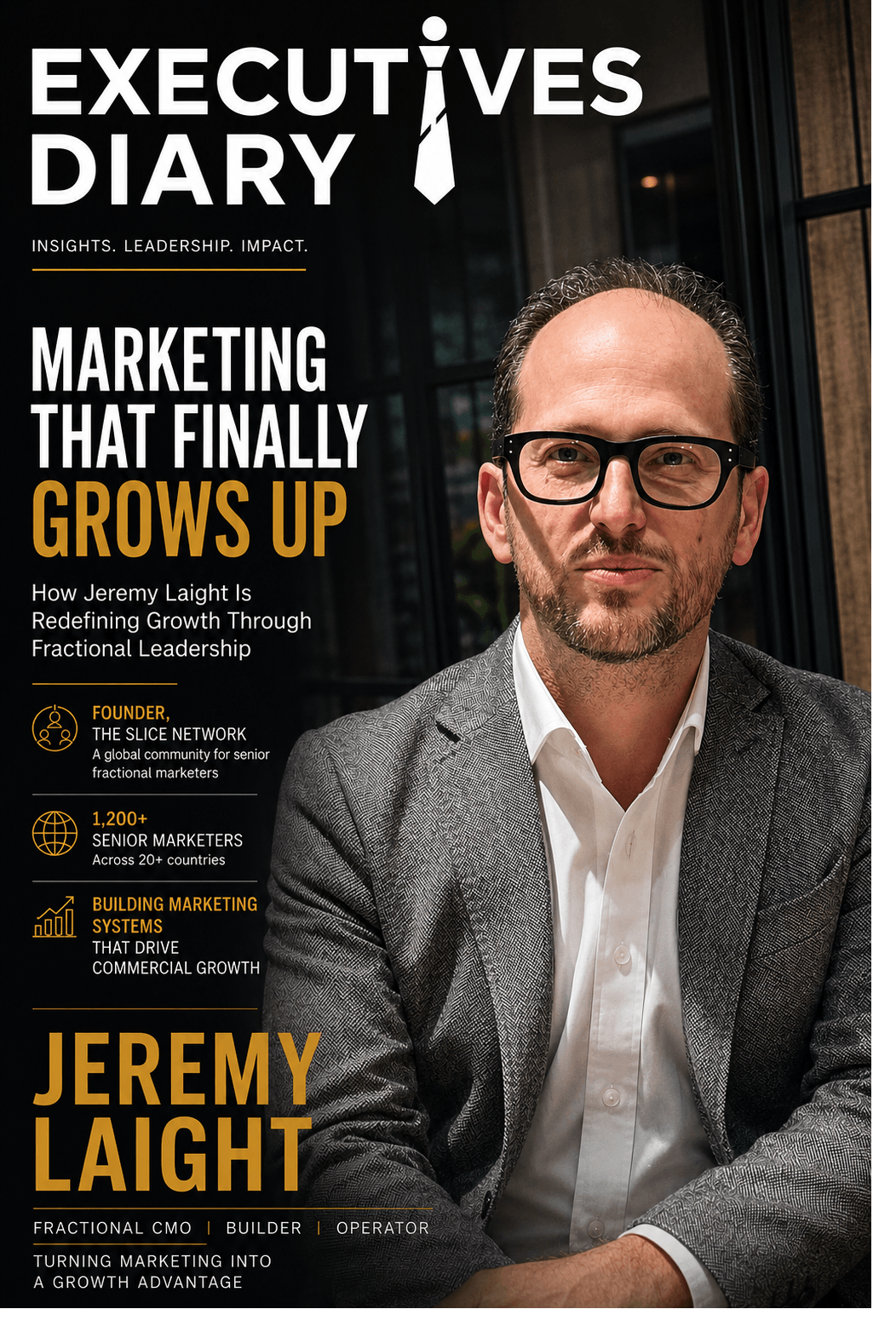
Jeremy Laight is a London-based fractional Chief Marketing Officer and the founder of The Slice Network, a global community for senior fractional marketers that has grown to nearly 1,200 members across more than 20 countries since its launch in July 2025. He works with founder-led scale-ups across Fintech, SaaS, Wealth Management, and Professional Services, typically stepping in when growth has stalled and leadership knows marketing should be doing more but cannot pinpoint exactly what that more should look like.
From Systems Thinking to Marketing Strategy
The path that built Jeremy Laight reveals why his approach to marketing problems is different from most practitioners in the field. He studied Geography at the University of Glasgow, graduating with a 2:1. Geography might seem like an unconventional foundation for a marketing career, but the discipline shaped how he approaches complex business challenges. Geography is fundamentally about understanding systems, patterns, and the relationship between environments and the people who move through them. Those instincts for reading context before drawing conclusions show up in everything he does now.
His early career took him through senior marketing roles that spanned categories and geographies, but what most people don’t know is that Jeremy holds a granted patent for a financial transaction system, filed in 2009. A marketer holding a systems patent signals something important about how his mind works. This isn’t someone who just communicates ideas; he builds the architecture behind them.
At Crown Worldwide Group, where he served as Group Marketing Director, he built a centralized marketing function that supported regional operations globally, driving brand governance and demonstrating measurable commercial impact. A colleague who worked alongside him described him as “my go-to person” for sound advice, someone who “drove brand governance and marketing strategy across the globe and demonstrated how marketing commercially impacted the business.” That phrase, commercially impacted, reflects a standard Jeremy has held himself to throughout his career.
In 2020, he completed Mark Ritson’s Mini MBA in Marketing with distinction, adding to certifications in AI, brand strategy, and NPS. These aren’t credentials collected for a LinkedIn profile. They represent a practitioner staying sharp in a field that keeps shifting underneath everyone’s feet.
The Work That Changes How Marketing Gets Done
Jeremy’s client work follows a consistent pattern, not because he applies a template, but because the problem he gets called to solve tends to look remarkably similar regardless of sector. Growth has plateaued. Marketing is busy but not trusted. The board sees cost, not return. Leadership isn’t sure where to start.
His approach begins with diagnosis before prescription. He audits capability, operating models, budgets, and channel effectiveness before recommending anything. He’s not interested in producing a strategy deck that gets filed away. He embeds, leads, and builds momentum, then helps the team sustain it without him. The measure of success, by his own definition, is when a full-time CMO hire becomes a confident next step rather than an anxious gamble.
Across his current engagements, including a fractional advisory role at Nomi, a SaaS business where his scope covers brand positioning, campaign architecture, PPC, SEO, email, CRM, and partner marketing, the outcomes he focuses on are specific: more qualified pipeline, lower customer acquisition costs, faster activation, and higher retention. Not brand awareness in the abstract. Commercial results with numbers attached.
His thinking on AI reflects the same discipline. Where most executives reach for AI as either a magic solution or an efficiency play, Jeremy uses it as what he calls a “thinking partner.”
During a recent customer value proposition project, he used AI to stress-test positioning, challenge assumptions, and adopt the voice of different customer personas. The technology expanded the surface area of his thinking, but the judgment, trade-offs, and final decisions remained entirely human. That’s the pattern: use it to widen the field, then narrow the path with experience.
The Slice Network represents where Jeremy’s work takes on a different scale entirely. What started as a response to a structural problem has become a category-defining community. Fractional CMOs were, in his words, “elite operators working in isolation.” Senior enough to carry C-level accountability, yet often running solo, without a bench, without feedback loops, without peers to challenge their thinking daily.
The network runs structured touchpoints: roundtables, spotlight series profiling leading fractional CMOs, research reports on the state of fractional marketing, and flagship events including panels at Robert Half’s London headquarters in The Shard. The research coming out of The Slice Network is producing data worth attention. Referrals and personal networks remain the dominant source of fractional opportunities in the UK and Europe. Inconsistent lead flow is the single biggest challenge members report. Structural isolation quietly caps the growth of even the most capable operators.
The Standard That Changes Everything
Jeremy Laight didn’t set out to become a category builder. He set out to fix a problem he kept encountering: marketing that worked hard but was never trusted, brands that felt fuzzy, budgets that felt opaque, and founders who had quietly concluded that marketing was a cost they tolerated rather than an investment they believed in.
The fractional model gave him the freedom to work across more businesses, diagnose faster, and move without the constraints of organizational politics. The Slice Network gave him a way to solve the problem not just one client at a time, but across an entire profession.
His core insight remains uncomfortable but true: activity is cheap, ownership is not. Most marketing departments are busy. Few are accountable. The difference between the two is what separates marketing that grows businesses from marketing that simply spends budgets.
Because in his view, marketing only really grows up when the people leading it do first.
Key Takeaways / Playbook
- 1. Systems Strategy over Simple Execution: Understanding broader context, patterns, and organizational architecture must come before spending budgets on disconnected tactical campaigns.
- 2. Demand Real Commercial Impact: Move away from abstract brand metrics. Focus on lowering customer acquisition costs, accelerating activation, stabilizing retention, and growing qualified pipelines.
- 3. Transition from Activity to Ownership: Success requires structured accountability, internal diagnostic maturity, and deep capability audits rather than throwing tools or funds at unguided problems.