Louise Thomas Knows Impact Won’t Get You Funded. Here’s How She’s Scaling Air Aware Labs Anyway.
The Blind Spot Worth BillionsLouise Thomas knows the word “impact” will clear a room of investors faster than a fire alarm. She also knows that, on its own, moral urgency rarely moves a term sheet from maybe to yes.
So when she pitches Air Aware Labs to potential backers, she does not lead with saving the world. She talks about the billions spent annually on health, fitness, chronic disease management, and performance optimization. Then she points to something those massive markets barely measure: the air people actually breathe while they exercise, commute, and live their daily lives.
She is building a business on that blind spot. Not the feel-good story about clean air as a human right, but the hard commercial logic hidden inside eight million annual deaths from air pollution.The Blind Spot Worth Billions
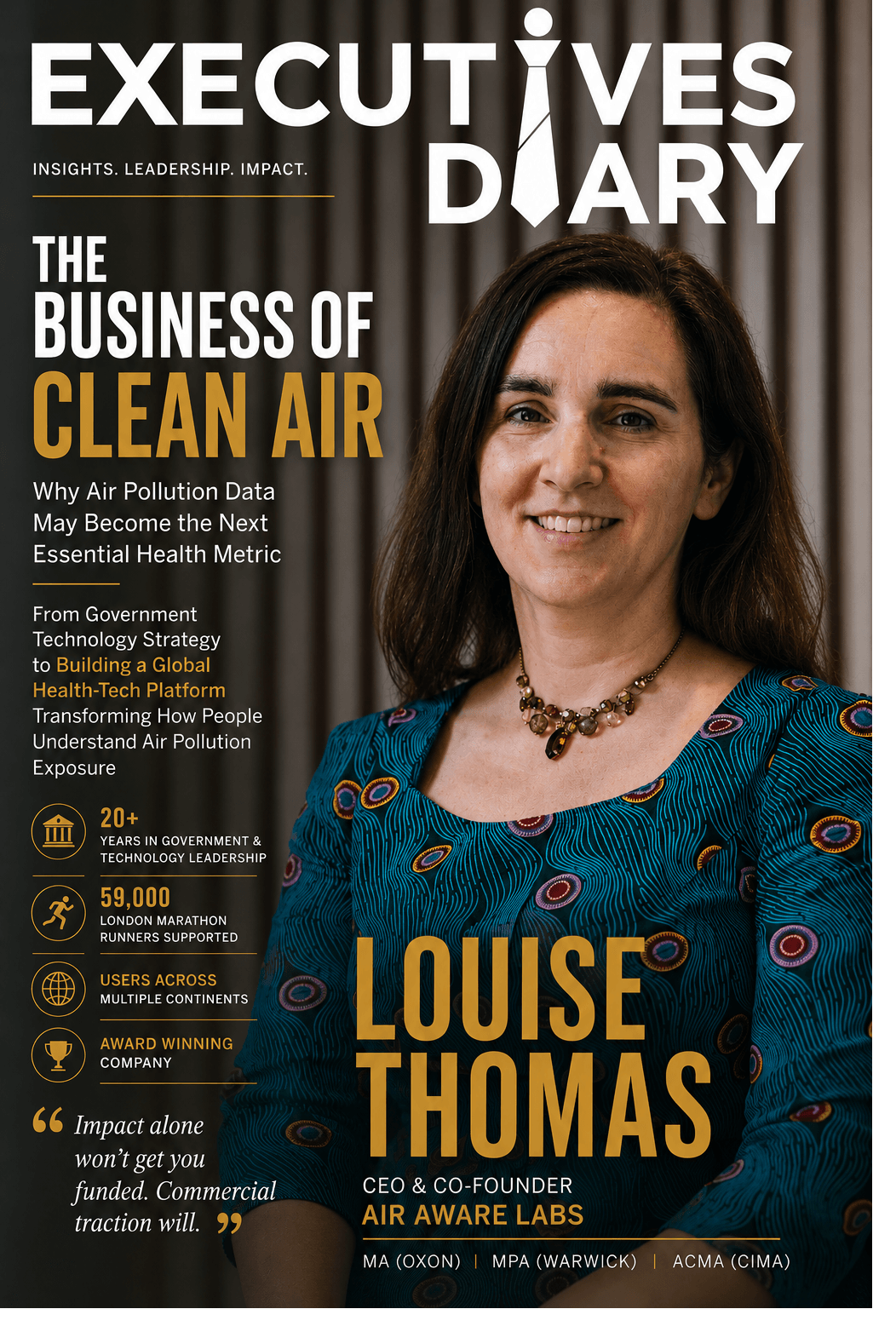
Louise Thomas is the CEO and co-founder of Air Aware Labs, a London-based health technology company that provides hyper-local air quality data and personalized insights to individuals, healthcare providers, and the fitness industry. She spent more than two decades in UK government service, including launching the country’s first International Technology Strategy as Deputy Director at the Foreign, Commonwealth and Development Office. What defines her now is not that she took a break from senior government work, but that she treats air pollution exposure as a commercial blind spot the health and wellness industry has been too slow to recognize and price in.
From Oxford Maths to Whitehall to ZINC
The path to Air Aware Labs was not a sudden conversion moment. It was a long accumulation of seemingly disconnected experiences that only make complete sense in retrospect.
After earning First Class Honours in Mathematical Sciences from the University of Oxford, Thomas built nearly two decades of expertise across strategic planning, international partnerships, and emerging technology policy. The roles were substantial and increasingly senior. As Deputy Director covering international technology policy, she established new teams from scratch and managed complex international relationships that required holding tension between geopolitical complexity and the practical realities of how technology actually gets deployed at scale.
But parallel to her government career, Thomas was spending evenings and weekends on something entirely different. For five years, she campaigned locally on air quality issues around schools and for children in London. She watched the same pattern repeat: overwhelming scientific evidence, sophisticated monitoring systems, detailed policy frameworks, and almost no practical tools for individuals to act on any of it. And it brought her full circle to her university days, studying maths and what might now be called data science, while campaigning on social and environmental issues.
The convergence point came through a conversation. A friend who had moved from government into venture capital mentioned the ZINC venture builder program, which was recruiting a cohort around eliminating environmental threats to health. Thomas saw immediately that it was where her local air quality work, her technology strategy experience, and her commercial instincts could finally come together in a single focused effort.
She joined ZINC as an Entrepreneur in Residence in October 2023, founded Air Aware Labs, and discovered that the transition from policy balconies to startup battlefields involves more ladder climbing than most former civil servants expect.
59,000 Marathon Runners as Proof of Concept
Air Aware Labs launched its mobile app, AirTrack, and the numbers since tell a clear story about market demand for environmental intelligence that people can actually use.
The most striking proof of concept came at the London Marathon, where Air Aware Labs provided hyper-local air quality data to 59,000 runners. Not city-level averages or regional estimates, but personalized, route-specific environmental intelligence delivered to athletes who had no idea that air pollution was affecting both their performance and their long-term cardiovascular health.
That framing is deliberate. The global health and fitness market represents hundreds of billions in annual spending, with increasingly sophisticated tools for tracking sleep patterns, nutrition intake, heart rate variability, and recovery metrics. But it has almost entirely ignored the air those users breathe during training, competition, and daily activity. Air Aware Labs is not positioning itself as a charity filling a gap in environmental awareness. It is a technology company with a clear commercial thesis: air pollution exposure deserves the same normalized, data-driven attention as step counts or calorie tracking, and the market for tools that deliver that precision is enormous and largely unserved.
AirTrack now includes a Cleaner Routes feature that suggests less polluted paths for walkers, runners and cyclists, 24/7 pollution tracking through its AirCoach feature, and pollen tracking for hay fever sufferers launched just weeks after the major platform update. The pollen feature went from decision to deployment in under a week, reflecting a team built for rapid iteration and user-responsive development.
Global Scale, Local Solutions
The international dimension is already operational rather than aspirational. Air Aware Labs has active users across multiple continents and partnerships with organizations from Thailand, Philippines and beyond, working on air quality monitoring and public health initiatives. When an influx of potential ambassadors from across Africa revealed that AirTrack’s data coverage there was limited by sparse monitoring infrastructure, Thomas did not treat it as a public relations challenge. She treated it as a product development opportunity and began building partnerships with organizations deploying open source monitoring networks to expand data availability.
The company is currently among the final twelve startups from across Europe in a competitive angel investment program, having advanced through multiple selection rounds from an initial field of more than forty companies. A recent bid for a Women in Innovation award, aimed at building a pregnancy-specific version of AirTrack with clinical partners at King’s College and Guy’s and St Thomas’ hospitals, missed funding by less than one percentage point. Thomas scored 80.3 percent when the funding threshold was 81 percent.
The Hard Truth About Impact Funding
Her response to that narrow miss reveals the commercial pragmatism that separates her from founders who treat rejection as validation of the system’s unfairness. Within the same week, she had identified a UCL Women’s Health program and submitted a new application targeting the same clinical opportunity through a different funding mechanism.
That perspective is not cynicism about the funding environment. It is the opposite. It reflects her belief that the work is serious enough to deserve serious capital, and serious capital requires serious commercial discipline rather than moral arguments.
Up a Lamp-Post in Brixton
The discipline shows up in unexpected places. In Thomas’ local community work with Breathe London, she and her partner realised that the pollution monitor near St Matthew’s Church in central Brixton had started showing unexplained variations, the response was not a technical support ticket. It was Thomas herself, holding up the ladder herself on Sunday morning, to get the monitor replaced.
The image is not glamorous, but it is precise. The CEO of a data company understands that if the sensors are wrong, everything built on top of them becomes unreliable. That willingness to own the foundational details, from monitor maintenance to narrating her own app onboarding videos, reflects the operational reality of early-stage companies where the person with the most context often ends up doing the job that needs doing, regardless of what their business card says.
Making Clean Air as Normal as Step Counting
The longer-term vision extends far beyond individual consumer apps. Air Aware Labs already provides data and insights to partners in healthcare, fitness, and active travel sectors, enabling them to integrate environmental intelligence into their existing services and patient care protocols. In that model, air quality stops being a niche environmental concern and becomes infrastructure that sits quietly underneath other products, changing decisions at scale without requiring users to think about it explicitly.
The normalization principle is what transforms a specialized environmental app into a platform that could reshape how entire industries think about health optimization. When tracking pollution exposure becomes as routine as checking a smartwatch for daily steps, the behavioral and commercial implications extend far beyond the environmental sector into insurance, corporate wellness, urban planning, and healthcare delivery.
For executives reading this who will never run the London Marathon, never pitch at a European angel conference, and never climb a Brixton lamp-post to fix a pollution monitor, the question is why any of this should matter to their industries or investment portfolios.
The answer returns to the uncomfortable gap Thomas identified between settled science and practical action. If your health strategy, employee benefits programs, sports science protocols, or city planning initiatives still ignore the air people breathe minute by minute, you are missing both risk and opportunity. Louise Thomas is betting her next decade that once people can see their pollution exposure with the same clarity they see their step count, they will not be willing to go back to making decisions blind.
Because the real transformation she is building toward is not in policy papers or product demonstrations, but in the moment when clean air stops feeling like an abstract environmental right and starts feeling like a daily metric you are no longer prepared to leave to chance.
Key Takeaways / Playbook
- 1. Move Beyond Impact: Urgency alone won’t secure funding; center your pitch around large established commercials, market sizing, and scalable metrics.
- 2. Target Unaddressed Blind Spots: Build robust commercial solutions inside existing multi-billion dollar fields—like the air quality layer missing within the health and fitness ecosystem.
- 3. Ground-level Accountability: True leadership means maintaining extreme technical accuracy and owning foundational details, even if it requires handling hands-on problem solving directly.