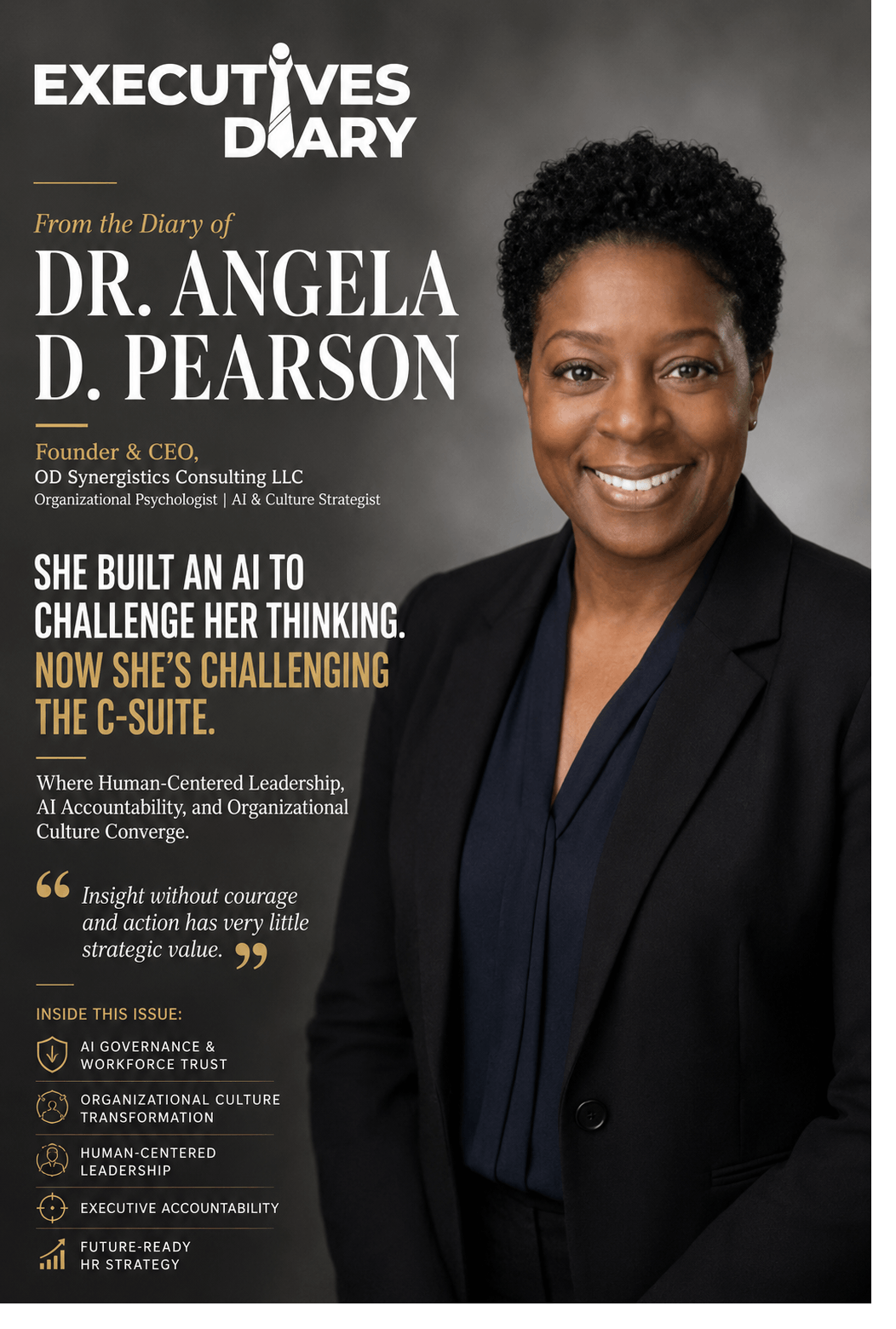
Dr. Angela D. Pearson
Built an AI Agent to Challenge Her Assumptions. Now She’s Challenging the C-Suite.An AI Built to Argue, Not Obey. She did not build an AI to make her work easier. She built one to challenge her.
Most executives approach artificial intelligence as a productivity tool. Scale faster, cut costs, automate decisions. Dr. Angela D. Pearson started from a completely different premise. She created an AI strategic partner called Max, then programmed it to challenge her thinking on leadership, culture, and organizational risk. When she demonstrated it to her HR team at ITHAKA, she did not position it as an efficiency upgrade. She positioned it as intellectual accountability. She let them watch her assumptions get questioned in real time.
That choice tells you everything about how she operates. While most consultants sell certainty, she practices disciplined uncertainty. While others promise quick fixes, she builds systems designed to surface what leaders would rather not see.
Where Belonging Meets Accountability
Dr. Angela D. Pearson is the Founder and CEO of OD Synergistics Consulting LLC, based in Albany, New York, and former Director of Organizational Culture and Belonging at ITHAKA. She is an organizational psychology practitioner who teaches executive teams that belonging and accountability are not opposites, they are prerequisites for each other. What makes her impossible to ignore is not her credentials, but how bluntly she connects culture gaps to business risks in rooms where people prefer softer language.
From Uniform to Boardroom
Her path to boardrooms began in uniform. She served in both the U.S. Navy and Army National Guard and Army Reserves, an unusual combination that exposed her to different military cultures and leadership philosophies. The military taught her two foundational principles that now anchor everything she does. First, that shared purpose can move people through conditions most corporate teams will never face. Second, that organizations often confuse belonging with conformity, which kills both innovation and individual contribution.
That insight followed her through early roles in operations, human resources, and learning development. She watched organizations invest heavily in engagement surveys and leadership training while quietly avoiding harder questions about equity, psychological safety, and systemic barriers. Over time, she stopped seeing those as separate issues and started reading them as one interconnected system.
Building Diagnostic Capability
Her MBA in Global Management from American InterContinental University provided business acumen. Her PhD in Industrial and Organizational Psychology from Walden University gave her the research framework to prove what she already knew from experience. Culture shows up in retention data, safety incidents, and where career advancement stalls. She began building her reputation around a specific capability: diagnosing the gap between what organizations say they value and what their systems actually reward.
Professional roles across corporate, nonprofit, and education sectors added operational texture. Board leadership with The Food Pantries for the Capital District and executive positions in professional associations were not resume builders. They were laboratories where budgets, community needs, and staff realities collided. Each role sharpened her ability to spot where stated values and daily practices diverge.
The Architecture Problem
By 2019, when she founded OD Synergistics Consulting LLC, the pattern was clear. She had spent years watching organizations pour resources into culture initiatives that produced minimal change. The problem was not effort or intention. The problem was architecture. Most culture work treats symptoms without examining the systems that keep producing them.
Her consulting practice operates differently. She partners with senior executive teams to examine what is actually happening beneath the surface of their organizations. Using culture assessments, people analytics, and organizational diagnostics, she identifies where trust is breaking and why. Then she asks leaders to confront the structural reasons, not just individual behaviors.
At ITHAKA, where she served as Director of Organizational Culture and Belonging for over four years, she led enterprise-wide culture strategy as a core component of human capital planning, not an HR side project. Culture data sat alongside business metrics. She deployed more than ten custom GPT solutions to support leadership development, inclusive workplace practices, and HR decision-making at scale. These were not generic chatbots. They were purpose-built tools designed to bring consistent questioning into situations that usually depend on whoever happens to be in the room.
AI as Human Strategy
At OD Synergistics, that philosophy becomes concrete work. She helps organizations build AI governance that connects directly to workforce trust. This includes clarifying who remains accountable when AI influences decisions, what employees understand about those systems, and how errors or bias get corrected. Her monthly newsletter, The Human Advantage, reaches over 1,200 subscribers with research on who benefits from AI adoption, who is prepared, and who gets left behind.
Recovery as Performance Strategy
One of her most effective interventions addresses a problem most leaders ignore: recovery as a performance requirement. In one client organization, she introduced structured transition time between high-stress interactions and operational demands for frontline leaders. Within a quarter, peer conflict and emotional exhaustion dropped significantly while engagement indicators improved.
Courage Over Insight
Her recent contribution to the Hacking HR Global Capability Framework demonstrates how she thinks about HR’s strategic evolution. Working with practitioners from multiple regions and industries, she helped define the technical and behavioral proficiencies that will separate strategically relevant HR leaders from those who get bypassed by business decisions.
That statement is both observation and warning. Data literacy, AI fluency, and people analytics are necessary but insufficient. The real division inside organizations is not between leaders who understand technology and those who do not. It is between leaders willing to say out loud what the data already shows and those who hope difficult realities will stay buried.
Her own practice demonstrates she asks nothing of clients she will not do herself. Building Max was not a marketing strategy. It was intellectual discipline. Creating InsightPath HR, her AI-powered strategic guide for people decisions, follows the same principle. The tool does not make decisions for users. It walks them through considerations, surface risks, and helps frame choices in human and legal terms. Better judgment, not faster shortcuts.
Dr. Angela D. Pearson built an AI to challenge her assumptions because she understands that human judgment, including her own, is fragile and prone to blind spots. She now asks executives to apply that same rigorous honesty to their leadership and their cultures.
The organizations that survive AI adoption will not be the ones that automate fastest, but the ones that maintain the clearest accountability when algorithms influence human decisions.