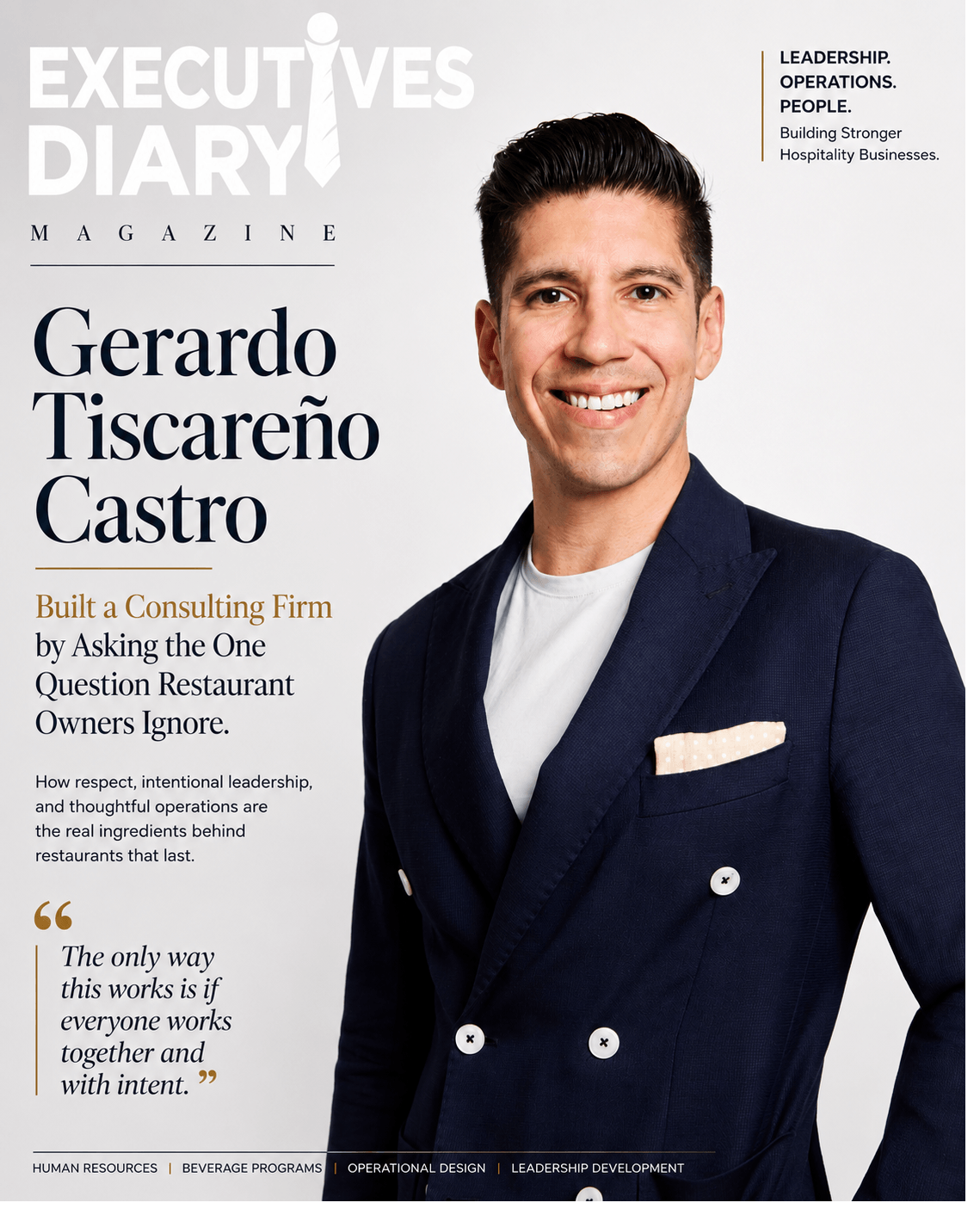
Gerardo Tiscareño Castro
Built a Consulting Firm by Asking the One Question Restaurant Owners Ignore.The Question That Changes Everything
There is a moment in every job interview Gerardo Tiscareño Castro conducts that stops candidates cold. After the usual questions about experience and availability, he asks: “What do you want or look for from an employer?” Most people stare. Some blink. A few laugh nervously before catching themselves. Then, almost universally, they say the same thing: respect. Not a raise. Not a title. Respect. The fact that no one had ever asked them before tells Gerardo everything he needs to know about why so many New York restaurants quietly fall apart from the inside out.
The Architect of Thoughtful Operations
Gerardo Tiscareño Castro is the founder and principal consultant of GTC Consulting, a New York-based hospitality practice that serves clients from luxury boutique hotels on the Upper East Side to high-end establishments in New Jersey. He works at the intersection of human resources, beverage program development, and operational design, a combination rare enough in the industry that most operators do not realize they need it until they see what it produces.
Geneva Taught Him What New York Would Test
The foundation was built far from Manhattan. Gerardo studied at the Glion Institute of Higher Education in Switzerland, one of the most rigorous hospitality programs in the world, and completed his final internship at the Swissotel Métropole in Geneva. He does not speak about that period casually.
That word, why, became the organizing principle of his entire professional life. In Switzerland, he watched teams operate with a precision that had nothing to do with fear and everything to do with shared understanding. Every person on the floor knew how their role connected to the person beside them. When one link in the chain slipped, everyone felt it. When every link was held, the result was something guests experienced as effortless.
He carried that understanding back across the Atlantic and began building toward it, one role at a time.
His early career moved through some of New York’s most demanding hospitality environments. At the Andaz 5th Avenue, he managed two departments and nineteen unionized employees, learning the particular discipline required when compliance is not optional and relationships with staff are governed by contract as much as character. From there, he moved into food and beverage management at Row NYC, then to The Lowell Hotel, a property where the standards are set by guests who have seen everything and expect more.
At The Lowell, Gerardo was handed a private events program that had room to grow and a union team that had seen managers come and go. He knew the sequence mattered. Before touching the brochure or reworking the pricing, he spent time earning the trust of the people who would actually deliver the experience.
What followed was a complete repositioning of the hotel’s Pembroke Room. Rather than compete with larger Manhattan venues on volume or variety, Gerardo focused on what the room actually was: intimate, charming, and specific in a way that no amount of money could manufacture. He leaned into afternoon tea, baby showers, and bridal events, built a planning experience that made hosts feel attended to long before their guests arrived, and let word of mouth do what advertising rarely can. Private event revenue increased by 70 percent in 2018.
From The Lowell, he moved to Madison & Vine as General Manager, where he was eventually promoted to oversee the Bookmarks Rooftop Lounge as well. Then came Alligator Pear, where he built the HR infrastructure for a new restaurant from the ground up, writing the employee handbook, leading recruitment, designing training programs, and managing a multi-floor operation through its most vulnerable period: opening month.
Each role added a layer. Each environment sharpened a belief.
What He Builds for Clients Now
In June 2024, Gerardo launched GTC Consulting, and the practice reflects everything those years accumulated. His client portfolio spans Manhattan restaurants and Long Island establishments, luxury hotel food and beverage operations, and service businesses that sit adjacent to hospitality. He offers HR audits, compliance audits, beverage programs creation and development, service standards documentation, staff training, and leadership development for management teams. The range is deliberate.
His consulting model is built around that reality. Rather than hand a client a policy document and leave, Gerardo works through the specific conditions of each business. On the HR side, that means understanding state and federal compliance requirements, then building programs that help managers understand not just what the law requires but how to lead the people working under it. On the beverage side, it means asking questions that seem obvious but frequently go unasked: Who is actually dining here? What do they drink? How much storage exists? How many bartenders can realistically be scheduled per shift?
The connection between the two sides of his practice is not accidental. Both are about reducing the friction that operators generate for themselves when they move too fast or think too narrowly. A restaurant with a sharp beverage program and a chaotic HR structure will lose the staff who know how to sell it. A restaurant with strong compliance and no coherent service identity will retain employees who have nothing compelling to deliver. Gerardo’s argument, demonstrated across years of New York operations, is that these problems share a root.
That root is the absence of intentional leadership. He trains managers to stop going on autopilot during busy shifts, because autopilot is where the small failures accumulate. A server who forgets to clear plates before the next course gets fired. The runner arrives with food and nowhere to put it. The rhythm breaks. What felt like a smooth service becomes a chaotic one, not because of one large mistake but because of several small moments of inattention that nobody caught.
His Marquis Who’s Who recognition reflects a career that has operated at the intersection of precision and empathy for over fifteen years. But the recognition Gerardo seems to value most is quieter: the moment a manager he has trained starts asking their own staff what they need, and means it.
The Answer Was Always the Same
New York restaurants fail for many reasons. Rent, competition, timing, and bad luck all take their share. But the failure Gerardo Tiscareño Castro has spent his career addressing is the one that happens before a single guest walks through the door: the failure to treat the people delivering the experience as worth understanding.
He built a consulting firm around a question most operators never think to ask. The answer, every time, is the same. And the restaurants that act on it tend to stay open.