
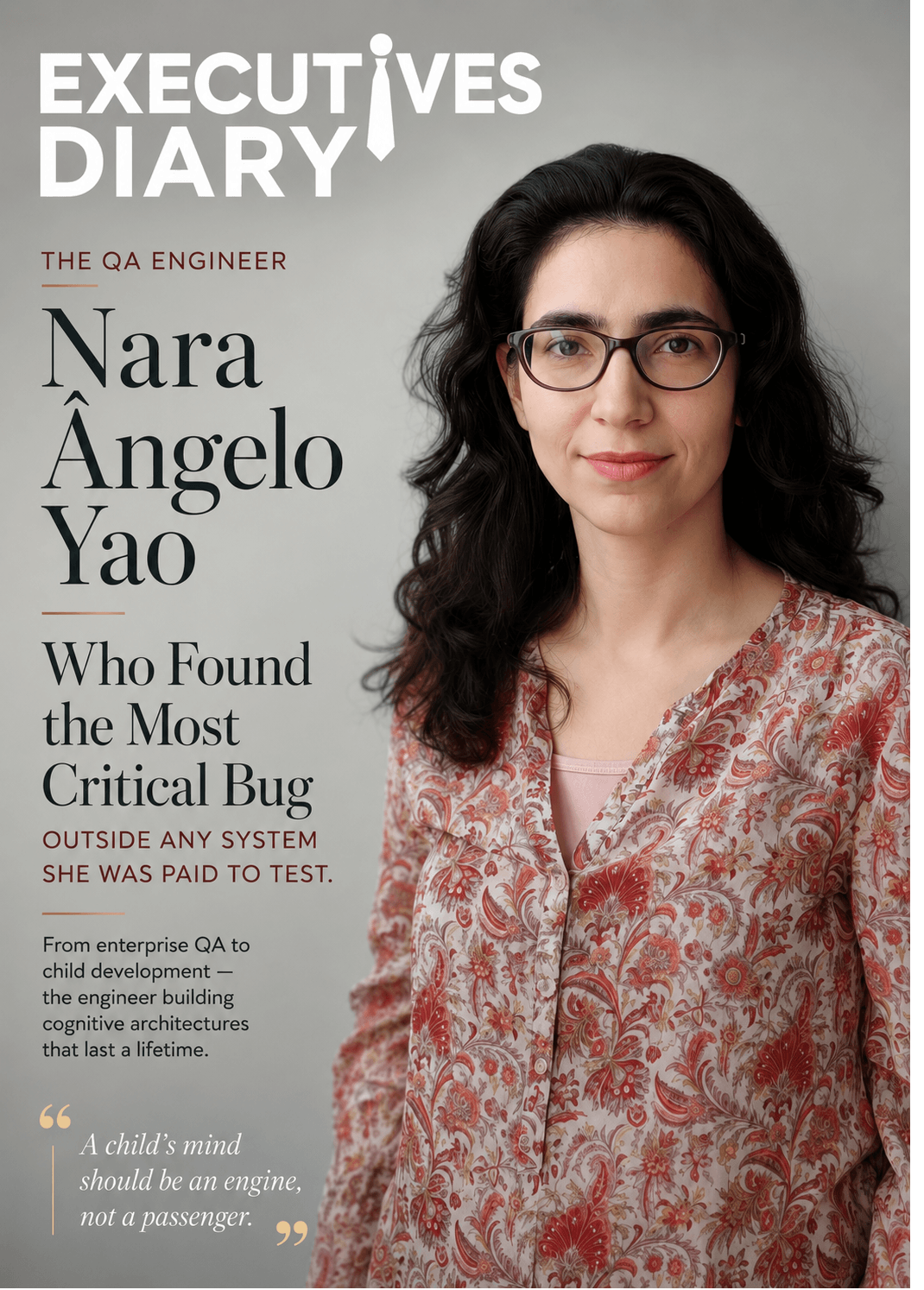
Nara Ângelo Yao
The QA Engineer Who Found the Most Critical Bug Outside Any System She Was Paid to TestThe most serious flaw Nara Ângelo Yao ever found did not live in a code repository. It sat in a living room, glowing quietly from a tablet, wrapped in bright colors and excellent retention metrics.
For more than a decade, she had built a career on seeing what others missed. Edge cases, failure paths, the quiet ways a system could betray its users. Clarity and precision were not branding lines for her. They were survival skills in the world of enterprise software, where a single overlooked bug could cascade into system-wide failure.
Then she became a mother of twins, and the same instinct that once scanned interfaces began scanning toy shelves and educational apps. The problem she saw was simple and devastating. The products claiming to support children were not designed to build thinkers. They were designed to hold attention. The child was the user, not the agent. The mind was the metric to be captured.
That is the bug Nara Ângelo Yao is now trying to fix.
The Engineer Who Sees Children as Operating Systems
Nara Ângelo Yao is the Founder and Director of Thriving Berries, an Irish-based company that designs screen-free activity packs to build focus and problem-solving skills in children aged two to five. After thirteen years in Software Quality Assurance and tech leadership, including leading teams of thirty engineers at Carelon Global Solutions Ireland, she made a radical pivot when the company closed. She walked away from the next QA opportunity to work on a system with higher stakes than any enterprise deployment she had ever tested. She is not interested in keeping children busy. She is interested in building what she calls the “cognitive architecture” for life.
The Path That Built a Different Kind of Quality Engineer
The progression from Engineering Physics to toddler cognitive development makes perfect sense once you understand how Nara thinks about systems. Her Master’s degree at Universidade de Aveiro focused on advanced sensors and optical amplifiers. Her dissertation explored single pump hybrid optical amplifiers. These are not the credentials most people associate with early childhood development, but they are exactly the credentials that explain why Thriving Berries works the way it does.
Physics trains you to look for underlying structures. Not what something appears to be, but what it actually is and how it behaves under different conditions. That instinct followed her into software, where she spent over twelve years applying it to systems of increasing complexity.
Soon after her first industry role at Coriant, she moved to AnubisNetworks in Lisbon, where she was the sole QA professional on a lean team shipping features weekly. No safety net, no established process to inherit. She built the testing discipline herself. At Sportdec, she developed the company’s entire quality engineering strategy and integrated automated testing directly into CI/CD pipelines. By the time she reached SynergySuite, she was presenting quality metrics to C-suite stakeholders and leading distributed teams across multiple time zones.
But there was another education running parallel to her technical career. Growing up, Braille was simply part of daily life in her household. She lived alongside someone born blind. The sound of the writing machine. The thick paper. Card games where she would deliberately look away because she could see the dots and they couldn’t.
That early lesson about independence being a design problem would surface decades later in a completely different context. Good design removes barriers. The right tool, built with the right intent, gives a person the power to navigate the world on their own terms.
For years, Nara kept motherhood off her professional profile. Not for privacy, but for probability. She knew the data on how it affects women’s careers in tech. The irony is sharp. The thing she kept quiet became the catalyst for everything she is building now.
The Bug That No Enterprise System Could Have Caught
When her twins were around two, Nara began applying her quality engineer instincts to the products surrounding them. What she found was a fundamental design flaw that went deeper than any software bug she had ever diagnosed.
Most products for that age group were optimized for the wrong outcome. Not for a child’s growth, but for a child’s attention. Electronic toys created feedback loops where children reacted and systems rewarded. Apps taught letters and numbers through constant prompting and praise. Everything was designed to keep small users engaged, clicking, responding.
“Electronic toys often foster passive entertainment where a child merely reacts to a button, whereas the real world requires active participation,” she explains. “A child’s mind should be an engine, not a passenger.”
Her conclusion was technical, not sentimental. A toddler’s brain has a far higher processing capacity than their motor skills or vocabulary suggest. When you design around what their hands cannot yet do instead of what their mind can already handle, you artificially lower the ceiling. That gap between cognitive capacity and available materials was where she saw the real opportunity.
She started building activities herself. Her twins became her first test environment, which in QA terms is not a metaphor but a methodology. She watched how they interacted with each task. She identified friction points. She adapted designs based on different behaviors and preferences.
That last metric matters deeply to her. Time spent in genuine focus, without being pulled forward by external rewards, is the output she optimizes for.
Thriving Berries emerged from that private practice. She treats each activity pack like a product release, complete with design framework, validation process, and continuous improvement loop. Every pack uses her signature three-level system. Level one builds familiarity and confidence. Level two introduces variation and light challenge. Level three requires children to combine ideas and make independent decisions without being told exactly what to do.
The activities themselves are deliberately tactile. Structured worksheets combined with collaborative recipes and simple home experiments. Not because screens are inherently evil, but because removing the interface forces a different kind of engagement. Children must decide, create, ask why and how. They are not rewarded for clicking. They are rewarded for thinking.
“We shift the child from a consumer to a creator,” Nara explains. “By removing the limitations of a graphical interface and focusing on tactile, family-oriented play, we encourage children to ask ‘why’ and ‘how,’ building the intellectual confidence to interact with the world actively rather than being conditioned by a screen.”
Parents are not left guessing. Every pack includes detailed guidelines explaining the developmental reasoning behind each task and how to support without taking over. She is blunt about the real client.
“My goal is to provide parents with the tools to build an internal engine in their children. This ensures they enter the world not just ready to participate, but ready to lead it.”
The business is growing methodically. She pitched at TU Dublin’s Startup Café, attended the National Education Show Ireland 2026, and is building partnerships with schools to validate the approach in classroom settings. Her subscription model is expanding, but her longer-term ambition is more structural.
She wants Thriving Berries positioned as a corporate family benefit. The logic is clean and very much that of a systems thinker. Parents who have tools for deeper, more intentional interaction with their children are more present, more grounded, and ultimately more effective at work. The child benefits. The parent benefits. The organization benefits.
“Companies talk about supporting working parents, but most benefits stop at time and money. I want to support organizations that recognize that providing parents with tools for deeper, intentional interaction with their children is a direct investment in the long-term well-being and performance of their workforce.”
The Quality Engineer’s Ultimate Test Case
The global tech industry spends billions capturing human attention. Nara Ângelo Yao walked away from that machine to build something that actively resists it. She took the rigorous testing protocols of enterprise software and applied them to the most consequential user base on the planet.
She is no longer hunting for bugs in corporate code. She is debugging the fundamental assumptions about how children learn to think. The most critical flaw she ever found was not in any system she was paid to test. It was in the belief that keeping a child occupied and helping a child think are the same thing.
They are not. And every day she spends building Thriving Berries is another day spent making sure more parents understand the difference.
Key Frameworks & Core Philosophy
- 1. Cognitive Architecture: Building focus and problem-solving structures rather than relying on passive entertainment and attention-retention systems.
- 2. Three-Level System: Designing a progression where level one builds confidence, level two introduces light challenge, and level three requires independent strategic actions.
- 3. Intention Over Attention: Replacing flashing interfaces with tactile, family-oriented play to make the child an active creator rather than a simple device consumer.