Jack Beauregard
The Machine Is Getting Smarter. Jack Beauregard Wants to Know if You Are Getting Wiser.There is a question that cuts through every AI strategy session, every automation decision, every executive conversation about the future of work. It is not the question most leaders are asking. They want to know how fast they can deploy, how much they can automate, how far ahead of competitors they can get. The question that matters asks something different entirely: what happens when the technology outpaces the wisdom of the people holding it?
Most of corporate America treats that gap as a technical problem requiring technical solutions. Better guardrails. Smarter regulation. More sophisticated interfaces. Jack Beauregard has spent nearly four decades arriving at a different conclusion. The gap is not technical. It is human. And closing it requires something no algorithm can generate: the deliberate cultivation of wisdom, judgment, and the kind of self-awareness that takes a lifetime to develop.
The Practical Business Philosopher Who Walked Into Silicon Valley’s Argument
Jack Beauregard is the Founder of The Wisdom Company, based in Cambridge, Massachusetts, and creator of Humans First, AI Second™ and Living Intelligence™. He is not a technologist or a futurist in the conventional sense. He is something considerably more rare in the current conversation: a business philosopher with four decades of practical work behind him who has been preparing for exactly this moment since before most executives had heard the term artificial intelligence.
When Roles Disappear, Only the Person Remains
The path that built Jack Beauregard’s current authority does not follow the expected trajectory. It follows a single question, asked across different contexts and decades, sharpening with each application. He graduated from Duquesne University with a degree in Political Science in 1967, then spent three years at Harvard University’s Graduate School of Divinity between 1980 and 1983. That combination, political science and ethical philosophy, prepared him for work most business schools never contemplate: understanding what happens to human beings when the systems around them change faster than they can adapt.
He took that philosophical foundation directly into organizations, first in behavioral medicine, then in mergers and acquisitions. The work revealed a pattern that would define his career. When systems were designed like machines, people started to behave like parts. Roles hardened. Metrics crowded out meaning. Titles replaced identity. Most damaging of all, leaders began to mistake efficiency for effectiveness, extraction for value creation.
The breakthrough insight came through his work with business owners who had sold their companies. “I was told by many business owners who had sold their companies that they had no idea what they were going to do after they left,” he recalls. “They were trying to build a new future from an old identity based on outdated assumptions, fears, roles, and definitions of success that no longer fit.”
That observation led to InnerVisions Associates, which he founded in 1988, and later the Successful Transition Planning Institute. The methodology was identity reinvention, helping professionals discover who they were when the role ended. He trained wealth managers, accountants, and business coaches to guide clients through what he called the transition from the Golden Years to the Platinum Years. The framing was intentional. He was not helping people wind down. He was helping them reconstitute themselves around something more durable than a job description.
Each phase added a critical layer. The philosophical training provided a framework for understanding the whole human person. The behavioral medicine work showed him how mechanistic systems suppress human capacity. The transition work revealed how fragile externally based identity becomes under pressure. By the time artificial intelligence arrived as a cultural and professional force, Beauregard had already spent decades studying exactly the kind of identity crisis it was about to create on a massive scale.
Building What AI Cannot Replace
The Wisdom Company represents the culmination of that four-decade preparation. His flagship Living Intelligence TM programs consisting of Human Development for the Age of AI show how to enhance one’s authenticity, wisdom and personal significance in a world of artificial intelligence, while the Living Intelligence™ for Business provides the methodology for the creation of human-centered organizational implementation of AI. The Humans First, AI Second™ Program helps professionals move from being replaceable AI task performers to being invaluable judgment-centered value creators. The children’s version of the program teaches children how to build healthy, empowered, and responsible relationships with AI from the beginning based on the foundational truth that: AI is the tool. The child is the thinker. These programs are being developed as online courses, assessments, and a certification program.“The greatest professional danger is not that AI will replace tasks,” he explains. “The deeper danger is that professionals may begin to outsource their judgment, allowing AI to define the problem, frame the question, supply the interpretation, and shape the final recommendation.”
His prescription sounds deceptively simple: Think before you prompt. Question before you accept. Decide before you delegate. Behind those principles lies Living Intelligence™, his framework for the human capacities that remain irreplaceable: the ability to think contextually, decide ethically, relate authentically, adapt wisely, and act with conscience.
The distinction is crucial. He is not arguing that AI is dangerous. He is arguing that humans who stop developing their own intelligence become dangerous when they hold AI.
The practical applications extend far beyond individual professionals. Through The Wisdom Company’s organizational work, he helps leadership teams conduct what he calls a Value Creation Audit. Where is the company creating genuine value that strengthens the whole system? Where is it generating profit by shifting costs, risks, or harm onto employees, customers, communities, or the environment?
The same audit now applies to AI adoption. Is the technology being used primarily to remove people, or to increase their capacity? Is it deepening human agency and quality of judgment, or eroding it by automating decisions that still require conscience? Is it widening access to opportunity, or concentrating power further?
When organizations make this shift from what he calls mechanistic thinking to living-system thinking, the changes are immediate and measurable. “Organizations begin to have more honest conversations. Trust increases. Silos soften. Conflict becomes less defensive and more generative,” he reports. Leaders make decisions with greater awareness of long-term consequences. AI adoption becomes less about replacing people and more about increasing human capability.
His work extends beyond the C-suite to what may be the most critical application: children and family AI readiness. Parents and educators, he argues, cannot wait for perfect regulation or fully mature safeguards. “We are no longer in an era where identity reinvention is optional or occasional,” he says. “In the age of AI, it becomes a permanent human capacity.”
The questions children now face mirror what professionals are experiencing: Who am I if a machine writes better than I do? What is my worth if my success depends on tools I barely understand? How do I develop real confidence in a world of manufactured answers? Those are not technical questions. They are human ones. Which is precisely his point.
The Race That Actually Matters
The machine is getting smarter by the quarter. Processing power doubles, training data expands, capabilities leap forward with each new model release. The speed is breathtaking and, for many professionals, terrifying. Jack Beauregard has spent his career preparing for this exact moment, when the external acceleration would force an internal reckoning.
His answer is not to slow down the technology. His answer is to speed up human development. To cultivate the wisdom, judgment, and ethical capacity that no algorithm can generate. To help people anchor their identity not in what they produce, but in who they are and how they think.
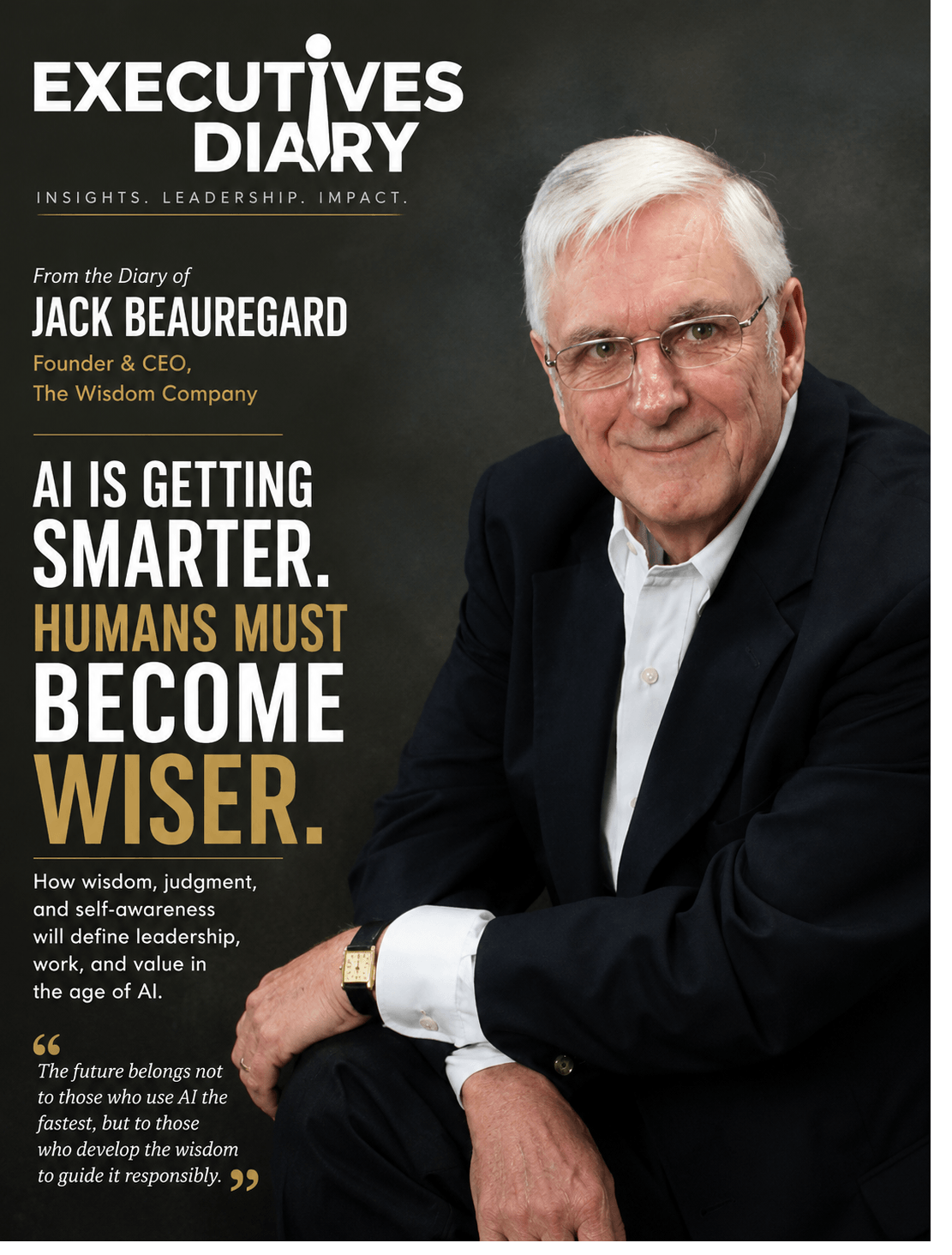
“AI is getting smarter. Humans must become wiser,” he says. The future belongs not to those who use AI the fastest, but to those who develop the wisdom to guide it responsibly.
Key Alignment Summary
- 1. Living Intelligence™ Framework: The explicit human capacity to think contextually, decide ethically, relate authentically, adapt wisely, and act with conscience.
- 2. Humans First, AI Second™ Philosophy: Moving corporate leaders and future generations from replaceable algorithmic task performers into irreplaceable, judgment-centered value creators.