
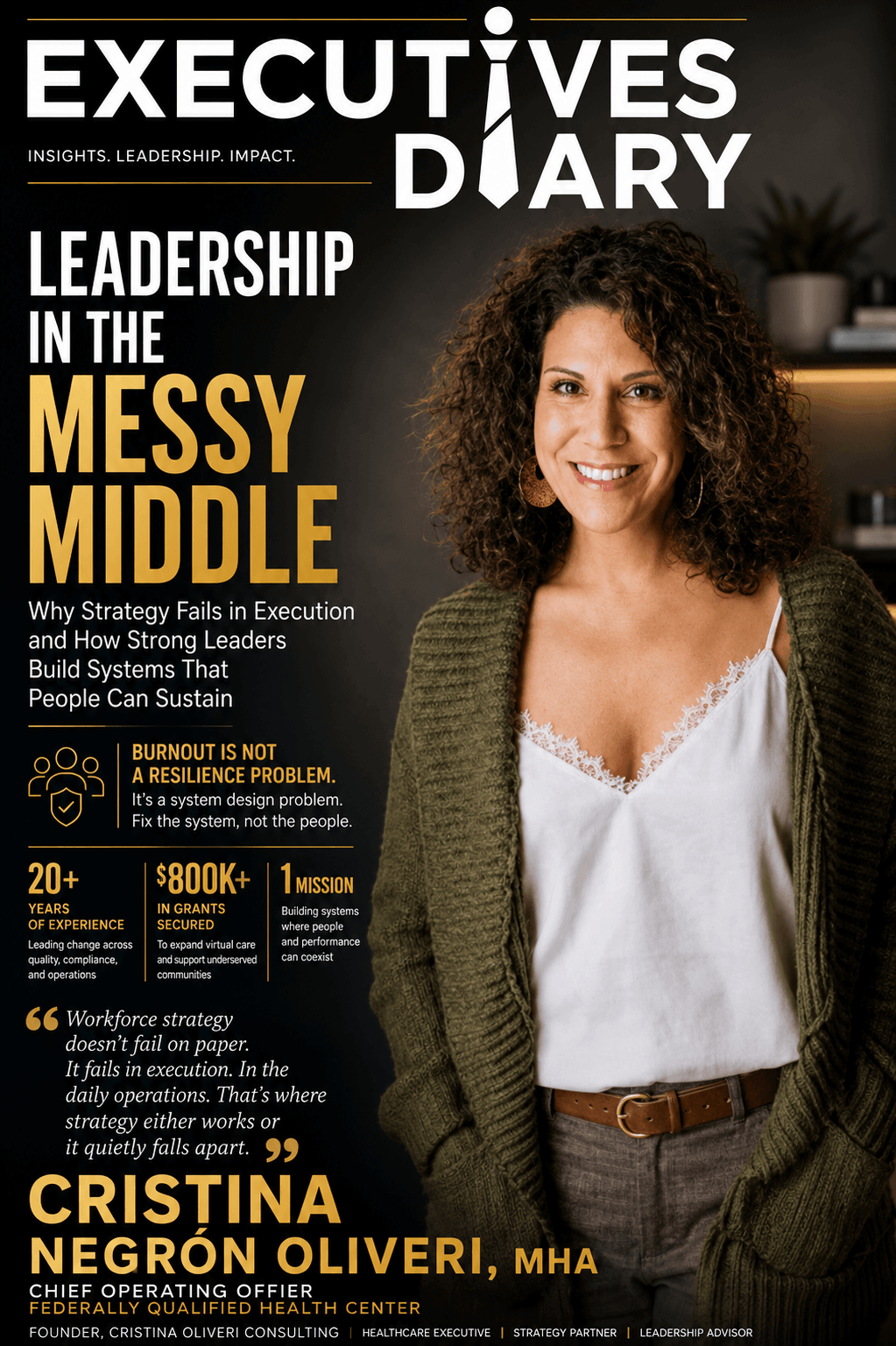
Who is Cristina Negrón Oliveri?
Cristina Negrón Oliveri is the Chief Operating Officer of a Federally Qualified Health Center in Maine and founder of Cristina Oliveri Consulting, a firm dedicated to solving the problem that most healthcare organizations refuse to confront directly: burnout is not a resilience problem. It is a system design problem. She has spent over two decades in healthcare, starting at the front desk and working her way to the executive level. That journey has given her an almost uncanny ability to see the gap between what organizations claim to value and what their actual systems require.
She reads patterns. Not personalities. Patterns.
A senior leader sits across from her team at 8:47 AM on a Tuesday. The quarterly numbers are finally moving in the right direction. Patient satisfaction scores are up. Compliance metrics are green. The strategic plan that was drafted eighteen months ago is on track.
She delivers the good news, waits for the relief on their faces, and watches it never come.
Instead, she sees exhaustion. The physical therapist who used to stay late because she loved the work is now leaving at exactly 5 PM. The front desk manager who knew every patient’s story by name is calling in sick twice a week. The nurse who trained half the staff is interviewing at the hospital across town.
The strategy worked. The people did not.
She drives home wondering if she is solving the wrong problem. If the plan was ever the real problem at all.
A Different Model of Leadership
Her father was a superintendent at a correctional facility in New York. He worked in environments designed for control, yet he remained one of the calmest and most human leaders anyone ever encountered. He commuted from Long Island to Albany every single week for seven years, leaving early Monday mornings and returning late Friday nights, all in pursuit of a career move he believed in.
As a child, you never understand the level of sacrifice your parents make to build a better life. Years later, when Cristina found herself working in a different kind of high-pressure environment, healthcare, she began to understand what she had been watching all along. The strongest leaders were not the ones who carried everything. They were the ones who created conditions where people could function, adapt, and solve problems together.
It was a lesson she had been learning long before she had the language for it.
He taught her something that would become the foundation of everything she would eventually build: balance is not a luxury. Balance is wisdom.
“You can’t change people,” he told her. “You can’t take on everything. You need to know when to let go.”
These were not the words of someone who believed in pushing through walls. They were the words of someone who understood that leadership, real leadership, was about creating space where people could actually breathe.
She went into healthcare. Started at the front desk, where she watched systems work and watched them break people. Pursued an MHA at Southern New Hampshire University after realizing her career path required deeper knowledge specific to the field. Moved through roles in quality, compliance, operations. Each position added another layer of understanding. A Director of Quality role at a critical access hospital where she led transformative initiatives and learned about rural healthcare. A Director of Quality and Compliance at an FQHC in the New York area, where she learned from innovative leadership that shaped her passion for working with underserved communities. She helped secure over $800,000 in grant funding during the COVID-19 pandemic to support virtual care services.
The pattern became clearer with each role. Organizations could implement policy. They could improve metrics. They could say the right things about culture. But the moment you looked at what the system actually required of people, the disconnect became unmistakable.
She eventually built a consulting practice specifically to work in that gap. Then she was offered a role as Chief Operating Officer of a Federally Qualified Health Center. She accepted because she could finally work on the problem at the architectural level, where systems are actually designed.
What Breaks at the Edge
Her current work sits at the intersection of operations, quality, risk, and compliance. But that description misses what she actually does. What she actually does is translate the gap between what federal requirements demand and what real human beings can sustainably provide.
She calls it the “messy middle.”
The messy middle is where strategy meets execution. It is where policy that looks perfect on paper collides with actual people in actual conditions. It is where feedback gets delivered. Where accountability gets handled. Where pressure shows up or gets absorbed. That is where strategy either works or quietly fails.
“Workforce strategy doesn’t fail on paper,” she writes. “It fails in execution. In the daily operations. That’s where strategy either works or it quietly falls apart.”
Most organizations have missed this entirely. They have obsessed over what they should do while remaining incurious about how it actually gets done. They have treated culture change as a program rather than as a permanent feature of how leadership works.
Cristina’s philosophy is different. She believes that many leaders absorb too much. They become the container for everyone else’s discomfort, the escalation point for every conflict, the emotional sponge for the entire system. Over time, she has learned that carrying everything is not a sign of strength. It is a sign that the system has become overly dependent on the leader rather than developing collective ownership and accountability.
What actually matters is pattern recognition. Not judgment. She looks for triangulation, avoidance, manipulation, shutdown. These are not character flaws. These are signals. Data points that reveal how a system responds under pressure.
“Not every emotional reaction requires emotional participation,” she has said.
This is perhaps the most counterintuitive thing she believes. You can remain neutral while still holding standards. You can listen without absorbing. You can support without overfunctioning.
She has brought this exact approach into her current work. She is designing operating models and governance structures that allow what leadership is supposed to do to actually happen. She is building frameworks that let strategy become action without requiring everyone in the system to burn out in the process.
The work is methodical. It is slow. It is also the only kind of culture change that actually sticks.
The Oliveri Playbook: 5 Lessons
Burnout is not an individual weakness. It is a system design flaw. When people burn out, organizations offer resilience training. Wrong answer. The system was built to require more than humans can sustainably provide. Fix the system. Not the people.
Pattern matters more than personality. Leaders waste energy reacting to individual conflicts and emotional moments. Step back. Look for what keeps repeating. That is your real problem.
Psychological safety is not morale. It is infrastructure. It is about whether the system actually allows people to be seen, heard, protected during failure, and advanced based on merit. Build that infrastructure.
Leaders must protect their own nervous system to lead effectively. The moment a leader becomes emotionally flooded, culture work becomes reactive instead of strategic. Know your limits. Regulation is leadership.
The gap between strategy and execution is where everything actually happens. Stop obsessing over what you plan to do. Pay attention to how it actually plays out. That messy middle is not a problem to eliminate. It is the real work.
Creating the Conditions
That senior leader sitting across from her team at 8:47 AM is waiting for permission to believe something different. She is waiting to understand that exhaustion is not a leadership strategy. That culture is not what is written in a handbook or communicated in a town hall. It is what the system consistently rewards, tolerates, and allows.
Cristina would tell her this: stop trying to make people more resilient. Start asking why the system requires that kind of resilience in the first place. The moment you ask that question, everything changes.
She would tell her that leadership in the messy middle is not about being stronger. It is about being clearer. About seeing patterns. About protecting your own foundation so you can actually help others protect theirs. About understanding that the person you are when you are regulated, observant, and grounded will always be more effective than the person you are running on empty.
Human behavior follows the environment around it. When leaders change the conditions and systems, the people inside them can heal.
The work is not to fix people. The work is to create conditions where people can succeed.
Cristina Negrón Oliveri, MHA, is a healthcare executive and founder of Cristina Oliveri Consulting, specializing in organizational strategy, workforce sustainability, and leadership development in high-pressure healthcare environments. She partners with organizations to translate strategy into sustainable execution and build systems where people and performance can coexist. To connect with Cristina or learn more, visit her LinkedIn profile.