TIM HOBBS
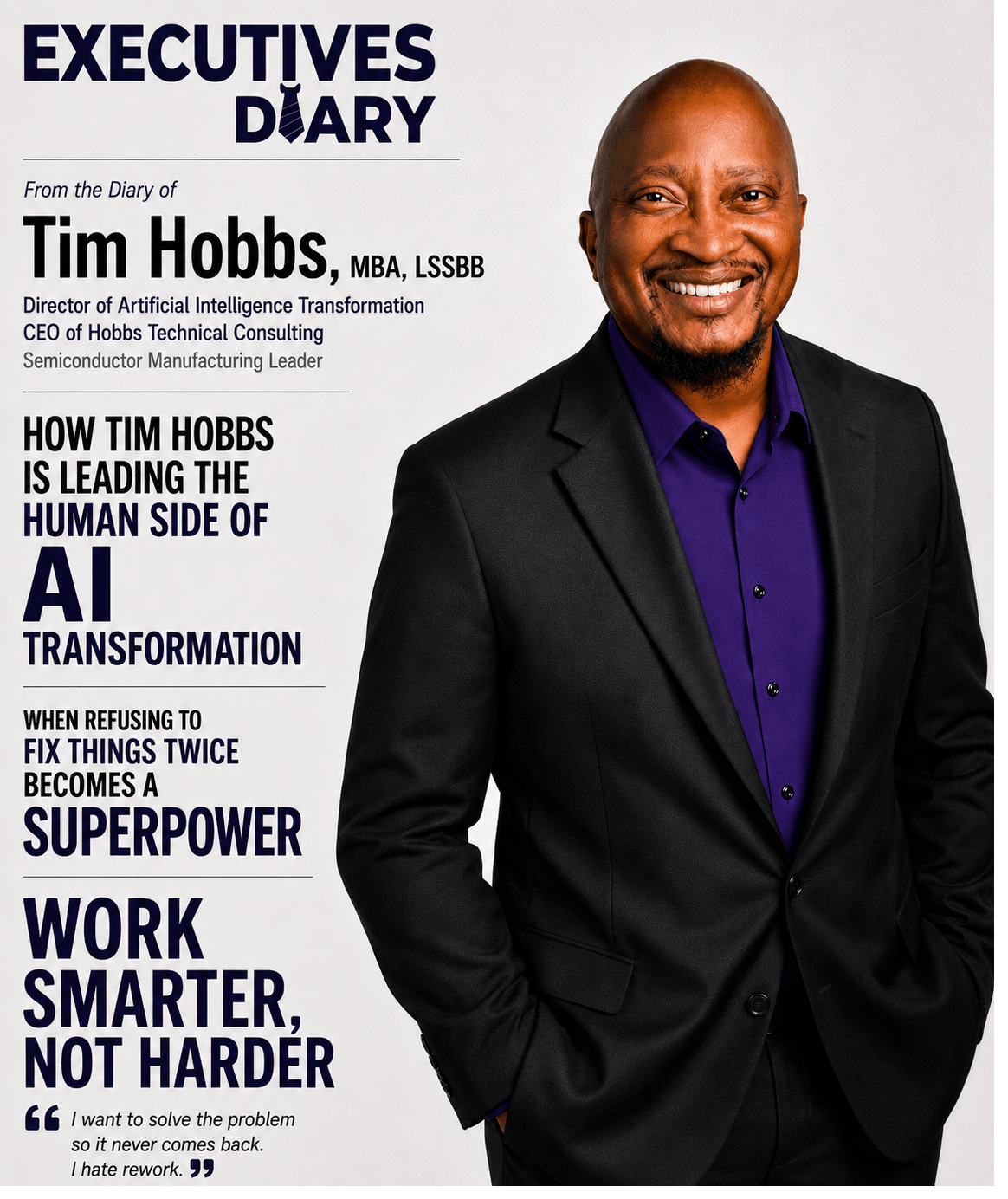
Leading the Human Side of AI Transformation in Semiconductor ManufacturingWhen Refusing to Fix Things Twice Becomes a Superpower Tim Hobbs has a confession that stops conversations. He calls himself “intuitively lazy.” Coming from a Navy veteran who holds an MBA in Technology Management, runs a consulting practice, and directs artificial intelligence transformation in a major semiconductor equipment manufacturing company, it sounds like either false modesty or a setup for a punchline. It is neither.
“Work smarter, not harder,” he explains. “I want to solve the problem so it never comes back… I hate rework.”
In semiconductor manufacturing, where a single process failure can cost millions and rework is often treated as inevitable, that attitude makes him dangerous. It also gives him exactly what a major semiconductor equipment manufacturing company needed when they decided someone had to figure out how to integrate AI into semiconductor processes built on decades of human expertise.
The Executive Caught Between Two Worlds
Tim Hobbs is a Director of Artificial Intelligence Transformation in a major semiconductor equipment manufacturer, where he manages a tension that is tearing apart manufacturing organizations worldwide. On one side, executives are pouring money into AI initiatives and demanding measurable returns. On the other hand, employees who built careers on deep technical knowledge are watching algorithms learn their jobs and wondering if they still have a future.
Most companies try to manage this gap with change management presentations and communication campaigns. Hobbs manages it with a framework that treats the human side of AI adoption as seriously as the technical side.Where Preparation Beats Intuition Every Time
His approach started forming in the Navy, where he learned a truth that would shape everything that followed: under pressure, people do not rise to the occasion. They fall to their level of preparation.
That distinction matters more than it sounds. It means the real work happens before the crisis, not during it. It means systems and training matter more than individual heroics. It means that when something breaks, the response should be calculated and repeatable, not always improvised.
After departing from the Navy in 1996, Hobbs spent 14 years at a major semiconductor chip manufacturer, then joined a major semiconductor equipment manufacturer in 2010. Throughout his combined 30 years, he moved through increasingly complex roles, from Technician, Senior Equipment Engineer, Lean Six Sigma Black Belt, Director of Digital Transformation to his current position, following the same internal logic. He was not chasing titles. He was following problems that kept getting larger and more consequential.
At each stop, he encountered the same pattern. Seasoned employees with deep expertise could handle familiar problems brilliantly. When they faced something new, they defaulted to what he calls “shot-gunning,” trying multiple fixes rapidly until something worked. The same problems returned. The cycle repeated.
“What happens when you face a problem you’ve never seen before?” That question, which he kept asking himself, became the foundation of everything he built next.
The Four Phases of AI Adoption No One Wants to Admit
Through meticulous field observation and research, Hobbs identified four distinct phases organizations move through as AI enters their operations. No-Existence, where AI is experimental and humans carry all expertise. Co-Existence, where AI tools exist but people do not trust or use them deeply. Shared-Existence, where humans and AI work together effectively. Non-Existence, where AI handles specific tasks completely.
Many employees are fearful that AI will replace them. Jensen Haung President and CEO of NVIDIA says it the best “AI is not going to take your jobs. The person who uses AI is going to take your job.” AI is going to impact every industry.
Most organizations, he will tell you, are stuck in Co-Existence and do not know it. The tools have been purchased, validated, and are available. The processes are running. And the people who know the most about the actual work are solving problems exactly the way they did before the AI arrived.
“My focus is to move teams from Co-Existence to Shared-Existence, where AI augments human capability rather than threatens it.”
In his current role, that philosophy gets tested daily across some of the most technically demanding manufacturing and business process environments on earth. When a semiconductor process tool fails, the margin for error is measured in nanometers and the cost of misdiagnosis can ripple across entire product lines.
Hobbs does not start those conversations with algorithms or model architectures. He starts with the stubborn problem at hand. What problem are we solving? Where is it occurring? Who feels the pain? What is the impact? How have we tried to solve it? What data already exists? Then he shows how AI can extend what skilled people already do, instead of dismissing their experience.
For example, when teams are constantly reacting to erratic process performance, he uses AI to surface patterns that no one had time to see in a fraction of the time, then plugs those insights into familiar problem-solving frameworks. The win is not that AI “caught” the humans. The win is that humans now have sharper tools inside methods they already trust.
Building Problem Solvers, Not Heroes
The same logic shapes his work outside the semiconductor industry. Through Hobbs Technical Consulting, which he founded in 2005, he speaks at industry conferences such as the Baldrige Foundation and the Association for Manufacturing Excellence (AME) and advises organizations that want more than slogans about continuous improvement.
“Problem solvers are built, not born,” he tells clients. “If the Navy could train me to solve complex problems under pressure, companies can train their people too.”
The Anatomy of Problem-Solving
Based upon his inaugural book “The Anatomy of Problem-Solving” and Hobbs Problem Solving workshops, he breaks problem solving into learnable components:
- • Developing concise problem statements.
- • Engaging the right stakeholders.
- • Collecting and validating data.
- • Analyzing and identifying true root causes.
- • Managing problematic personalities.
- • Implementing and validating solutions.
- • Documenting and proliferating learnings.
- • Recycling those learnings into the next challenge.
He also teaches leaders about their own visibility, using what is referred to as the PIE Model. Performance, the value you deliver, accounts for 10 percent of career advancement. Image, your brand, accounts for 30 percent. Exposure, who knows you, accounts for 60 percent.
“In today’s market, your digital presence influences 90 percent of your upward mobility,” he tells new and seasoned leaders. “If no one sees your thinking, they cannot invite you into bigger rooms.”The Answer Hidden in Plain Sight
The semiconductor industry is spending billions on AI infrastructure while quietly struggling with the same problem: the technology is ready before the people are. Tools get deployed into cultures that were not prepared to use them, and the result is Co-Existence disguised as transformation.
Tim Hobbs built his career on refusing to accept the status quo. The man who calls himself intuitively lazy has never stopped working. He just refuses to do the same work twice while choosing to work smarter and not harder. In an industry racing toward AI automation, that might be the most human skill of all.