Galina Yordanova
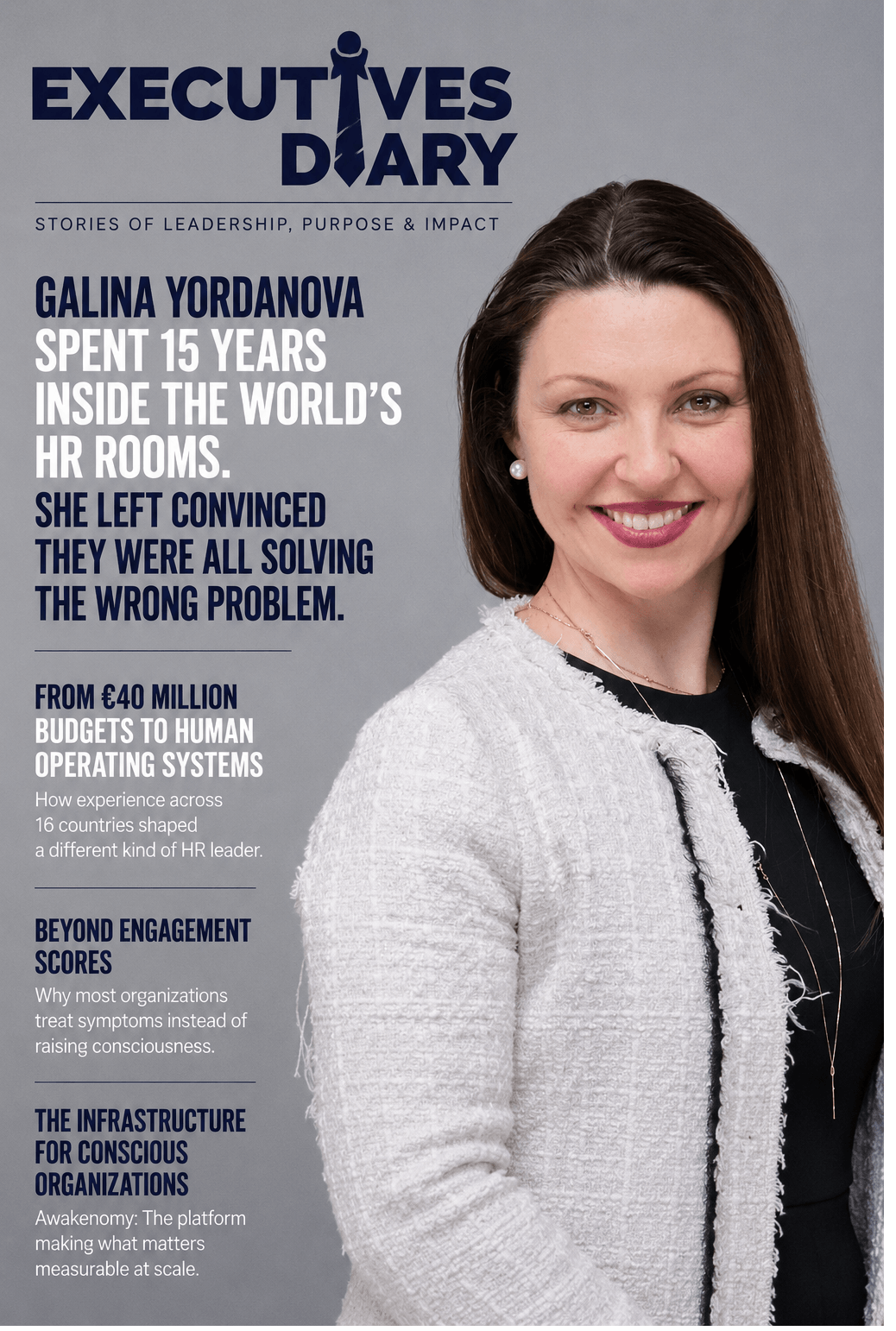
Spent 15 Years Inside the World’s HR Rooms. She Left Convinced They Were All Solving the Wrong Problem.The slide decks always looked impressive. Engagement scores climbed and dipped, new performance frameworks appeared every year, and leadership programs filled calendars across Europe. The feedback scores were strong. Executives shook hands at the end of workshops and said the right things about culture and leadership and engagement. And then, reliably, within months, the same organizations were back with the same problems wearing slightly different names.
Galina Yordanova sat in enough of those rooms to recognize the pattern. Not once or twice. Hundreds of times, across sixteen countries, over fifteen years. The programs were not failing because the content was wrong. They were failing because everyone in the room was treating symptoms while the actual condition went unnamed. What did not change was the feeling that something essential about how organizations treated human beings at work was being left untouched.
The Executive Who Measures What Others Ignore
Today, Galina Yordanova is the Chief People Officer at Kingfluencers and naoo and the Founder of Awakenomy, based in Zurich. She has turned that unease into a clear thesis: most organizations try to manage performance when they should be raising consciousness, and she is building the infrastructure to make that shift measurable at scale. She has trained more than 5,000 professionals, delivered over 1,000 workshops across sixteen countries, and spent the better part of two decades inside the kind of organizations that spend heavily on leadership development and wonder why the results don’t stick.
From Forty-Million-Euro Budgets to Human Operating Systems
Her conviction did not appear overnight. It was shaped, step by step, by a career that rarely followed the linear pattern expected of a senior HR executive. Yordanova studied International Economic Relations and Civil and Corporate Security simultaneously in Bulgaria, then added a master’s degree in managerial economics and, later, an MBA in digital transformation in Vienna. Security, economics, and digital strategy may look like separate disciplines, yet for her they formed a single question: how do complex systems behave under pressure, and what makes them resilient or fragile?
Retail gave her the first real-world laboratory. At Peek & Cloppenburg in Sofia, she moved quickly from deputy department manager to deputy store manager, responsible not only for sales but for the growth and wellbeing of a fifty-person team. The numbers were unforgiving. Every week brought fresh data on revenue, conversion, and margins. What stayed with her, however, was not the dashboards. It was the visible difference between teams run through fear and teams led through trust.
She carried that insight into Vienna, where she joined the company’s central organization and took on merchandise controlling across sixteen countries. Managing more than €40 million in budget, she learned how executive decisions echo through an entire network of stores, partners, and employees. It was a commercial role, yet people issues were never far away. When stock decisions were misaligned with reality on the ground, stress rippled through branch teams. When communication was clear and leaders were aligned, performance followed.
The Pattern That Kept Repeating
That pattern pulled her toward learning and development. Over the next eight years she built and led L&D for sixteen European markets, personally delivering more than 700 leadership trainings and coaching more than 5,000 employees in German and English. She worked with executives, branch managers, and future talents on topics from feedback culture to change management. On paper it was a success story. Inside the training rooms, she started seeing the limits of the traditional approach.
That realization hardened as she moved into senior People & Culture roles, first as Senior HR Business Partner for a rapidly growing retailer in Switzerland, then as Head of HR and later Chief People Officer at Kingfluencers. She led organizational design, built HR analytics, professionalized people operations, and partnered directly with boards and CEOs during periods of rapid scale and integration. Her impact in the field was recognized in 2026 when she was named Chief People Officer of the Year in Europe, an acknowledgment of both her leadership within high-growth organizations and her willingness to challenge conventional thinking about people, culture, and performance.
The business results were concrete, yet the same invisible pattern kept reappearing. Misalignment was rarely about process. It was about how leaders perceived reality.
The Infrastructure That Doesn’t Exist Yet
Awakenomy was born from that diagnosis. Instead of treating culture as something soft and anecdotal, Yordanova set out to build what she calls the first infrastructure for organizational consciousness. The platform collects data on aspects such as trust, leadership maturity, communication, accountability, purpose, and adaptability, then presents a structured view of how different groups experience the same company.
In one transformation project, that view revealed how far apart leadership, teams, and stakeholders really were. Executives believed communication was transparent and priorities were clear. Frontline employees experienced confusion and constant fire-fighting. Once those differences were visible, conversations changed. “Suddenly we were no longer debating opinions,” Yordanova explains. “We were looking at shared data that showed how consciousness levels differed across the system.”
The result was faster decision making, more honest discussions, and a shift from blame to responsibility. Leaders could see where their own perceptions diverged from their teams. Employees felt heard, not just surveyed. Performance metrics improved, but so did something harder to quantify: a sense of collective alignment.
Her ambition is unapologetically large. “My ambition is to do for organizational consciousness what Agile did for project management: create a globally recognized framework, language, and ecosystem that helps organizations evolve.” She is already piloting new leadership roles she calls Awakener Officers, executives whose craft is to build trust, resilience, and awareness across organizations as strategic capabilities.
The urgency of this work is becoming clear as artificial intelligence accelerates the pace of business transformation. “In the age of AI, technology should handle the repetitive and transactional work so humans can focus on what matters most: awareness, creativity, connection, purpose, and growth,” she says. The challenge is no longer access to information. “The next crisis will not be an information crisis. It will be a truth crisis.” When technology can generate endless content and recommendations, human discernment becomes the ultimate competitive advantage.
What Fifteen Years of Full Rooms Finally Taught Her
The perspective she brings to this work is shaped not only by boardrooms and executive teams, but also by life beyond them. As the mother of two boys, Yordanova thinks deeply about the kind of future today’s organizations are helping create. Questions of awareness, responsibility, trust, and human development are not abstract leadership concepts to her. They are qualities she hopes the next generation will inherit and strengthen.
At Kingfluencers and naoo, Yordanova continues to lead the full People and Culture strategy across both organizations, overseeing transformation management, cultural integration, and leadership development during periods of rapid scaling. She is doing the work she describes and building the infrastructure to scale it simultaneously. Her argument to executives facing burnout and execution pressure is precise: the problem is almost never hard work. It is unclear priorities, constant context switching, and decision-making bottlenecks that drain organizations of energy they cannot afford to lose.
The training sessions were always full. The scores were strong. The handshakes were sincere. And still, the organizations came back. Galina Yordanova is not building another leadership program. She is building the measurement system that would have told those organizations, years earlier, exactly what they were missing and where to look.
In a world drowning in information but starved of discernment, she is betting that the organizations worth working for will be built by leaders who are willing to examine not just what they do, but the consciousness from which they do it.