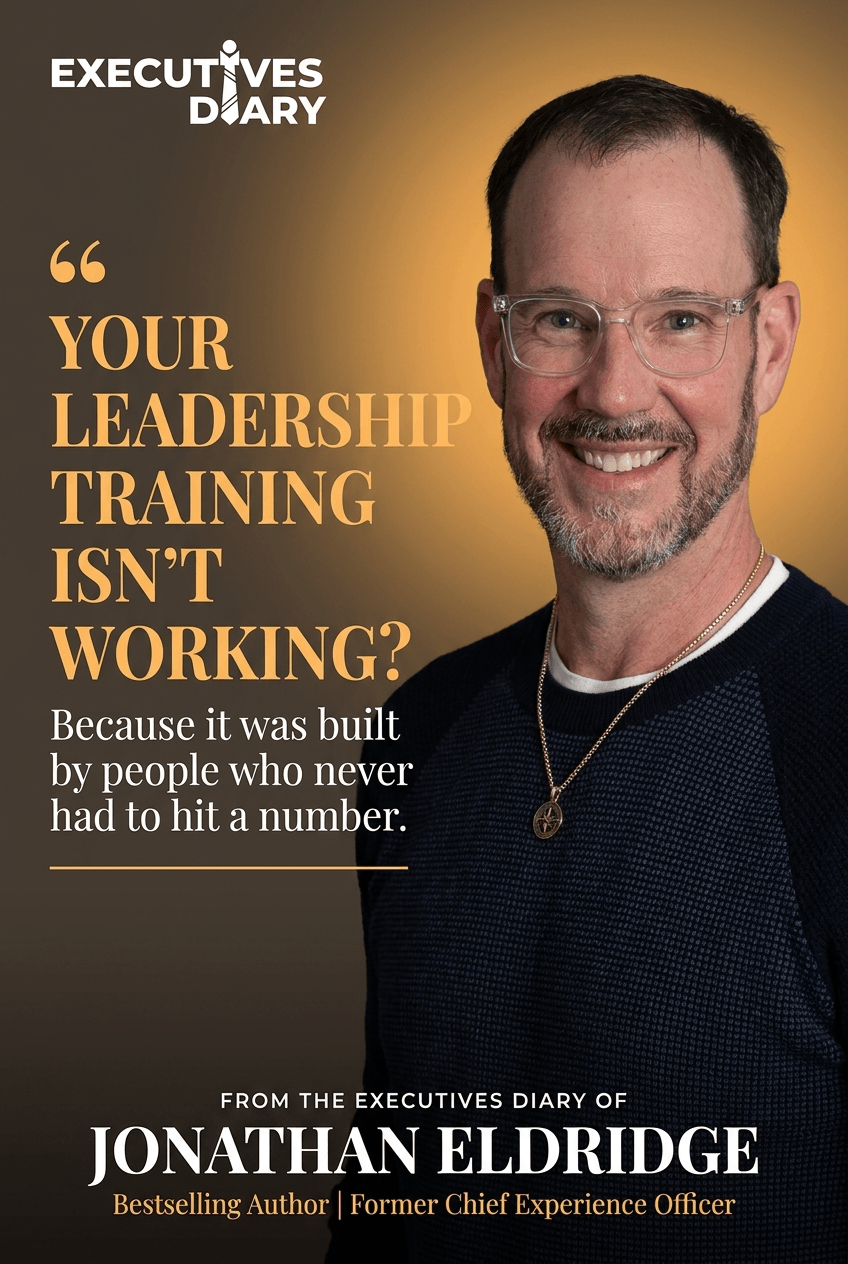
Most Leadership Frameworks Were Built by People Who Never Had to Hit a Number
Jonathan Eldridge hit the number for 22 years, opening Eight Eleven Group’s Michigan and East Coast markets from the ground up. The CARE Framework is what he brought out.
The standard corporate answer to a disengaged team is a program: communication tactics, feedback models, a redesigned org chart. The sessions end, the habits do not change, and engagement stays a soft metric on a dashboard. Jonathan Eldridge spent 22 years at Eight Eleven Group on the other side of that dashboard, where engagement was a revenue outcome with his name attached. “I can walk a client through the $120,000 to $135,000 cost of losing an engineer and know it’s not a slide. It’s a number I was personally accountable for.”
Eldridge is the founder of Soul Focus, LLC, creator of the CARE Framework, and the former Chief Experience Officer of Eight Eleven Group.
The IT Factor, Tested Twice
Underneath CARE sits a single idea Eldridge calls the IT Factor, and its working definition is deliberately plain. “It’s the credibility a leader earns by living their own growth in front of their team, not just preaching it. So when they ask people to push through something difficult, the team already knows the leader can.” He did not arrive at that definition in a workshop. He was forced into it twice.
The first time was Philadelphia. In 2006, four years after opening Eight Eleven Group’s first Michigan office in Novi, Eldridge relocated to build the company’s first East Coast market in a city where the firm had no footprint and his reputation counted for nothing. “Detroit was home turf. I could lead the way I’d always led,” he says. “Philadelphia stripped that away.” So he led differently: explaining the why behind decisions instead of handing them down, bringing new hires into calls he would once have made alone. “It stopped being ‘my’ market. When we hit a wall, we failed together. And when it worked, it was a team win, not a personal one.” Philadelphia became the anchor of a regional operation he went on to run across Detroit, Columbus, Philadelphia, and New York City, on the way to more than six years leading Experience for the company, its clients, and its thousands of consultants.
The second test came at the top of the company. In his third year as Chief Experience Officer, Eldridge stopped drinking, inside a culture built on work hard, play hard, where drinks after a hard-won deal or a client win were how the team celebrated together. “It wasn’t a small decision. It changed how I showed up at every offsite, every happy hour, every celebration after that.” The moment that stays with him came years later, at his 20-year anniversary celebration with the company: a non-alcoholic option available for anyone in the room, no questions, no spotlight on who chose what. The culture had made room without making it a thing. “The leader who shows up sober in a room built for celebration isn’t opting out of the culture. They’re showing everyone else it’s safe to bring their whole, real self to the table too.”
Reverse-Engineered, Not Invented
Eldridge’s critique of the leadership development industry he now works in starts with who builds its products. “Most leadership frameworks are built by people who studied leadership from the outside, consultants and academics teaching principles they never had to bet a P&L on,” he says.
The second problem is sequence. “Most corporate leadership programs get the sequencing backwards,” Eldridge says. The programs treat performance as a systems problem, solvable from the outside in. “What I watched actually hold teams together across three divisions at Eight Eleven Group wasn’t process. It was whether people believed the person leading them had actually gone through something hard and come out the other side still showing up for them.”
CARE is what that observation became once it was named. For years the pattern surfaced anecdotally, in exit interviews, in client debriefs, in the reasons candidates and clients gave for choosing the firm over much larger competitors. “It didn’t come from a whiteboard,” Eldridge says. “It came from data.”
The CARE Framework
- Consistent: Consistency itself (something a leader must be), compassion (something a leader must show), and curiosity (something a leader must have).
- Approachable: Approachability as a mindset, authenticity, and adaptability to the industry’s day-to-day.
- Respect: Respect given unconditionally, reliability around the clock, and relatability to the audience in front of you.
- Enthusiastic: Living the day, execution that matches your word, and eagerness (a working sense of urgency).
None of the twelve is exotic, and that is the point. The claim is not that the vocabulary is new. It is that these twelve, practiced together, are what buyers and teams are actually choosing when they choose a leader.
The hunch hardened into a system when the company began running Net Promoter Score internally. “Once we had real data instead of stories, the numbers came back well above world-class, and we’ve stayed above world-class ever since,” Eldridge says. “It told us the twelve things we’d been coaching informally for years weren’t just nice-to-have soft skills. They were the actual, measurable drivers of why people stayed, why clients renewed, and why teams outperformed.” That is the argument he now carries into client rooms, currently with a team of leaders at one of the largest architecture, engineering, and construction firms in Michigan, working through the full framework.
The Three Questions Any Leadership Team Can Steal
Strip CARE back to its derivation and the portable part emerges. Before buying anyone’s framework, run the audit Eldridge’s company was doing informally for years: collect the answers the organization already produces. Why do people stay. Why do clients renew. Why did they choose you over a larger competitor. The raw material had been accumulating in exit interviews and client debriefs long before anyone treated it as strategy.
The discipline comes next: name the pattern the answers form, then hold it to a hard metric before treating it as a system. At Eight Eleven Group the pattern became twelve attributes and the metric was Net Promoter Score. “Every attribute in the four pillars was pressure-tested against real retention numbers and real revenue targets, not theoretical scenarios,” Eldridge says.
That sequence is what separates a framework that was derived from one that was bought. “Other programs teach engagement as a soft skill,” Eldridge says. “CARE teaches it as a growth lever with a dollar figure attached, because for 22 years I was the person who had to hit the number that engagement produced.”
The Operator Behind the Framework
Jonathan Eldridge spent 22 years inside one company. He opened Eight Eleven Group’s first Michigan office in Novi in 2002 and moved to Philadelphia in 2006 to build the firm’s first East Coast market from the ground up, then ran regional operations across Detroit, Columbus, Philadelphia, and New York City. He closed his tenure with more than six years leading the company’s Experience function, as Executive Vice President and then Chief Experience Officer, across its three divisions, Brooksource, Medasource, and Calculated Hire, its clients, and its thousands of consultants, helping scale the company into a multi-division national staffing leader.
The operator record runs alongside a personal one: four knee replacements, relearning to walk four times, a 70-pound weight loss, the arc he chronicles in Struggle to Strength: How Authentic, Relatable Leadership Shapes Success, an Amazon #1 bestseller in Mentoring & Coaching and Business Mentoring & Coaching that also reached #2 in Motivational Self-Help, #3 in Leadership Training, and #10 in Business Leadership. He is specific about which resilience came first. “I had to fight and claw for every piece of business building Detroit and Philadelphia from the ground up. There were some very dark days. But it was those days I had to live through that gave me the strength to take on all the personal challenges I have had to endure.”
Today Jonathan Eldridge is the founder of Soul Focus, where he delivers keynotes and leadership development workshops built on the CARE Framework and grounded in emotional intelligence, including his current engagement taking a team of leaders at one of the state’s largest architecture, engineering, and construction firms through the full framework. His signature talk in development, Live the Day, shares its name with the attribute that anchors the framework’s final pillar. The through line has not moved: engagement, taught by someone who was accountable for what it produced.