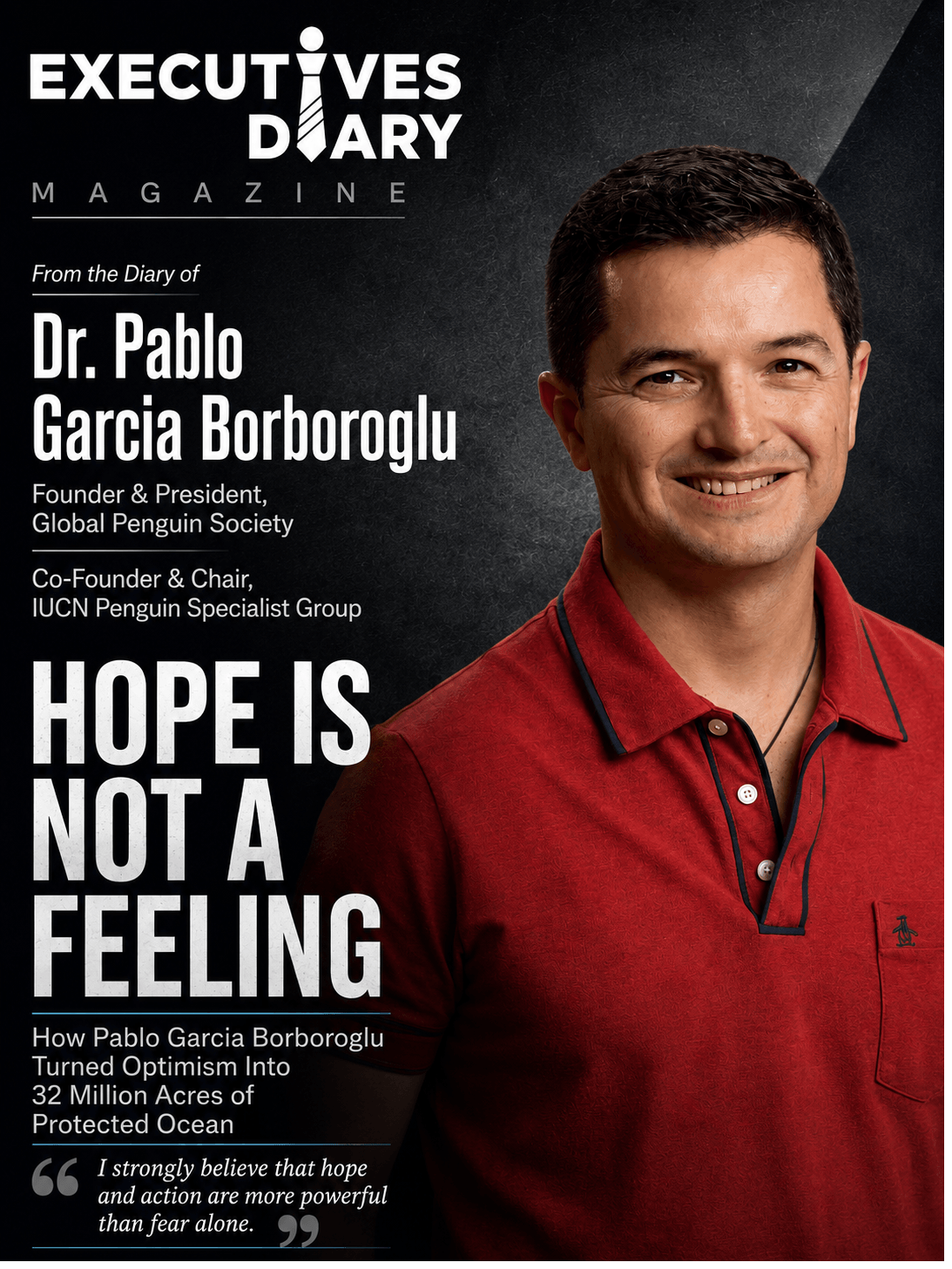
Hope Is Not a Feeling
How Pablo Garcia Borboroglu Turned Optimism Into 32 Million Acres of Protected OceanWhen Optimism Meets Logic
The world adores penguins. They generate billions in movie revenue, ecotourism to Antarctica and many countries, fill gift shops with plush toys, and draw crowds to aquariums from Tokyo to London. Yet this global affection has not prevented half of all nineteen penguin species from sliding toward extinction. Overfishing strips away their food sources. Oil spills coat their feathers. Climate change reshapes their ancient feeding and migration routes. The gap between loving penguins and actually saving them has never been wider.
Most conservationists respond to this crisis with urgency and alarm, flooding the world with data about decline and disaster. Pablo Garcia Borboroglu chose a different weapon entirely. He chose optimism. Not the soft, comfortable kind that avoids hard truths, but the disciplined, evidence-backed conviction that committed people can bend the arc of environmental destruction toward measurable success. That distinction between optimism as comfort and optimism as strategy explains why his work has produced results that most conservation efforts can only model in spreadsheets.
The Coalition Architect Disguised as a Marine Biologist
Pablo Garcia Borboroglu is the founder and president of the Global Penguin Society, a scientific researcher at Argentina’s National Research Council, and co-founder and Chair of the IUCN Penguin Specialist Group. In 2025, he was named Rolex National Geographic Explorer of the Year, joining an elite group of 18 global leaders whose work has fundamentally changed how humanity relates to the planet. What defines him, however, is not his titles but his approach: he builds coalitions as fluently as he builds research protocols, and he treats penguins not as the end goal of conservation but as the most effective ambassadors for protecting the entire ocean.
The Foundation Built in Patagonia
The architecture of a global conservation empire began with a single afternoon on the windswept coast of Patagonia. A boy stood beside his grandmother, experiencing his first wild penguin colony. Thousands of birds called, chicks begged, adults commuted from the surf. The energy was electric and overwhelming. Then his grandmother pointed to the sand. There were dead penguins soaked in oil, victims of a spill that would never make international news.
That collision of wonder and horror became the organizing principle of his life. He could have processed the grief and moved on. Instead, he turned it into a question that would drive the next four decades: how do you make the world care enough to actually change?
His academic foundation was built entirely within Argentina, but each step was deliberate. At the Universidad Nacional de la Patagonia San Juan Bosco, his undergraduate thesis examined the habitat selection and distribution of Magellanic penguin colonies in northern Patagonia. He was already returning, scientifically, to the coastline where his grandmother had first shown him what was at stake. His doctoral work at the Universidad Nacional del Comahue deepened that focus into a rigorous framework for seabird population ecology and management that would eventually underpin conservation policy across multiple countries.
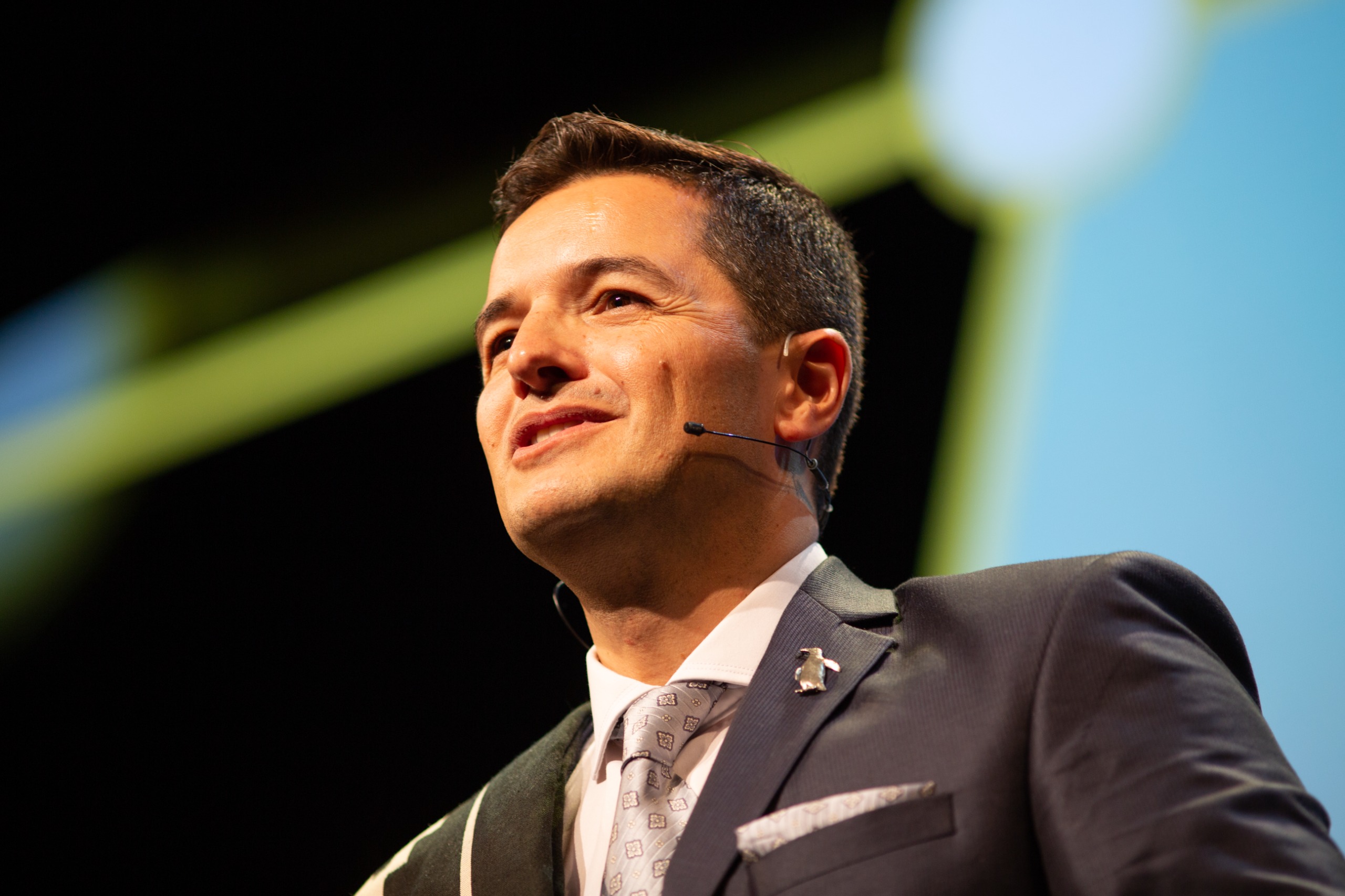
In 1998, he joined CONICET, Argentina’s National Research Council, as a scientific researcher. That institutional anchor gave him something rare in conservation science: the long-term stability to pursue work that takes decades to produce measurable results. His parallel appointment as Affiliate Associate Professor at the University of Washington, beginning in 2009, extended his reach into North American academic networks and created pathways for the international collaboration that would become essential to his global strategy.
But Pablo understood early that science alone would not save penguins. Data that stays in academic journals is not enough to reshape fishing regulations or establish marine protected areas. In 2009, the same year he joined Washington, he founded the Global Penguin Society. In 2015, he co-founded the IUCN Penguin Specialist Group. Each institution served a specific function in translating research into policy and policy into protected habitat.
The Strategy That Scales
The figure that appears most often in coverage of Pablo’s work is thirty-two million acres of protected marine and coastal habitat. To put that in perspective, it represents an area roughly the size of England or Greece, protected not on land where boundaries are clear, but in the ocean where enforcement is complex, and the science required to justify protection is extraordinarily demanding.
The number itself, however, is almost beside the point. What matters is how it was built, because the method is what makes it replicable and scalable beyond any single charismatic scientist working alone.
This framing is sophisticated and deliberate. It rejects the false separation between environmental protection and economic interest that has killed more conservation proposals than any amount of scientific opposition. Pablo speaks about stakeholders the way a seasoned CEO speaks about markets: scientists, governments, local communities, industries, and decision makers. Different incentives, different time horizons, different languages. His job is to translate complex datasets into figures and maps that a minister can defend in parliament, to explain to fishing communities why temporary restrictions mean more fish and more income later, to show corporate boards that supporting penguin habitat protects both brand reputation, long-term ocean stability and incomes through ecotourism and a more productive environment.
The Four Integrated Pillars of GPS
- 1. Science: Tracks penguin populations, breeding success, and food availability to drive proposals for marine protected areas.
- 2. Habitat Protection: Pushes science-backed proposals into policy and management zones across multiple countries.
- 3. Education: Connects local and global communities to ocean conservation through local engagement and awareness.
- 4. Communication: Turns penguins into effective ambassadors for the larger ocean ecosystem and species that share those habitats.
The Global Penguin Society operates across Argentina, South America, Africa, Oceania, and Antarctica through four integrated pillars: science, habitat protection,education and communication. The science tracks penguin populations, breeding success, and food availability. Those findings drive proposals for marine protected areas and fisheries management zones. The management work pushes those proposals into policy across multiple countries. Education and outreach turn penguins into ambassadors for the larger ocean ecosystem.
“Penguins are extraordinary ambassadors for the ocean,” he says. “By protecting penguins, we protect vast marine ecosystems and thousands of other species that share those habitats.”
Executives understand proxy metrics in business. Penguins, in Pablo’s world, serve as proxy metrics for ocean health. Their breeding success, body condition, and survival rates mirror what is happening in fisheries, sea temperature, and pollution long before those changes hit human supply chains or coastal economies. When he calls them sentinels, he is not being poetic. He is being practical.
“Penguins are sentinels of ocean health,” he notes. “Their populations reveal what is happening in our seas long before humans fully recognize the consequences.”
This framing is why ministries of environment listen when GPS presents new proposals, and why corporations and philanthropies engage. Protecting penguins is not a side project for wildlife enthusiasts. It is a way to safeguard the natural infrastructure that regulates climate, produces oxygen, stabilizes coasts, and supports food security for billions of people.
The recognition has followed the results. The Indianapolis Prize in 2023, often described as the Nobel of animal conservation, acknowledged not just the scale of what has been protected but the sophistication of the coalition-building that made protection possible. The Rolex National Geographic Explorer of the Year recognition in 2025 expands that spotlight to audiences who may never have considered penguins as anything more than entertaining film characters.
The Optimism That Delivers
Pablo plans to use that visibility strategically. “This recognition is an opportunity to amplify the global importance of penguin and ocean conservation,” he says. “My goal is to strengthen international collaboration and accelerate science-based conservation policies across continents.”
Notice what is missing. There is no self-congratulation, no focus on individual legacy. He is far more interested in what this visibility can unlock in others: finance leaders who can redirect capital toward sustainable fisheries, engineers who can design coastal infrastructure that respects breeding sites, technology leaders who can improve monitoring systems, educators who can reach the next generation before they tune out environmental news altogether.
“Solving the environmental challenges of our time requires not only scientists, but also leaders in finance, engineering, architecture, technology, education, media, and business working together toward a shared vision for the planet,” he explains. This is a direct invitation to the executive reading this article. Pablo is not asking for donations or sympathy. He is making a structural argument that the skills and networks concentrated in boardrooms are precisely what ocean conservation is missing.
Underpinning everything is the lesson from his grandmother in Patagonia. She taught him to observe nature with wonder, humility, and respect. Those early experiences shaped not only his connection with penguins but his belief that people protect what they emotionally connect with. Today, that perspective guides his leadership approach.
For leaders accustomed to operating under pressure, this is a familiar stance. You acknowledge the crisis. Then you ask what can be done, at scale, with others, right now. For almost forty years, Pablo has not simply believed that committed people can make a difference. He has proven it with thirty-two million acres of protected ocean and a global coalition that treats penguin conservation as ocean infrastructure maintenance.
The boy who stood beside his grandmother on that Patagonian beach asked a question that most people would have answered with grief and moved on. Pablo Garcia Borboroglu turned it into the most productive question of his professional life, and the ocean is measurably larger because he refused to let optimism remain just a feeling.