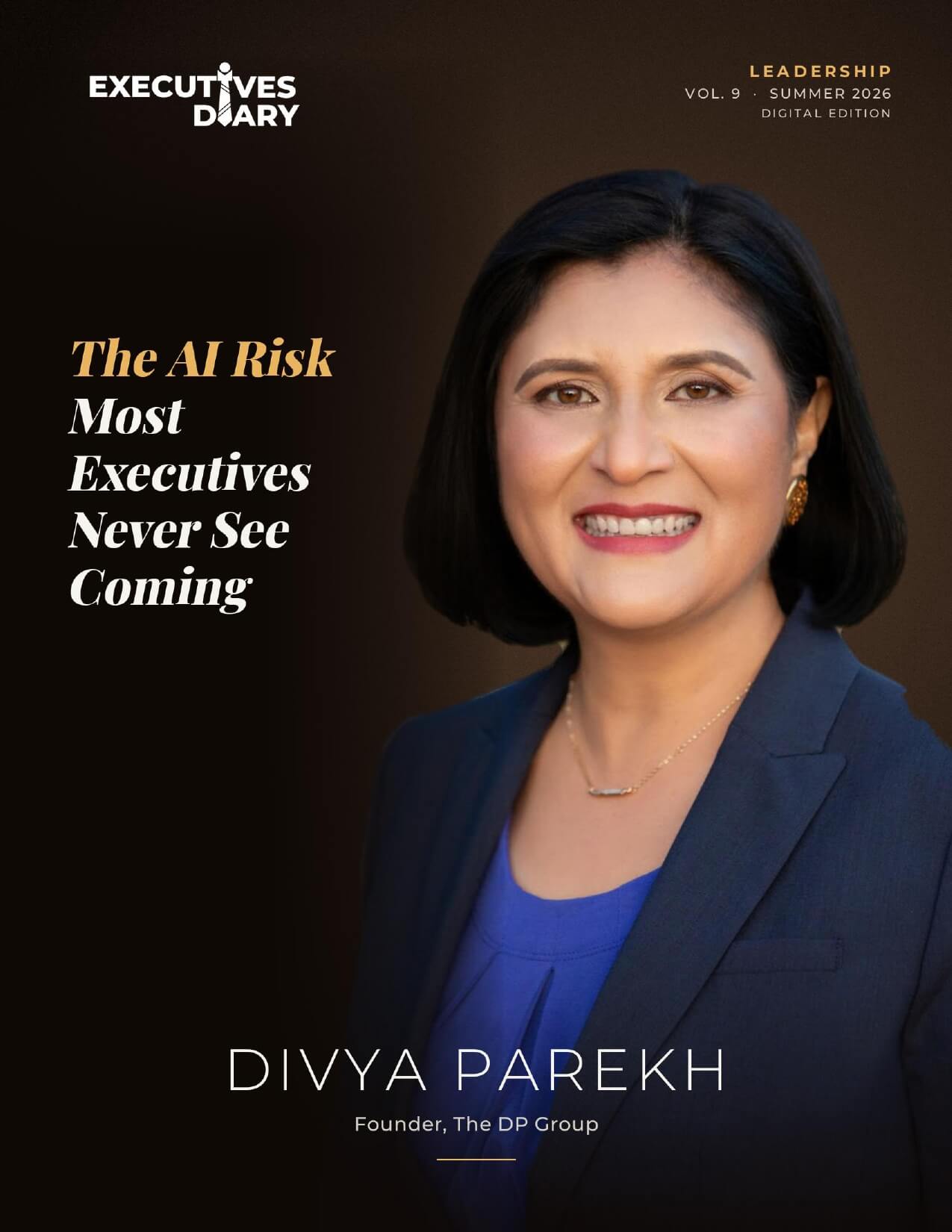
The AI Risk Most Executives Never See Coming
Top Global 50 Influential Coach & AI Leadership Advisor“What does the model not know that you do?” Divya Parekh puts that question to every team she works with, and what comes back tells her how much judgment survived the rollout. The prevailing assumption is that AI adoption is a procurement exercise: choose the platform, train the staff, count the hours returned. “Leaders assume the risk is falling behind on tools,” she says. “The deeper risk is quieter: people treat the model’s confidence as a substitute for their own judgment.
Divya Parekh established The DP Group in Raleigh, North Carolina, and Thinkers50 recognized her as one of the Top Global 50 Influential Coaches.
The Real Bottleneck Was Decision Clarity
The constraint she finds inside stalled organizations is rarely the software. More often, nobody has agreed on what would count as enough evidence to act. Her first request is not for a system map. Before discussing any tool, she asks participants to bring three recent high-stakes decisions to the table, real ones with names and dates. The team records who decided, duration, plus where discussion halted. Then she encourages the team to test each decision against one question: “When you finally decided, what were you actually missing? Was it information? Or was it the confidence to act on information you already had?”
The pattern often unsettles the team. “Usually it wasn’t missing data. The team already had plenty of information. What they lacked was agreement on what counted as enough evidence to move,” she says. That diagnosis sets her apart from the two starting points CEOs most often encounter. An advisor who comes mostly from technology will often start with the platform. An advisor who comes mostly from coaching will often start with mindset. Her sequence puts neither first. “I start with the decision itself, and the right tools and the right mindset both follow from what that decision needs.”
That discipline traces back to the same instinct, honed over fifteen years in technical and process leadership roles in the biopharmaceutical industry, where Parekh helped advance products through complex, highly regulated environments. Lean Six Sigma was a core working discipline there. “You don’t move a product forward on enthusiasm. You move it through stage-gates, using Lean Six Sigma and core scientific disciplines, because a wrong step downstream is expensive and sometimes dangerous.”
Where the Agency’s Backlog Was Building

A PR and marketing agency came to Parekh with what appeared to be a capacity problem. Every client deliverable, including briefs, drafts, and reports, passed through senior team members for manual review, and the backlog limited how many clients the firm could take on. The obvious answer seemed to be another tool. Parekh first mapped how the work moved and where it stalled. She then built AI-assisted workflows around the repeatable tasks, incorporating the agency’s voice and standards and defining what a human reviewer would still examine before anything reached a client. Parekh reports that the redesigned workflow cut turnaround time by about 45 percent. “That didn’t put anyone out of a job. It freed the team to take on more clients with the same headcount, which was the actual goal.”
What surprised her sat on the human side of the room. “The team worried that faster would mean sloppier and that the work would stop feeling like theirs.” Reassurance alone did not resolve that concern. “The turning point came once they saw the human review step working and the quality remaining intact.” Looking back, Parekh would move faster on that conversation next time: “If I ran it again, I’d have that conversation on day one instead of letting it surface on its own.”
What Executives Rolling Out AI Can Learn From Stage-Gate Discipline
Parekh’s adoption sequence is ordered on purpose, and the order carries most of the value. Diagnosis precedes tooling, tooling precedes scale, and managers are coached before the rollout is considered complete.
- First, audit the decisions before auditing the technology, and be honest about where the organization actually sits on AI maturity. You cannot plan the route until you know the starting point.
- Second, choose one pilot tied to an actual business problem and a measurable outcome, rather than a demonstration alone. “A narrow pilot tells you the truth quickly and cheaply. A sprawling one hides its own results.”
- Third, install governance while the workflow is still being designed. In practice, that means rules on what data may be used to train which systems, when human review is required, who signs off before the workflow moves into production, and how employees can raise concerns without being dismissed as difficult. “I treat it the way I treated quality in biopharma. It belongs at the start, not in the cleanup.” Parekh reframes governance deliberately: “Governance isn’t the brake on adoption. It’s what lets you move faster later without flinching at your own decisions.”
- Fourth, coach the managers. Parekh says this is the step most leaders underinvest in. “When AI absorbs the routine work, a manager’s job shifts from producing the work to directing, reviewing, and judging it.” The strongest managers use one specific practice in review meetings. “They pause the dashboard mid-review and ask what the model got wrong and why. That is where the skill develops.”
- Fifth, name the human contribution out loud. Parekh describes a healthcare analytics leader who flagged a possible misclassification in an AI-generated patient summary that could have delayed a handoff. What the leader didn’t do matters as much as what she did. “She didn’t overrule the system on a hunch. Intuition isn’t automatically right, and I would never argue that a feeling should beat the data.” Parekh continues: “What she did was pause the automation and ask for a sample review. The review confirmed the error.” Parekh sums it up: “Staying in charge of oversight is part of the job, not a sign that you distrust the tool.”
- Sixth, measure the right things. Track adoption beyond the early enthusiasts, how often people review AI output, how quickly errors are escalated, time to decision, and rework volume. Additionally, also track whether employees feel safe raising a concern and whether leaders can explain why they accepted or rejected a recommendation. “If they can’t explain the reason, we are not ready to scale.”
For executives who fear that AI will cost the organization its character, Parekh places the responsibility on leadership choices. “AI doesn’t decide how human your company is. Your people do, in the moments they choose to review the output, question it, and take responsibility for what the machine hands them.”