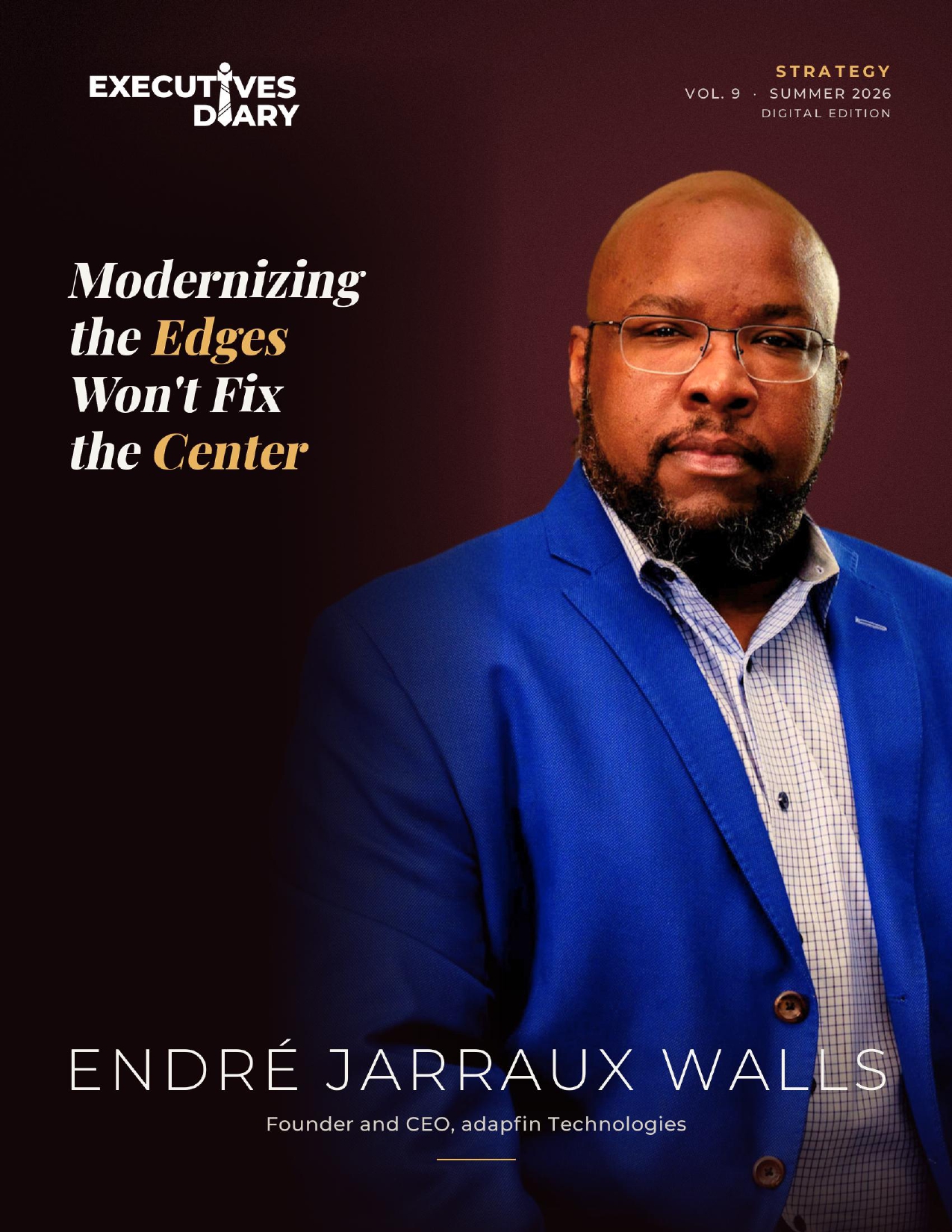
Endré Jarraux Walls
Banks Keep Modernizing the Edges While the Complexity Stays at the CenterThe modernization projects keep landing. The complexity keeps growing. Endré Jarraux Walls stopped treating that as a coincidence.
Different institutions. Different strategies, cultures, executive teams, customer bases. The same wall each time, in the same place. Endré Jarraux Walls spent two decades inside regulated financial services and healthcare watching that repeat, and watching the response never vary either: another vendor, another integration, another AI layer bolted onto a core designed decades before any of it existed. “The industry has spent decades treating architecture as an integration problem when it’s actually an operating model problem,” he says.
Walls is the CEO and founder of adapfin Technologies in Greater Philadelphia, an award-winning CISO, and the former EVP Chief Operations and Technology Officer of a $21B super-regional bank .
The Constraint Was Never Execution
Complexity, in Walls’s account, is not a condition banks inherit. It is a decision they keep making, one integration at a time. “I stopped believing complexity was simply the cost of doing business and became convinced it was an architectural choice,” he says.
He reached that view from both sides of the recommendation. As a global practice leader at Ricoh USA he advised C-level executives at Global 50 organizations across healthcare, finance, technology, change management, and education. Then he ran the systems himself, as chief technology officer at a health and human services organization operating in fifteen states, and at Customers Bank as EVP Chief Information Security Officer and then EVP Chief Operations and Technology Officer. “As a consultant, I could recommend solutions; as an executive, I had to live with their consequences,” he says.
The projects arrived under different names. “What began as initiatives around cybersecurity, operational efficiency, or digital transformation almost always converged on the same underlying issue: increasingly fragmented technology foundations that made every new capability harder to deliver than the last.” The reaction was what surprised him, not the pattern: “what surprised me most wasn’t that these organizations faced similar challenges; it was how consistently they responded by adding another integration, another vendor, or another layer of complexity.”
Those seats also produced a resilience record. Across them Walls helped mature governance, strengthen operational resilience, and carry institutions through regulatory examinations and independent audits, and “in one executive role, the institution operated for four years without a material cybersecurity incident.” He is specific about how that was judged: “We measured success through audit outcomes, control maturity, operational stability, and resilience, not simply by counting blocked attacks.”
The Room That Could Not Name Its Own System of Record
The clearest version of the problem ran in a conference room, in what was meant to be a straightforward planning session for a new customer-facing capability. The assumption going in was a few weeks of work. Then each technology owner walked through their dependencies, and the whiteboard filled with system names, middleware, APIs, data transformations, vendor approvals, testing windows, and regulatory validation. “Every box we drew created three more,” Walls says.
Then someone asked why the customer profile could not simply be changed where they were looking. “Because this isn’t actually the system of record.” Another platform was offered. “Neither is that.” Walls describes what followed: “The room went quiet for a moment because everyone realized we couldn’t even agree where the authoritative customer record lived.” A discussion that opened on a few weeks closed on a roadmap measured in quarters, and the cause was not the talent in the room. “We weren’t building products anymore; we were coordinating systems.”
Built for Accounts, Not for Customers
That room is where Walls’s diagnosis goes one level underneath fragmentation. The deeper problem was that the architecture was never designed around a single, authoritative view of the customer. “Banking technology was largely designed around accounts, products, and systems rather than customers and experiences,” he says. Each product line got its own platform, its own data model, its own security posture, and the customer became a reconciliation problem spread across all of them.
Everything downstream follows from that choice. Customer data sits in fragments. Personalization stays shallow because no system holds the whole person. Products multiply because launching a new one is easier than changing an existing platform. And the intelligence layer inherits the same limits. Walls is precise about what the accumulated response finally produces: “an institution with dozens of vendors, multiple systems of record, inconsistent security models, fragmented customer data, and AI that can observe the business but cannot safely act across it.”
Why the Answer Had to Be a New Foundation
The conventional response makes the problem worse by design. “Every time a bank adds another point solution, API gateway, AI layer, or orchestration platform, it increases, not decreases, the complexity executives are expected to manage.” That is why Walls stopped looking for a better layer. “That’s why so many modernization initiatives fail to produce transformational outcomes, they modernize the edges while preserving the complexity at the center,” he says.
adapfin came out of that conclusion being shared rather than held alone. Walls and his co-founders, Diane McCracken, Robert Diegel, and Zia Karim, had each run technology, security, or operations inside financial institutions, and comparing notes made clear the fragmentation was structural rather than local to any one bank. Instead of building another point solution, they set out to redesign the foundation.
What they are building is Nucleus BankOS, an AI-native banking operating system intended to bring core processing, customer data, operations, lending, security, fraud, compliance, and governed AI onto one modular foundation rather than a set of integrated ones. The design intent separates it from the modernization layer it is meant to replace: Nucleus is built to operate as the core itself, or alongside an existing core while an institution transitions, rather than sitting above legacy infrastructure and adding to the stack. The standard Walls sets for it is the one he applies to everything else in the category. “Most platforms optimize one function; banks have to optimize all of them simultaneously while remaining compliant, resilient, and profitable.”
What a Bank Technology Executive Can Take Into the Next Modernization Review
- First, name where the authoritative customer record lives before scoping anything else. In the planning session Walls describes, the question surfaced late and stopped the room. If a technology leadership team cannot answer it inside the meeting, that is the finding, not a detail to run down afterward.
- Second, count the dependencies before committing to a date. The timeline in that room was set by the architecture, not by the capability of the people in it, and the boxes on the whiteboard were the honest forecast.
- Third, measure the program by what it removed, not by what it modernized. Fewer systems of record, fewer security models, fewer vendors in the critical path: those are the counts that show the foundation moved. A program that leaves all of them intact has bought a better interface on the same constraint.
His case to the executive who is midway through one of those programs and starting to suspect the approach itself: “If you’re halfway through another modernization project and wondering why every milestone seems to uncover three more integrations, don’t assume your execution is failing. Ask whether you’re trying to modernize an architecture that was never designed for the future you’re building.”