Julie Palumbo
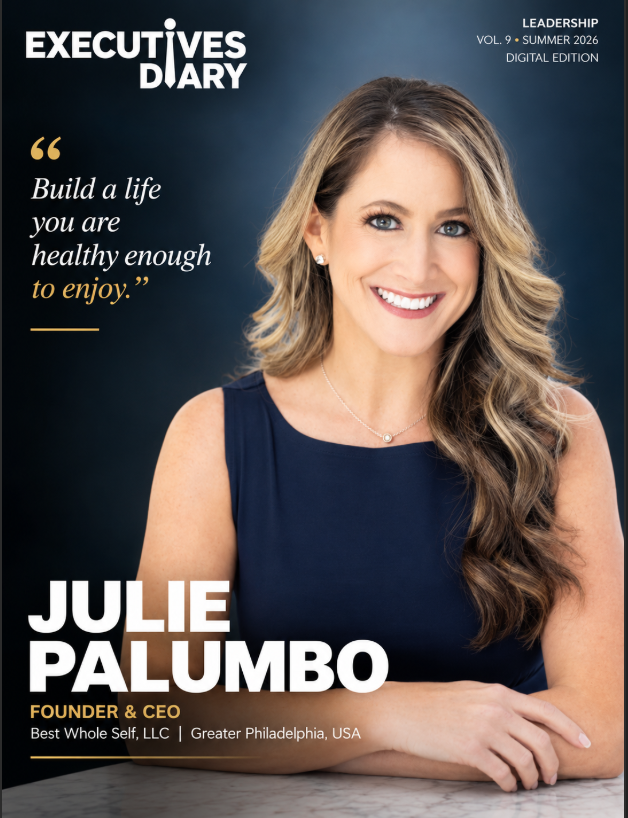
Julie Palumbo is Founder and CEO of Best Whole Self, LLC, in Greater Philadelphia, a health coaching practice for busy professionals, “especially those juggling careers, families, and chronic conditions,” as she describes it. Before founding it in December 2017 she spent a decade as a financial advisor. She has led wellness workshops for Exubrancy since 2018, and she has lived with Crohn’s disease through all of it. The idea she works from fits in one sentence: “Build a life you are healthy enough to enjoy.”
The most meaningful conversations, Julie Palumbo has said, “don’t happen from a stage…they happen around a table.” One morning this summer the table was at Triple Crown in Radnor, Pennsylvania, with breakfast, and four women who had come to a workshop she titled “The B.E.S.T. Strategy: Four Pillars for Living and Leading at Your Best.” They spent the morning, in her words, “reflecting on where we’re thriving, where we’re feeling stretched, and the small, intentional changes that can have the biggest impact on our health and lives.”
That is the whole method in miniature. Before habits, the question of what the habits are for. Before the plan, an honest account of where a person actually is.
Two Ways of Planning for the Future
Julie Palumbo studied marketing at Saint Joseph’s University’s Haub School of Business, graduating in 2008, with a semester at the American University of Rome the year before. Then she spent about ten years as a financial advisor, helping people prepare for a future they hoped to enjoy.
At the same time she was living with Crohn’s disease. The two experiences, she says, gave her “two perspectives on what it means to plan for the future.”
“I understood the importance of building financial security, but I also understood how much our health affects our ability to enjoy it.”
That connection is, in her words, “at the heart of Best Whole Self.” She wanted “to help people give their health the same attention and intention they give their careers and finances, before it becomes something they are forced to prioritize.”
The illness shaped something else, which she names as the bedrock of how she works: compassion. “Living with a chronic illness has shaped my awareness that we rarely know everything someone is carrying,” she says.
“A person can appear successful and capable while managing challenges that others never see.”
She joined the board of the Crohn’s & Colitis Foundation in October 2017, two months before founding the practice.
The Work That Proved It
Best Whole Self opened in December 2017. Within a year Palumbo was leading wellness workshops for Exubrancy, which designs custom wellness programs for small and medium-sized businesses in the New York area, and consulting on nutrition for HUSK, an employer wellness provider, where she stayed until May 2025. She wrote as a contributor for Health Union for nearly seven years, and in 2021 spent five months as a health coach at Oshi Health, a virtual clinic for people with GI conditions, the kind of patient she has been herself.
The one-to-one coaching is where the idea gets tested. “Before we talk about habits, we talk about what they want their health to make possible,” she says. “It might be having energy for their children after work, feeling more present in their relationships, or being able to travel comfortably.” Only then does the plan get built, “around their responsibilities, preferences, and challenges.”
When a client does not follow through, the response is not a lecture. “I want to understand what got in the way,” she says. “People need space to be honest about their lives without feeling judged. That honesty helps us build a plan that actually fits them.”
The results she has shared are modest and carefully qualified. This summer she compared the before-and-after health assessments of clients who had completed a 1:1 program with her. Every client improved their overall score, with the largest gains in nutrition, sleep, emotional resilience, feeling calm, physical health and daily energy. The clients “didn’t begin with identical goals or challenges,” she noted, but “each experienced measurable overall progress.” She added her own disclaimer: self-reported, and individual results vary.
She holds that the problem is larger than any one client’s habits. “We have normalized a version of professional success that leaves very little room for self-care,” she says.
“Skipping lunch, answering emails late at night, and running on too little sleep can become signs of dedication.”
“Then we expect people to solve the consequences on their own, often by adding an ambitious wellness routine to an already overwhelming schedule.”
What She Is Doing Now
Best Whole Self today works with individuals and with organizations. Her signature program, The B.E.S.T. Strategy™, is described on her profile as helping clients “lead your health the way you lead your life, on purpose, with strategy, and without overwhelm”; for teams, it is pitched as “a strategic, results-driven approach to health” aimed at energy, resilience and performance. She earned her National Board Certified Health and Wellness Coach credential in August 2025, and she is now taking the breakfast-workshop format around greater Philadelphia. This month she was named one of Modern Luxury’s Dynamic Women in the magazine’s September issue.
Her organizational work rests on a distinction she keeps returning to. “There is a gap between telling people their health matters and creating conditions that allow them to act on it,” she says. “Individuals need realistic strategies, and workplaces need to consider whether their expectations and culture support the wellbeing they promote. A wellness workshop can start a conversation, but employees also need room to put those ideas into practice.”
What she wants to change is the timing. “I want taking care of our health to become an expected part of a successful life, something we make room for throughout our careers instead of postponing until retirement or a health crisis.” She hopes to help “individuals and organizations move away from wellness approaches built around perfection, pressure, and short-term results,” and to see “more leaders create workplaces where those habits are supported.”
The measure she cares about is not the habit itself. “The impact I care about is what people can do with better health: have energy for their families, participate more fully in their lives, and enjoy what they have worked so hard to build.”
Where Julie Is Now
Philadelphia. Her oldest daughter turned seven this week, which, as she wrote the next day, meant seven years of being a mother, “a version of my life I couldn’t have fully imagined until she arrived.” September is her favourite month, because back to school means back to routines, and she takes her own advice: “Pick one or two things that got away from you this summer and start there.”
The Playbook
- Start with what the health is for. “Before we talk about habits, we talk about what they want their health to make possible.”
- Build the plan around the life, not the other way around. Habits fit “their responsibilities, preferences, and challenges.”
- When someone slips, ask what got in the way. Not why they failed.
- Don’t overhaul. Pick one or two things. “Not by overhauling everything at once, but by getting back to the habits that help you feel your best.”
- Leaders: a workshop starts the conversation. Then make room. Employees “need room to put those ideas into practice.”
- Do it now, not at retirement. Give health “the same attention and intention” as career and finances, “before it becomes something they are forced to prioritize.”