Sara Torvallbach
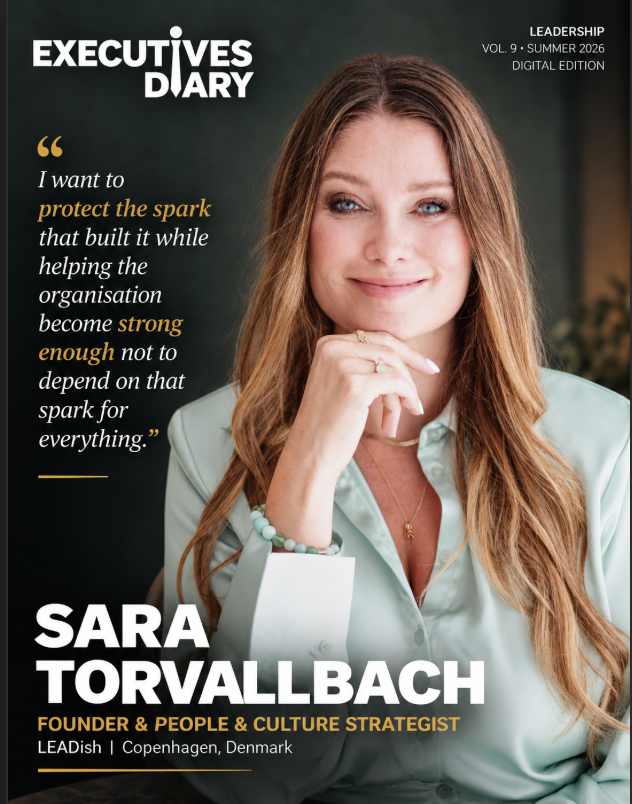
From the Diary of Sara Torvallbach. Sara Torvallbach is the founder of LEADish, a People & Culture advisory for founder-led companies, based in Copenhagen, Denmark. Before LEADish she spent more than three years as Head of People & Culture at Pengerådgivning, a fast-growing financial advisory firm with teams across seven Danish cities, and before that she founded and ran VØLVA, a leadership education platform in Bali, and No Stress Akademiet, a stress-prevention practice for the financial sector. Her idea is Founder Frequency: a founder’s energy, pressure, trust and way of seeing people do not stay personal but travel through the organisation and become its culture, whether or not anyone designed it. Through LEADish she offers FounderLEAD Profile, a leadership profiling experience that shows founders the patterns they are already transmitting into their company.
Sara Torvallbach once walked into a company workspace and felt the argument before she heard it. The structured, back-end people had been seated beside the highly social marketing team. Two ways of working, two sets of needs, and by the time she arrived, two teams so irritated with each other that nobody entering the room could miss it. Customers, clients, leaders and employees all had to cross that floor on the way to almost anything in the company.
Nothing about it would have shown up in a report. That, she says, is the point.
“You can have the right strategy, the right organisational chart and the right values written on the wall and still walk into a room and immediately feel that something is wrong.”
Torvallbach has spent nearly two decades learning to trust that feeling and then to do something with it. LEADish, the advisory she founded in Copenhagen in July 2026, is built on a single claim about founder-led companies: what the founder carries into the building does not stay with the founder.
The Banker Who Learned to Read a Room
Torvallbach started in finance. She trained at Nordea from 2007 to 2009 and, while still a trainee, was elected youth representative on the board of Finansforbundet, the Danish financial-sector union. On her LinkedIn profile she credits those years with teaching her “to understand organisations, structures, performance and business.”
What finance did not teach her, she learned the hard way. In a post published this week she wrote that around fifteen years ago she had her own stress breakdown, losing half her hair and, for a time, the ability to read above a seventh-grade level, which she had to recover and relearn. She calls it one of the most meaningful turnarounds in her life, and it set the direction of everything that followed.
In 2012 she founded No Stress Akademiet, teaching stress prevention to individuals and organisations, with a particular focus on the financial sector she had come from. She published two e-books, No Stress Yourself and The Ten Ways Out of Stress, and delivered workshops, keynotes and coaching until 2016.
Then she left Denmark. From 2016 to 2023 she lived in Ubud, Bali, where she founded VØLVA, a Scandinavian education and mentoring platform exploring leadership and self-awareness through Nordic wisdom traditions. She designed retreats, mentoring journeys and online programmes for an international community, and she describes on her profile how the experience challenged many of her assumptions about leadership and left her with a belief she still carries: sustainable performance begins with self-awareness, not control.
Asked what Bali and the stress work gave her that a normal HR background would not, she answers plainly.
“It taught me to notice what happens in people before it appears in a spreadsheet.”
“I learned not to dismiss that information simply because it is difficult to put into Excel.”
Seven Cities and a Founder’s Head
In October 2022, Torvallbach went inside a company to test whether that way of seeing could run a People & Culture function. Pengerådgivning, a Danish financial advisory firm growing quickly across seven cities, made her its Head of People & Culture. She stayed three years and eight months.
“When I came in, a lot lived in the founders’ heads,” she says. “Recruitment, leadership, culture, communication and people decisions were happening, but they were not yet connected as one intentional People & Culture system.”
Her remit grew wider than HR. She built the company’s leadership development programme, introduced DISC behavioural profiling across every leader and team, ran executive sparring and one-to-one senior leadership programmes, and worked on culture and community across the seven offices. Alongside it, from 2023 to 2024, she freelanced as an executive advisor with the consultancy Empa10, running behavioural-profile debriefs for senior and middle managers, the seed of what would become FounderLEAD Profile.
“The shift was from People & Culture happening around the business to People & Culture becoming something we consciously designed.”
She offers no headcount or revenue figure for the change. What she offers instead is the line one of the founders gave her afterwards.
“There is no one in the history of this company who has implemented as much change as you have.”
It was in this period that the pattern behind Founder Frequency became something she could name. “I have seen companies where people gradually learn to work around the founder,” she says. “They anticipate moods. They stop bringing certain problems forward. Leaders compensate for what the founder avoids. Decisions become dependent on one person’s energy or attention. Sometimes everyone becomes incredibly fast. Sometimes everyone becomes careful.”
“And interestingly, the founder may have no idea this is happening.”
What the Organisation Amplifies
LEADish opened in July 2026, and Torvallbach put the idea on its front door. On the company’s LinkedIn page she describes a founder’s frequency as the thing that travels: energy on entering a room, reactions under pressure, trust or mistrust, the behaviour they reward, what they tolerate, what they avoid. It moves through leadership, teams and decisions until it is the culture. Her image for it is the weather.
“A founder can walk into a room like the sun and something opens. The same founder, under enough pressure, can walk into the same room like a rain cloud and change the entire atmosphere without saying a word. Neither makes them a bad leader. It makes them human. The interesting question is: what does your organisation amplify when it experiences you?”
The line under all of it, repeated on LEADish’s site and in Torvallbach’s own posts, is the one she wants the company known for: “People & Culture will design itself, if you do not design it on purpose.”
LEADish, in her one-sentence description, is a People & Culture advisory for founder-led companies, helping founders intentionally design the leadership, culture and human systems behind sustainable growth. Its work runs from a fractional Head of People & Culture partnership and Company Scan, a deeper organisational engagement, to workshops, keynotes and executive coaching. Its most natural entry point, and the one Torvallbach is taking international, is FounderLEAD Profile, available on-site or remotely, with ExecutiveLEAD Profile alongside it for executives and senior leaders.
What does a profile actually show a founder? “It shows a founder how they lead beyond the version of themselves they consciously present,” she says. The example she gives is the one she meets most often: a founder discovers that the qualities that built the company, speed, instinct and an extraordinary ability to make decisions, have become the very thing preventing the next layer of leadership from growing. “They may believe they are empowering their leaders, while everyone around them has quietly learned that the fastest route is still to wait for the founder’s answer.”
The profile looks at who the founder is, what happens to them under pressure, what gives and drains their energy, how they affect the people around them, what the organisation has learned to compensate for, and what the next stage of the company will require of them. Since her own breakdown, she has made sure it also looks at capacity, triggers and recovery. Overload, she wrote this week, rarely stays personal for long.
“I want to protect the spark that built it while helping the organisation become strong enough not to depend on that spark for everything.”
The founders she wants to reach are those moving from what LEADish calls BUILD into SCALE, where more people enter the system and what once worked on instinct now needs structure, and where the business has grown faster than the People & Culture around it. She wants them beyond Denmark and Scandinavia. “They are curious about themselves, willing to look at their own impact, and understand that culture, leadership and human dynamics eventually become business infrastructure.”
The work is not confined to boardrooms. In late August she spent a day with the 36 Miss Denmark 2026 finalists on identity, values and the personal leadership it takes to stand by who you are when the room gets loud, a workshop run through SelfLEADish, the company’s strand for personal leadership. The question she left them with is the one she asks founders: who are you when you stop orienting yourself towards the applause of the room?
Where Sara Is Now
Torvallbach lives in Copenhagen with her three daughters, Bella, Svala and Kajsa, and writes on her profile that building businesses while raising a family has shaped what she believes about resilience, priorities and sustainable success. Since May 2026 she has served as deputy board member of Busses Skole, an independent school in Gentofte. LEADish is three months old and she is, in her own words, still buzzing from her first TechBBQ.
What she wants next is a different conversation. “I think the conversation around founders has focused enormously on how they build companies,” she says. “I would love to contribute to a deeper conversation about what building those companies does to the founder, and what happens to the company in return.”
Sara Torvallbach’s Playbook
- Design People & Culture on purpose, from the beginning. It will design itself otherwise, and the result will be whatever the founder happened to be carrying that year.
- Ask what your organisation amplifies when it experiences you. Energy, impatience, trust and avoidance all travel; the founder is usually the last to know.
- Watch for the people who have learned to wait. If the fastest route to a decision is still the founder’s answer, the next layer of leadership is not growing.
- Do not dismiss what you can feel in a room because it will not fit in Excel. Absence, conflict and resignation show up there first.
- Protect the spark, then build a company that does not depend on it. The goal is not to remove the founder from the business but to stop everything running through them.