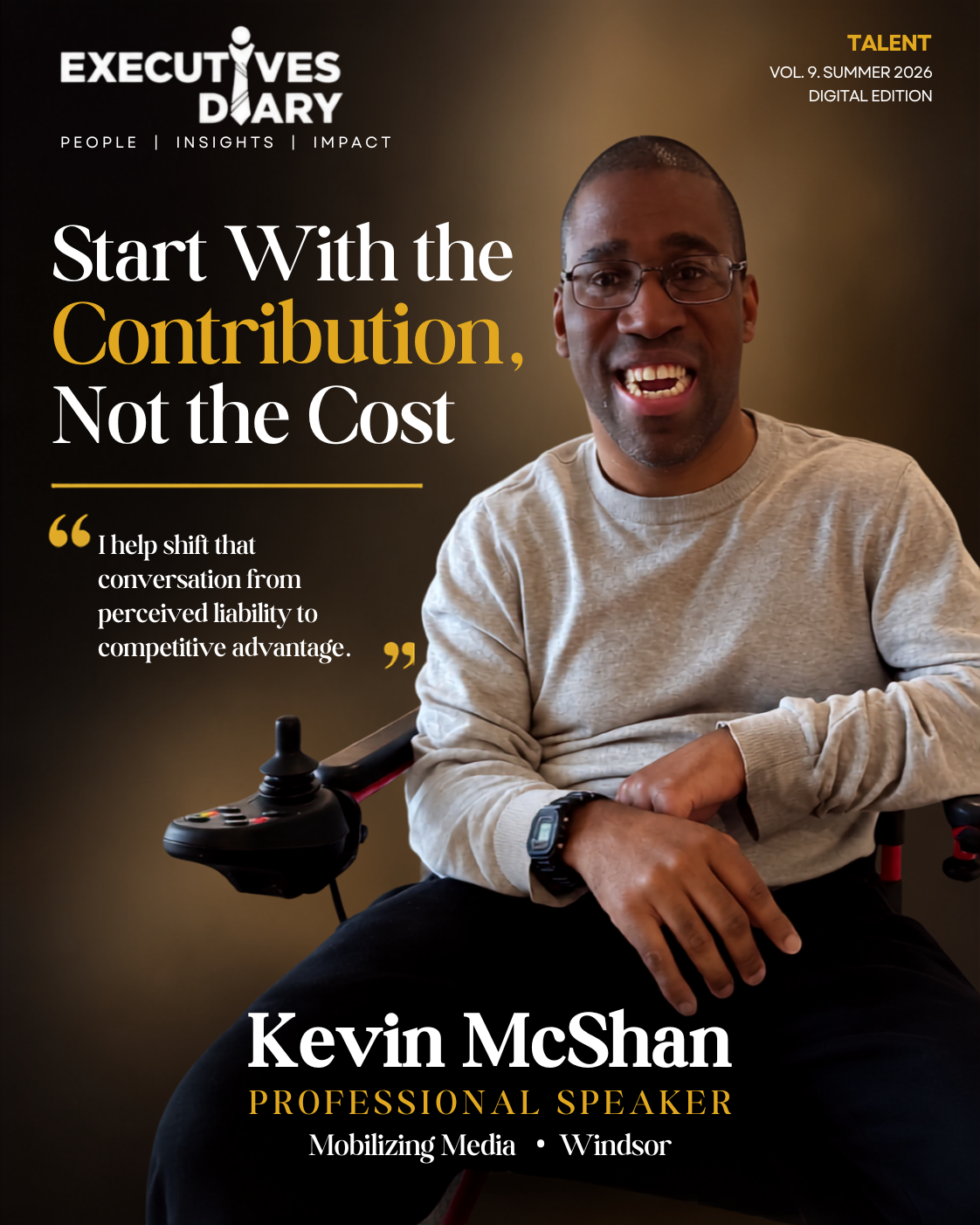
Ten employers turned Kevin McShan down after college. He spent the next decade in boardrooms and government chambers arguing the other side of that decision.
Ten employers said no, and Kevin McShan could name the reason each time. "After college, I spent six and a half years unemployed and faced 10 consecutive rejections while pursuing a career as a sports reporter because employers viewed my cerebral palsy as a liability," he says. A decade later he was the one being invited into hiring conversations, and the question he says leaders put to him first has not changed: where to start, and what it will cost.
Kevin McShan is a professional speaker who runs his practice through Mobilizing Media Innovations, and a 2012 recipient of the Queen’s Diamond Jubilee Medal.
What Employers Miss When They Price the Liability First
McShan’s argument runs in the opposite direction from the one most organizations have been handed. "My experience taught me that the strongest argument for disability inclusion isn’t about what organizations can do for people with disabilities. It’s about recognizing what people with disabilities can contribute to the organization." He did not arrive there through advocacy. He arrived by having the same conversation with employers, one at a time, for the better part of a decade.
The sentence he heard most often came with its arithmetic already done. "We want to hire people with disabilities, but we don’t know where to start, or what it will cost," is how he reports leaders putting it to him, in what he describes as "conversations in government chambers and corporate boardrooms." Cost is the only figure in that sentence. Nothing in it accounts for what the hire brings back, which is where McShan puts the weight: "I help shift that conversation from perceived liability to competitive advantage."
"What initially felt like a barrier ultimately became the foundation for my work helping employers recognize disability inclusion as a strategic business advantage," he says. In 2014, former Ontario MPP Taras Natyshak invited him to speak at a press conference in Toronto on disability inclusion in the workplace, and the appearance led to work alongside a special adviser inside the provincial government on employment opportunities for people with disabilities. "Through those conversations, I recognized an even greater need: employers required practical, localized education that could translate the broader case for disability inclusion into meaningful workplace action."
So he went local and stayed there. From 2016 he worked as a program development facilitator on WEareABLE, an Ontario Trillium Foundation and Assisted Living Southwestern Ontario initiative built to educate Windsor-Essex businesses and hiring managers on employing people with disabilities. From 2018 he partnered with the Ontario Chamber of Commerce as its Discover Ability Network Ambassador for the region, linking local businesses to a job-matching portal for employers and job seekers with disabilities. In 2019 he moved to the YMCA of Southwestern Ontario as a job developer, forming employer relationships and writing accommodation plans for students with disabilities and young adults. Three seats, one job: reach the person holding the requisition and change the calculation they run before they run it.
The shift he argues for is one of category. "When employers make that shift, disability inclusion moves from an obligation to an opportunity, and from simply opening doors to unlocking talent, innovation, and organizational growth."
One Keynote in Oklahoma, One Changed Mind
McShan gave the 2025 keynote at the annual conference of Oklahoma’s chapter of the Association of People Supporting Employment First. A division director at a state human services agency found him after the address. "You really opened my eyes up when it comes to valuing the contributions of people with disabilities and how they can strategically help organizations align their priorities, but also expand the way we look to solve problems and create innovation within organizational culture."
What Hiring Leaders Can Steal From a Decade of Employer Conversations
McShan does not run a program. What came out of those years is a sequence for the conversation itself, three moves in a fixed order, and the order carries most of the load: the business case first, the reasoning behind it second, the screen itself third.
Key Takeaways / Playbook
- 1. Start with the return, not the accommodation: Before an organization discusses schedules, software, physical access, or cost, put the talent and performance case on the table so the accommodation question arrives as logistics rather than as the premise. The Ontario Chamber of Commerce material he worked from as the network’s regional ambassador makes that case in the employer’s own terms: its Discover Ability Network employer resources cite Deloitte research published in 2018 finding inclusive workplaces twice as likely to meet or exceed their financial targets. "Disability inclusion should not be positioned simply as a social responsibility initiative; it should be understood as an investment in talent, organizational performance, and competitive advantage."
- 2. Focus on sustainable reasoning over simple compliance: Then take the reasoning up a level, because a hiring manager told to hire differently will comply for one requisition and revert on the next. "Sustainable inclusion requires more than asking employers to hire differently. Leaders need to understand why disability inclusion is both a sound business decision and a strategic workforce decision. When leaders understand the value behind the decision, inclusion has a greater opportunity to become embedded within organizational culture rather than treated as a stand-alone initiative." The test of whether it landed is whether the practice outlasts the person who introduced it.
- 3. Change what the screen is looking for: Third, change what the screen is looking for. McShan’s motto from those years: "it’s important to focus on the ability of people rather than finding ideal candidates to check boxes or to fit a predetermined standard." Neither a checkbox hire nor a perfect-fit hire has asked what this candidate can do that the current team cannot. In its place he offers a criterion. "People with disabilities are natural problem-solvers who routinely navigate environments not designed for their success, developing adaptability, creativity, and resilience along the way."
McShan’s line for the leader still filing this under compliance: "You’re missing out on an underutilized and untapped segment of our population, which can improve innovation, strategically propel your organization to its highest potential, and you’re missing out on a catalyst of knowledge to make you better as a leader."
Who Is Kevin McShan?
Kevin McShan is a professional speaker based in Windsor, Ontario, who works with organizations on resilience, workplace culture, and disability inclusion through Mobilizing Media Innovations, and a 2012 recipient of the Queen’s Diamond Jubilee Medal for advancing diversity, equity, inclusion, and disability rights in the workforce.
He came to the subject through a newsroom. McShan took a journalism diploma in print and new media at St. Clair College and joined CFTV34 as an assignment reporter in 2010, then spent a year as a multimedia journalist with Community Living Windsor. The medal came out of that period, awarded for the disability advocacy and the reporting on the subject he was doing while still in the program. He has run Mobilizing Media Innovations since 2013 and hosted the 2Man Advantage Podcast, a sports talk show, from 2014 to 2019. Since 2020 he has hosted Let’s Have This Conversation, a YouTube podcast covering news, sport, business, technology, and politics.
The inclusion record he speaks from was built between 2016 and 2019 across three organizations in Windsor-Essex. He was a program development facilitator on WEareABLE; the Ontario Chamber of Commerce’s Discover Ability Network Ambassador for the region, the role he places at the center of the work; and a job developer and enhanced employer support facilitator at the YMCA of Southwestern Ontario. Assisted Living Southwestern Ontario gave him its Influential Advocate Award in 2015 for his reporting and advocacy on the needs of people with disabilities in society and in the workforce, and in 2026 the John McGivney Children’s Centre gave him its Friends of the Centre Award for his work on the full inclusion and participation of children with disabilities in Windsor-Essex.
McShan was born with spastic quadriplegic cerebral palsy. From the years behind a microphone he takes one rule: "never be afraid to push the envelope in pursuing the people you’re most intrigued by, which can help move the needle of progress forward. You don’t know the answer unless you ask." Ten employers once decided what he could not do. The argument he has made ever since is that they were answering the wrong question.