


Dr. Joanna Ritz is a business psychologist, consultant, and entrepreneur whose career spans academic research, behavioral science, corporate HR, and management consulting. Based in Düsseldorf, Germany, she holds a PhD in Work and Organizational Psychology, is a certified Hogan Assessor, and has authored more than 10 peer-reviewed publications. Her career spans research, corporate HR, and senior consulting roles across Europe, with expertise in talent strategy, career development, leadership, people analytics, performance management, and workplace well-being. Few professionals bring such a broad perspective on how expertise is built, careers evolve, and professional value is recognized. Today, Ritz helps experts and organizations turn deep knowledge into something others can understand, recognize, and act upon. Her approach has been shaped by years of research, difficult career decisions, and a willingness to question what professional success is really supposed to look like.
There is a particular kind of professional uncertainty that appears when the life you built begins to look successful from the outside, yet no longer feels right from within. The degree is there. The title is there. The salary may be there. The next promotion seems within reach. And still, something is missing.
For highly educated professionals, that tension can be especially difficult to name. Knowledge becomes identity. Credentials become reassurance. Career progression becomes a sequence of achievements that can be measured, explained and displayed. But what happens when the conventional markers of success no longer answer the more personal question: What do I actually want?
Dr. Joanna Ritz has spent much of her career exploring that question, from academic research into workplace dynamics and employee well-being to corporate HR, management consulting, and eventually entrepreneurship. Her answer is not to abandon expertise, but to understand its value more deeply and to learn how to communicate it.
The Problem Experts Rarely See Coming
The professional world often rewards what it can quickly recognize. A qualification is easy to understand. A job title is easy to understand. A list of skills is easy to understand. Expertise itself is more complicated.
Ritz describes the distinction simply: “People mistake knowledge for expertise. Knowledge is what you know, expertise is what you do with it.”
That difference sits at the heart of her work. Professionals often focus on what they know, their degrees, technical skills, certifications, and years of experience. But employers, clients, and senior leaders need to understand something else: What can this person do with that knowledge? What have they achieved? What problems can they solve?
Ritz compares knowledge to a key. Expertise is using that key to open the door. The challenge can become even greater for people who know a great deal. Ritz has worked with academics whose expertise ranges from cancer diagnostics to workplace discrimination and global politics, yet who struggle to explain the impact of what they do.
Dr. Joanna shares, “Somehow, the more you know the more difficult is to see the depth and value of your expertise.”
For many professionals, particularly academics, PhDs, and women concerned about appearing arrogant, claiming that value can feel uncomfortable. They may know their subject deeply while finding it surprisingly difficult to talk about themselves. Ritz believes the answer is not louder self-promotion. It is better expertise communication.
A Childhood Lesson in Betting on Yourself
Long before Ritz began helping other professionals recognize and communicate the value of their expertise, she was learning what it meant to trust her own potential. At five, she watched her mother build and run businesses. Three years later, she lost her. Life changed abruptly, leaving her and her four siblings to navigate uncertainty and limited financial resources. Yet one belief remained intact: she was capable, intelligent, and there was value in what she could achieve.

Her father reinforced that belief whenever she came to him with another ambitious idea: “I have no doubt you can do it Joanna.” That confidence would follow her far beyond childhood. At 18, Ritz moved to the UK with just £160 to study. She worked, studied, and built an independent life. A few years later, she came close to failing her undergraduate degree, yet still secured a place on an MSc. By 26, she had returned to Poland with three diplomas, expecting her education to lead to the career she had imagined. It didn’t. Unable to find the right professional opportunity, she eventually applied for a PhD, initially almost out of desperation. She was accepted, moved to Brussels, and began what would become one of the most formative periods of her life.
Looking back, the pattern was already there: moments that appeared to signal failure, uncertainty, or a wrong turn often became the ones that opened an entirely different door. Ritz was learning something that would later become central to how she approached careers and expertise: the path that makes sense in hindsight is rarely the path you can see when you are standing at the beginning of it.
When the Career Looks Right but the Life Does Not
By 31, Ritz had built an impressive academic career at the University of Amsterdam Business School, researching workplace dynamics, employee experience, well-being, personality, and performance. Her earlier years at Vrije Universiteit Brussel had given her a strong research foundation through doctoral work, industry collaboration, and international research.
On paper, everything looked right. Then life changed.
Following the birth of her son, Ritz experienced a profound period of postpartum difficulty. Despite having a successful career and family, she was deeply unhappy. She began questioning whether the problem was where she was working. So she left academia.
She moved into people analytics at Sasol, working with HR data and organizational metrics. Later, she joined Boston Consulting Group as a Manager in the People & Organization practice, working across talent, workforce planning, people analytics, performance management, and skill-based organizations.
But the new role did not solve the old problem. “New job, old issues. Still unhappy.” Changing the job had not changed what was underneath.
Ritz was forced to confront a more difficult question: What if the answer was not finding a better job, but rethinking what she wanted her career to give her in the first place?
The Courage to Leave the Safe Path
Ritz’s most transformative professional moments have come from decisions she did not feel ready to make. Leaving academia was one of them. She worried she was walking away too soon, before establishing herself as an expert.

But afterward, she learned something important: credibility does not belong exclusively to one career path.“There are always multiple ways to get what you want. Academic path is not the only way to build credibility.” Leaving people analytics for consulting brought another lesson. She had feared that consulting intensity would consume her life. Instead, she learned that boundaries were possible, and that if something was fundamentally misaligned, she was not trapped. Then came the biggest leap. At 37, Ritz decided to risk it all. At 38, she left BCG and launched her own business. For someone who values stability, entrepreneurship was frightening. Her question was simple: what was the worst that could happen, and what was the best? She realized she had nothing to lose and everything to gain. Even if the business failed, she would learn. She could find another job. The upside was much greater: building something of her own, doing work she was good at, and creating a professional life that actually suited her. Her first paid client came. So did her first invited talk.
There were tears, stress and an enormous learning curve. There was also freedom. She discovered what entrepreneurship could offer when it was designed around the life she wanted rather than around an external definition of success.
“If you don’t bet on yourself, no one else will.”
Turning Expertise Into Something People Can See
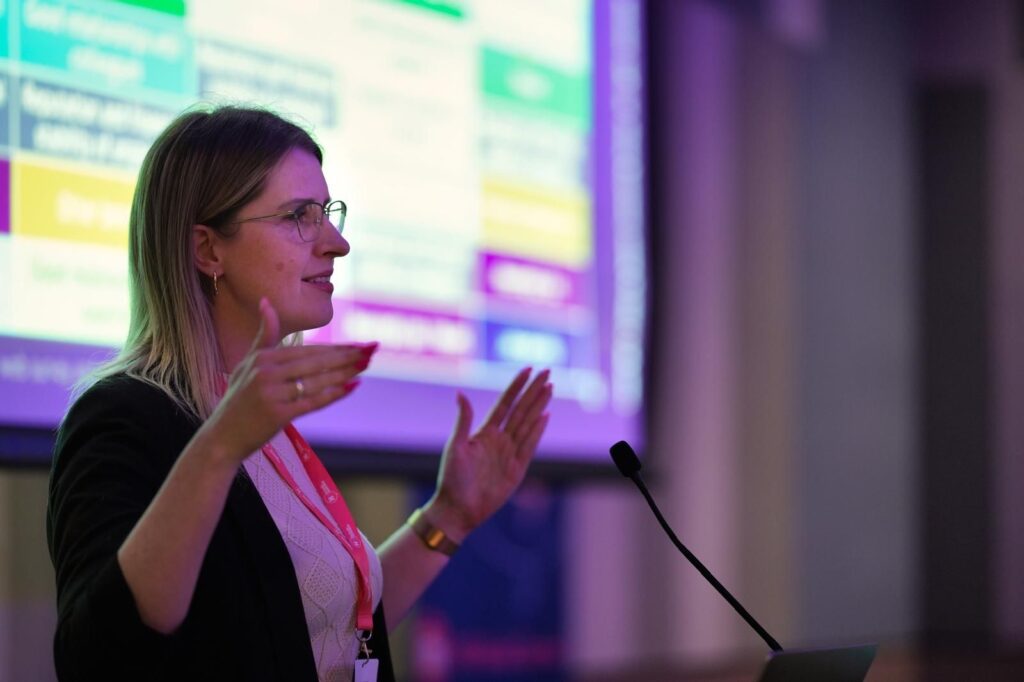
The business Ritz built grew from a problem she had experienced herself: expertise does not automatically create opportunities. Even exceptional knowledge can remain invisible if people cannot see its value. Her work helps experts bridge that gap from positioning and interviews to promotion conversations, networking, LinkedIn, and the transition from specialist to broader leadership. But Ritz takes a different view of personal branding. She does not believe visibility means constantly posting, promoting yourself, or becoming the loudest voice online.
“Your expertise is your brand, whether you see it that way or not.”
For one professional, that might mean speaking publicly. For another, it could mean making sure senior decision-makers understand the impact of their work. The strategy depends on the person, their goals, and what feels authentic. And it starts with something more fundamental than visibility: knowing what your expertise is actually worth, and having the evidence to prove it.
“Concrete evidence is key. Not only to convince others, but also to convince yourself.”
Because sometimes, the biggest barrier to being recognized is not a lack of expertise. It is failing to recognize your own. Discover more here.
Building Careers and Better Talent Systems
What happens when someone has exceptional technical expertise, but the organization has no clear way to turn that expertise into broader impact? That question sits at the heart of Ritz’s organizational work. Her consulting extends beyond individual professionals to companies employing researchers, engineers, data scientists, and other specialists whose expertise must translate into leadership, collaboration, and organizational value. Her work spans career pathways, onboarding, talent strategy, leadership transitions, skills strategy, and development frameworks.

The objective is not simply to retain talented people, but to create conditions where their expertise can be recognized, developed, and put to greater use. Across more than 200 clients and 250 projects globally, Ritz has supported talent, skills, and career development initiatives while developing more than 10 practical tools and frameworks covering talent management, performance assessment, skills strategy, and career architecture.
Her approach challenges a familiar assumption: that technical specialists must step away from their expertise to become influential. Ritz argues that organizations need to recognize nonlinear careers and assess people through the skills, evidence, and contribution they bring, not simply the titles they have held or years spent in a particular field. The real challenge is learning how to recognize its value when it does. Explore more here.
The Quiet Power of Being Seen Clearly
Does being visible at work really mean becoming louder? Ritz believes it does not. There is another misconception she continues to challenge: that professional progression requires becoming loud, aggressive, or performative. A person can communicate achievement without boasting. An introvert can build visibility without becoming a social-media personality. An expert can become influential without turning themselves into a product.
The deeper problem is often internal. People do not always believe, at a fundamental level, that their work has enough value to claim. That is why Ritz places such emphasis on evidence.
A manager who has led a team for ten years, supported more than 20 people, seen 12 promotions among team members, and consistently received positive evaluations has something concrete to communicate. The facts do not require exaggeration. They create confidence. And that confidence changes how a professional enters a meeting, approaches a promotion conversation, applies for a role, or explains their work to someone outside their field.
A Broader Mission for Expertise
The world has never had more ways to make information visible. But visibility is not the same thing as expertise. Ritz’s ambitions reach beyond individual career advancement. She wants more experts, particularly within academia to make valuable knowledge accessible to wider audiences. She sees the research-practice gap not as a failure of individual researchers, but as a systemic problem shaped partly by academic incentives and the publication system.
Publicly funded knowledge, she believes, should have a route into the wider world. At the same time, she is watching another challenge emerge: an environment in which AI can make almost anyone sound authoritative. That makes genuine expertise, scientific evidence, and the ability to distinguish substance from presentation increasingly important.
Her work sits precisely within that tension. How do you make expertise visible without reducing it to performance? How do you help highly knowledgeable people communicate with confidence without asking them to become someone they are not? And how do organizations learn to recognize capability before conventional career labels tell them what they are looking at? These are not merely communication questions. They are questions about how modern careers should work.
Redefining What Success Looks Like
Perhaps the most personal dimension of Ritz’s philosophy is her rejection of a universal definition of success. She questions the script many people inherit: obtain a useful degree, secure a well-paid job, earn promotions and continue moving upward. The problem, she argues, is not that those things are meaningless. It is failing to ask why they matter to the individual.
“What does it matter to you? Why do you need it? What’s going to change once you get it?”
Her own definition continues to evolve. Today, it means enough profit to cover expenses while she continues investing in her business. It means having breakfast and dinner with her family, picking up her son from kindergarten and finishing work at a reasonable time. It even includes a surprisingly specific boundary: she does not want a job requiring a second monitor because, personally, it feels overwhelming.
“If things are set up in a simple (yet effective) way, that’s a success to me.”
A Career Still Being Written
Ritz’s story does not end with entrepreneurship. It is still unfolding through her work as a business psychologist and consultant, her cohort programs, executive coaching, organizational work and continued engagement with research-informed practice. Her trajectory, from a young woman who left Poland with £160, to academic researcher, professor, people analytics specialist, BCG Manager and business owner offers no neat formula for professional success.
Instead, it offers something more useful: permission to reconsider the formula. The woman who once wondered whether leaving academia meant giving up credibility now helps others understand that expertise can travel.
The professional who feared leaving a stable consulting career now builds a business around freedom, boundaries and work she genuinely enjoys. And the psychologist who studies workplace behavior has made her own career a living examination of the same question she asks her clients: What happens when you stop waiting for someone else to recognize your value, and learn how to make it clear yourself?
For Dr. Joanna Ritz, the answer has been a career built not around staying on the safest path, but around repeatedly choosing the path that feels worth taking.
The Dr. Joanna Ritz Playbook: 5 Lessons in Owning Your Career
- Turn Knowledge Into Value: Remember that qualifications and information are only the foundation. Make the impact of your expertise unmistakable.
- Bet on Yourself Before You Feel Ready: Career transformation rarely arrives with complete certainty. Take thoughtful risks, question the safer path, and remember to bet on yourself.
- Make Your Work Visible, Not Your Ego: Professional visibility does not require becoming loud or performative. Build recognition around the expertise, results, and contribution you create.
- Use Evidence to Build Confidence: Replace vague claims with concrete proof of your impact. Evidence does more than convince decision-makers, it helps you recognize your own professional value.
- Define Success Before Chasing It: A bigger title or higher salary means little if it does not support the life you want. Build a career around your own priorities, boundaries, family, freedom, and definition of fulfillment.
Editorial Note
Dr. Joanna Ritz’s journey is ultimately a story about turning expertise into something the world can recognize, and having the courage to define success on your own terms. Through psychology, consulting, research, and entrepreneurship, she continues to help professionals move from being highly capable to being clearly understood, valued, and trusted. Her philosophy is simple but demanding: know your value, communicate it with evidence, and do not wait for someone else to decide what your career can become.