

From the Diary of
Sari Niemi
For the people who design products, spaces and policy: a Helsinki founder who built a place for the phone to rest, and the larger flaw she says it points at.
“What if designers and tech companies turned their knowledge of behavioral and brain science toward our wellbeing instead of using it to keep us hooked?”
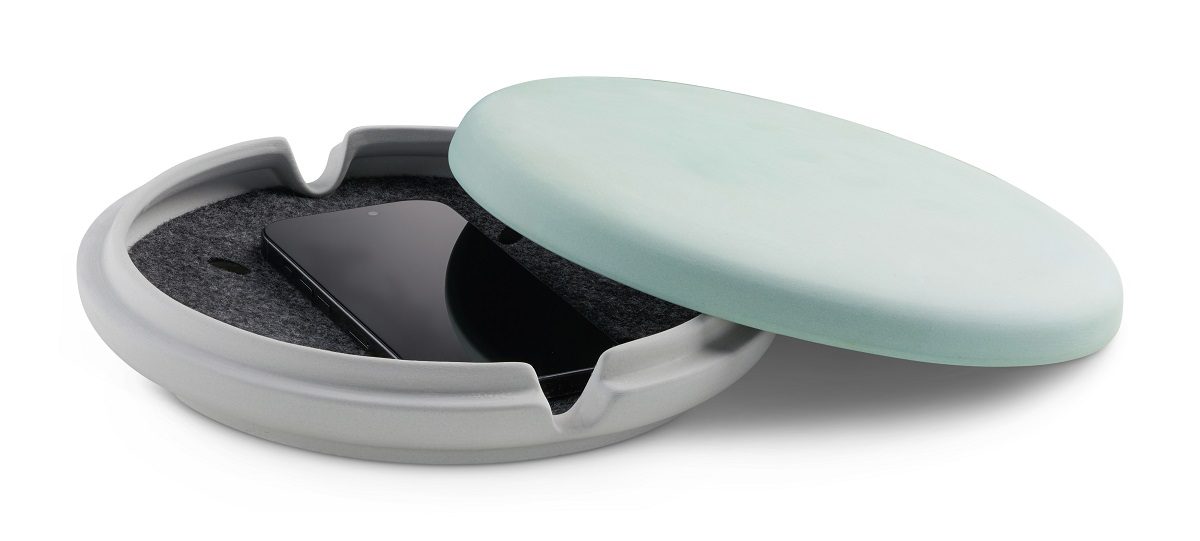
Piilo is a round object, 24 centimeters across and six deep, in matte ceramic and matte lacquered wood. You open it with two hands. Inside there is room for one or two smartphones of any size, and a cable outlet so a phone can charge while it’s out of sight. The base is covered in soft recycled felt. Nothing about it is electronic and nothing about it locks. It is, in Sari Niemi’s words, “just a little hideout for my phone,” designed to build friction between you and your phone.
Sari designed it with Pentagon Design, a Helsinki studio, and launched it in September 2024. It is the object at the center of MindUnwired, her third company, which she describes in one sentence: “MindUnwired is a space to think about us humans with technology, and to build small no-wifi bubbles amidst our lives. Piilo is a design object, a visual reminder of that thinking, a place for your smartphone to rest.”
In her dream city, offline bubbles, both the space and the time, are designed on purpose. She has been building small ones herself: an offline work retreat for solopreneurs in 2025, an offline cafe and a focus workshop for students in January 2026, and, this August, Design Offline with Re-Offline Studio at Helsinki Design Week, three days of asking how we could design our offline space. She keeps phone-free Sundays, is building a monthly newsletter, Quiet Times, about brain health, and is completing a nursing degree with a focus on brain health prevention. What ties it together is an argument, and it isn’t aimed at the person holding the phone. The people she wants reading this are policy makers, designers, founders, urban planners and creatives. Her point to them is that the responsibility for what phones do to our attention has been handed to the user, when a large part of it belongs with the people who design the systems.

A hideout, not a lock
Piilo came out of a period Sari describes plainly: burnout, followed by serious health challenges, and a long recovery. During that recovery she read Johann Hari’s Stolen Focus and found that Hari, too, was hiding his phone to get some peace, in a plastic box. That was the part she didn’t want to copy.
“I didn’t want plastic, electronics, locks, or anything that worked through forbidding,” she says. “I believe lasting rituals can’t be built on prohibition.” So the brief was something tactile and visually pleasing, with no electronics: a place the phone goes, rather than a thing that keeps you from it.
The design choices follow from that. The form is rounded so it doesn’t call a screen to mind. The ceramic and wood are chosen as grounding materials, and the felt is there to protect the phone, not to punish it. A second version, Piilo 2.0, took her through what she called, in the post announcing it, “my own version of an MBA.” She credited a long list of people in that post, and has since named the ones who stayed closest. “Since nothing builds in a vacuum, a coach and learning designer, Camilla Havanka, has been by my side throughout the Piilo and MindUnwired journey: our conversations have challenged me and pushed things forward. Alongside her, two communities, Like Hearted Leaders and Happy Startup School, gave me like-minded people and a safe space to think and learn. And Piilo would not be here without Do Wales 2023.”
What people want, and what is good for them
Sari’s argument starts with a habit she sees in the industry: treating all user insight as good insight. If people want something, it’s fine to build, especially if it’s profitable. She thinks that misses how we are made. Our brains evolved for survival and energy conservation, she says, not for the environment we now live in, and so we also want things that are easy, dopamine-driven and sometimes harmful. “Wanting something isn’t the same as it being good for us as humans.”
Not every user insight deserves to be built. People want what’s easy, that doesn’t make it good for them.
She trained as an anthropologist (Master of Arts, Jyväskylä University, Finland), and while Piilo was in development she interviewed people about their lives with the digital world. One of them, a 22-year-old man, described the problem this way: “I know that social media weakens my mental health and my self-image and takes my time. What I’ve come to terms with more recently is how I never seem to do random nice things, those little projects I could’ve done instead of doom-scrolling… It’s easier to open the phone… I have not yet saved myself from this.”
Her nursing thesis went at the same question from the other side: a literature review of how digital media multitasking affects the brain. The findings, she says, pointed to real harm, particularly in developing brains, and a clear link to executive function, attention, impulse control and working memory, “though causality isn’t yet settled and we still don’t know who is most vulnerable to these effects.” She keeps the qualifier in. The conclusion she draws is not that the science is finished, but that the problem is bigger than any one person’s willpower.
The flights stopped
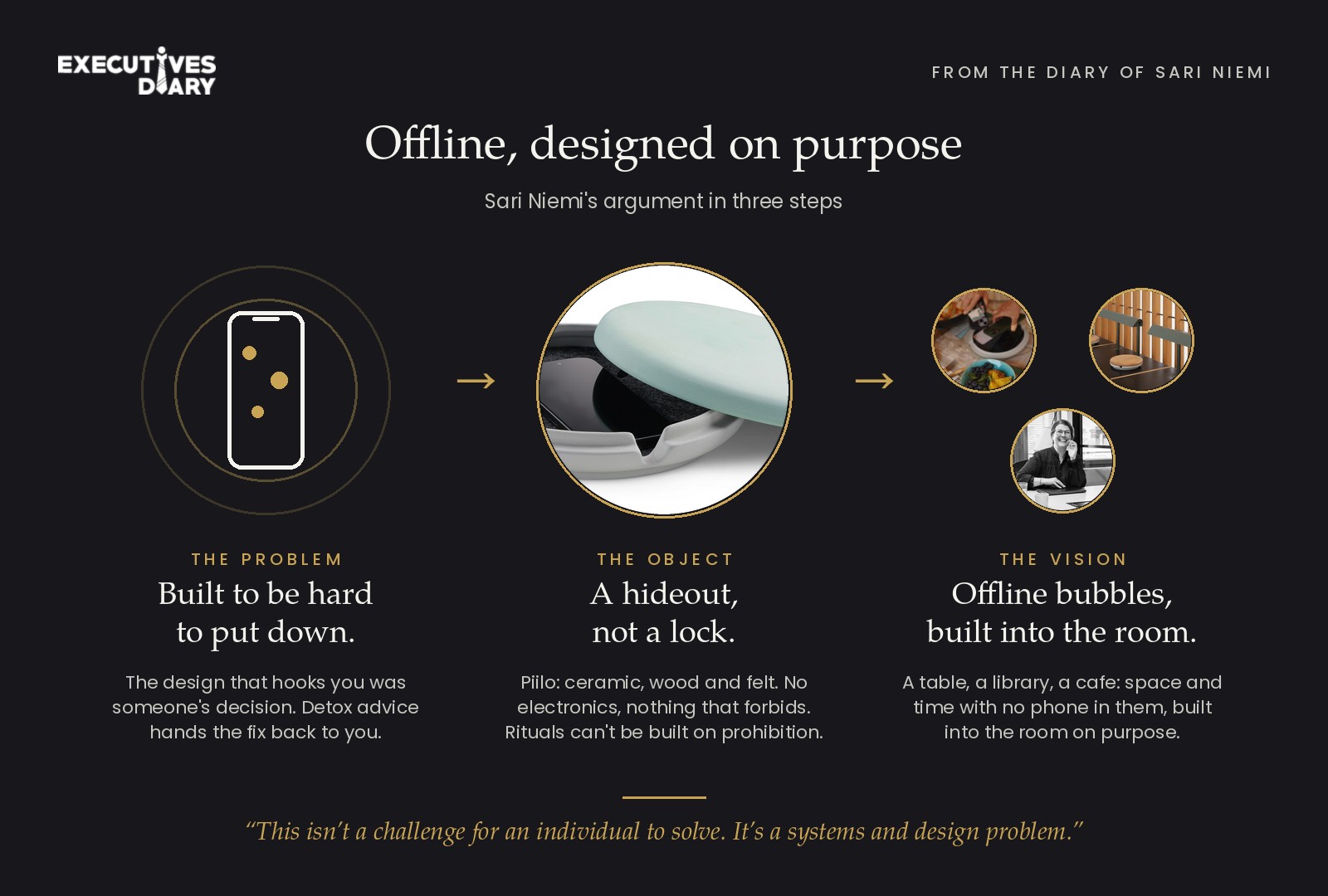
That is where the argument turns from the individual to the system. “The more I have studied the challenges we face in a digitalized environment, the clearer it has become,” she says. “This isn’t a challenge for an individual to solve. It’s a systems and design problem.” Weeklong digital detoxes and morning protocols, in her view, don’t reach it.
No one thought before COVID that flights could simply stop. Then a crisis forced it, and it turned out to be possible.
The pattern she wants noticed is that we treat things as immovable until we’re forced to move them. Some of the moving has already begun. In Finland, the Basic Education Act was amended so that phones and other mobile devices are, as a rule, prohibited during lessons, with exceptions only for learning or health reasons with a teacher’s permission, and the change took effect in August 2025. In November 2025 the European Parliament voted 483 to 92 for a report calling for an EU-wide minimum age of 16 for social media and for action against addictive design features such as infinite scrolling and autoplay. Then, on 17 September 2026, the European Commission adopted its proposal for the EU KIDS Act, which would reverse the burden of proof so that platforms have to show their services are safe by design, and would restrict addictive design features and the age at which a child can hold an account. None of it is law yet. It is, in Sari’s terms, a question being asked at the level where it can be answered.
She has made the same point about the language we use. Writing about a Helsingin Sanomat piece in which the cognitive scientist Anna-Mari Wallenberg criticized a discourse that always puts the responsibility on the person using the device, Sari set out her objection to the whole frame: “We’re told how to avoid getting hooked on phones that are designed to be addictive. We’re instructed on the pitfalls of AI, and the responsibility is shifted entirely to the user. It’s said the fault isn’t with the devices, but with how we use them. That’s not human-centered. That’s something-else-centered, with us as the resource.”
“Digital detox puts the problem on you,” she says. “I think the problem is bigger than that.” The question she keeps returning to is the one she would put to anyone building a product, a space or a policy: “Why not design technology so those detox exits aren’t needed in the first place?” It needs collective effort, she says, because “individuals, especially kids, young people and parents, can’t solve this alone.”
Why not design technology so those detox exits aren’t needed in the first place?
Three companies, then a full stop
Sari has built things for a living for most of her adult life. Her first company, Food Culture Pukkila, designed and organized concerts, art exhibitions and other cultural events. Her second, Evenio, she founded during her time in Warsaw, designing and organizing educational meetings for the pharmaceutical industry across Europe. She sold it in 2020. Beside those, she worked in a family company and organized the relocations of a family to different countries.
What came next is listed on her profile in four words: “Burnout. Covid. Heart. Recovery.” She gives it a little more room in her own account. “My body stopped after I ignored the warning signs,” she says. The recovery happened in quiet, and in the mountains, on long walks without headphones and without a phone. “Presence returned, then reflection, then focus, then finally creativity.”
Two things came out of that season. One was the object. The other was a decision to study the brain she had just been reminded she has, which is how a founder of event companies came to be finishing a nursing degree in brain health prevention while building her third. It has always been about understanding people: anthropology, events, brain health prevention.
Seasons, and a Sunday with the phone off
The recovery also gave her a way of working. “From that, I learned to design my life in seasons following my energy rather than fighting it,” she says: seasons for creativity and thinking, seasons for writing and producing, seasons for social visibility, and the ongoing work of balancing exploration and research against producing things. She has written about the same idea for people who feel they fail at consistency. “Some of my best thinking has happened in weeks that looked completely unproductive from the outside,” she wrote. “The off days aren’t broken. They’re part of it.”
She doesn’t pretend the chaos is easy. “I have always had many things cooking at the same time and moments of focus can sometimes disappear and I get tired and lose clarity,” she wrote in another post. “But it is in the chaos that the best ideas and solutions are born, and I find unexpected connections.” Taking them forward, she added, needs more controlled routines and focus. Piilo, as she puts it, exists because of both.
The routine most people would recognize as hers is MindUnwired Sundays: the phone off for the day, the hours given to tactile things, working with her hands, walking, reading and company. “Not always easy, but I keep coming back to it,” she says. “One revelation: there are so many hours in a day!” Her summer version of the same rule, from a post about kayaking, is shorter: some days she paddles hard, some days she just floats, and both count.
One revelation: there are so many hours in a day!
Where Sari Is Now
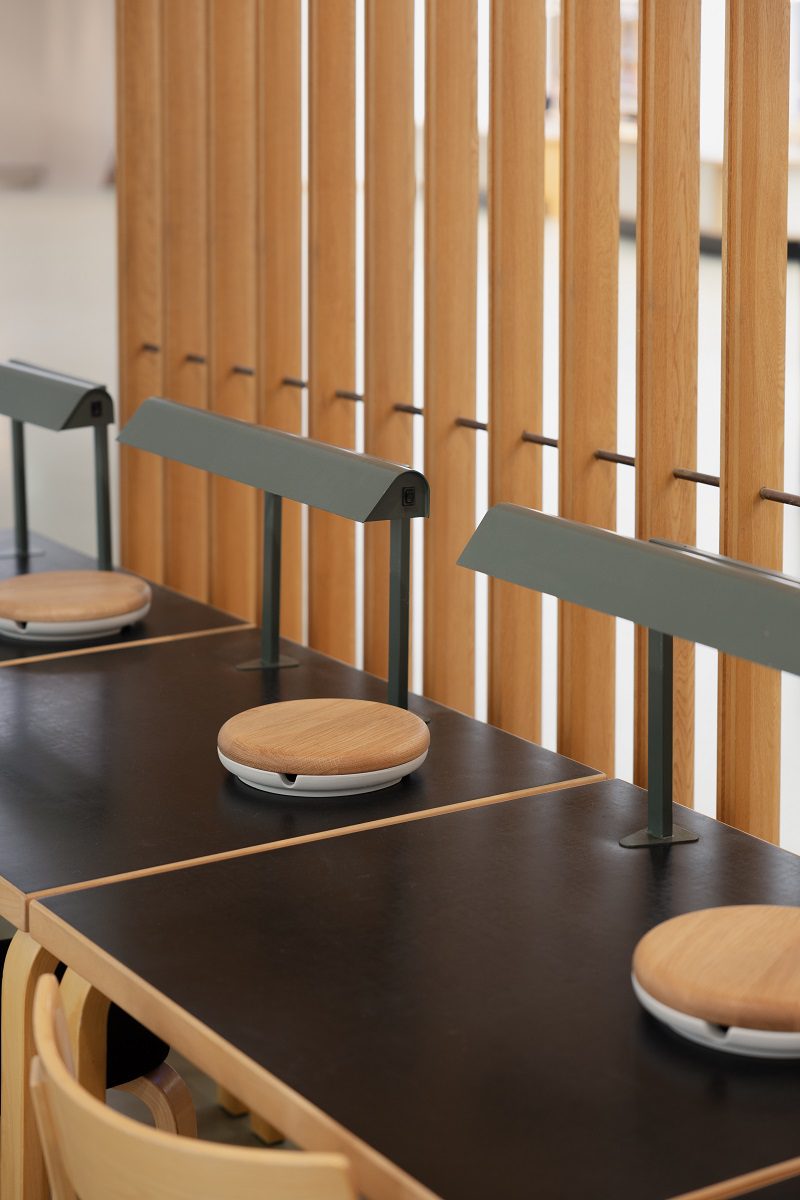
This year the work has moved from the object to the room, and to working out how best to communicate what the brain health research shows and how to cooperate with like-minded people. Design Offline, the exhibition she created with Re-Offline Studio for Helsinki Design Week, ran for three days at the end of August: an opening, an open studio to think and discuss how to design offline and to participate in offline activities together with others. Before that came smaller bubbles: Write and Chat, a Sunday at a Helsinki cafe with the writer Mathias Rosenlund where the rule was no phones for two hours; a Focus workshop for students and solopreneurs with Päivi Kettunen in Helsinki; and a Brainspace pilot for solopreneurs in the mountains in Italy. It has moved to dinner tables too, dinners she hosts for family and friends. “Sometimes, being offline is easier when done together with a playbook,” she wrote afterwards. “This way, the decision is outsourced, and there’s no need to think about it.”
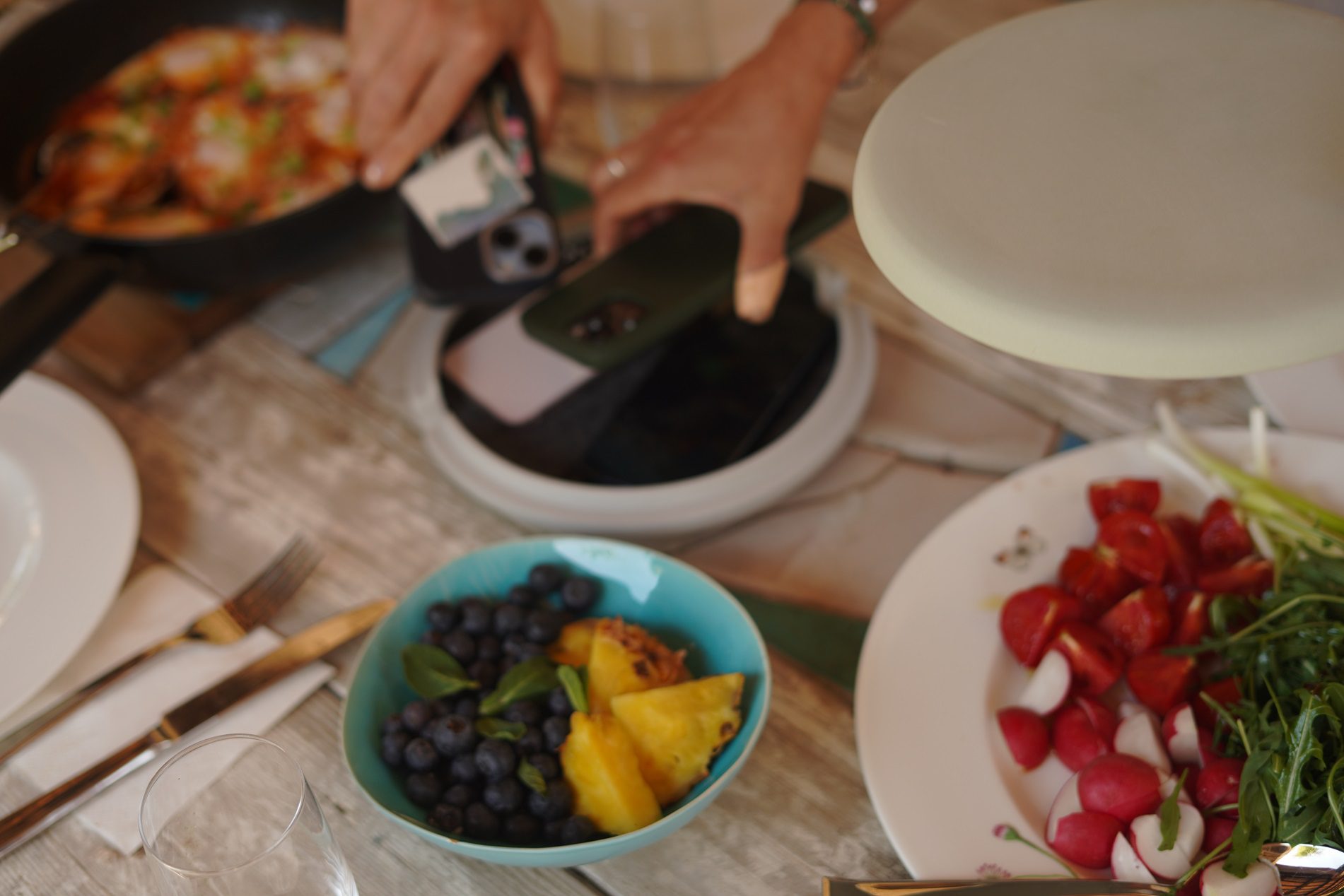
Piilo 2.0 is finished and shipping, and the reports she gets back are about rituals rather than screen time. One young owner told her: “We have Piilo on our kitchen table and when we have friends coming over, we hide our phones, it’s like a ritual, and it’s friends time, no phones.” Quiet Times, a newsletter she is building under MindUnwired, is planned to launch monthly from October 2026.
What’s next, in her words: “Designing little offline bubbles for 2027 (organising small gatherings and producing lectures, holding spaces for thinking and connection).” The people she wants in those rooms are everyone. It is, she says, “very important that the knowledge about the topic doesn’t stay with the specialist, but reaches the people too.” The people she wants reading this are the ones deciding what gets built: the designers, founders, planners and policy people whose choices decide whether an exit from the screen has to be improvised by each of us, or is simply there.
And the fieldwork continues where it always has. “Train rides are my offline bubbles. Poor wifi, nowhere to be till the next stop. I write there. And I observe, how people sit and talk and work. Old habit, really. I’m an anthropologist by training and never stopped being one, just changed what I’m looking at. Traveling is my fieldwork. It’s how I notice what’s actually going on in people’s lives with technology, before any of it becomes research or a product.”
MindUnwired isn’t really about the object. It’s the space that lets her say what she’s observing and what the research shows. She isn’t loud about it. She does the work quietly, one conversation and one small offline bubble at a time, gathering people’s experiences through interviews and carrying the research back to them, in her workshops and in her writing.
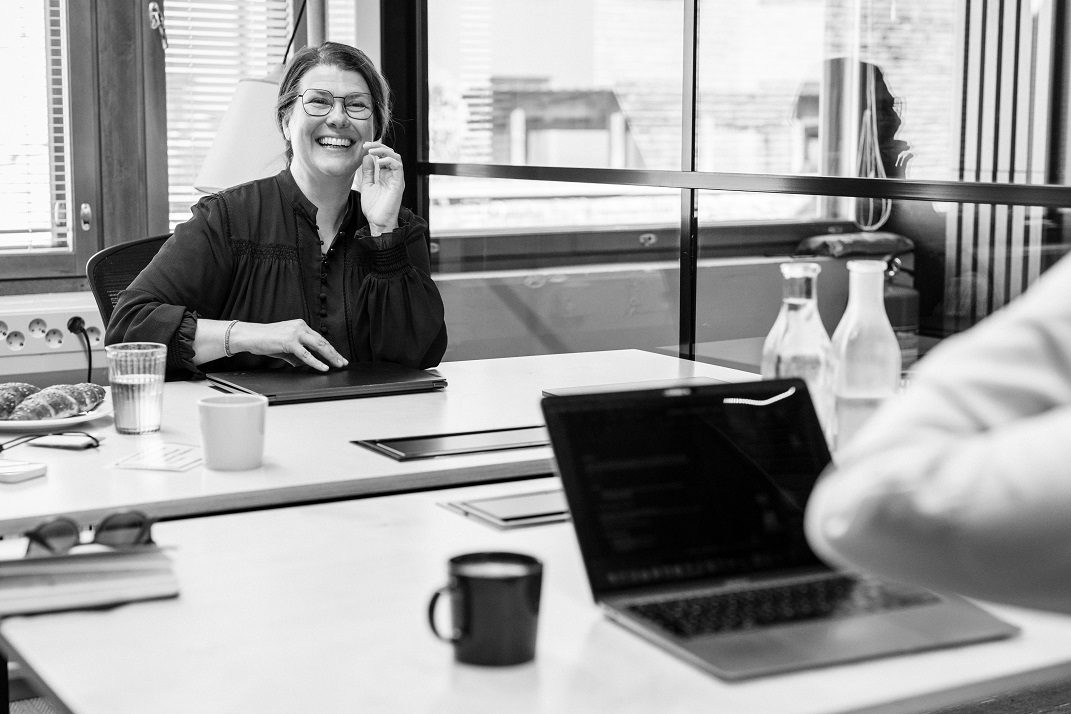
She has called it a quiet rebellion. It is a ceramic bowl on a kitchen table, a cafe with the phones away, a wall people write on. The rebellion is in the question underneath, and she has already answered it for herself: “I think we deserve better. And I think it’s time we expect it and start building it.”
Five Lines from Sari’s Diary
- “Digital detox puts the problem on you. I think the problem is bigger than that.”
- “Wanting something isn’t the same as it being good for us as humans.”
- “The off days aren’t broken. They’re part of it.”
- “One revelation: there are so many hours in a day!”
- “Traveling is my fieldwork.”
