
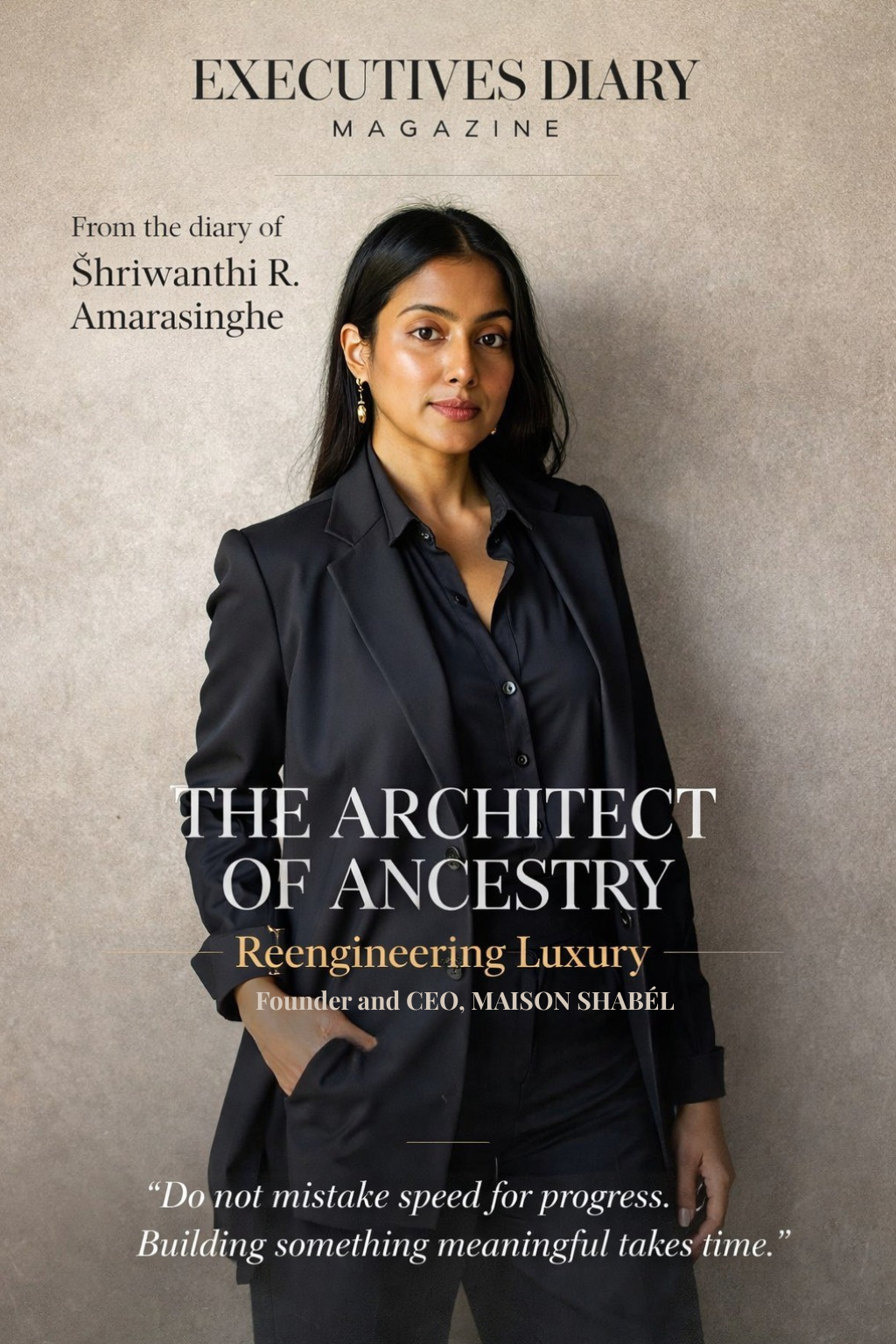
Who is Śhrīwanthi R. Amarasinghe?
Śhrīwanthi R. Amarasinghe (known as Śhrī) is an impact entrepreneur, designer, and the Founder and CEO of MAISON SHABÉL, a luxury design house that bridges the gap between traditional Sri Lankan craftsmanship and the global high-end market. Formerly a software engineer with an Honors degree from the University of Wales, Śhrī spent 20 years in the technology sector before pivoting to luxury stewardship. Today, she utilizes her technical background to “reengineer” the artisan ecosystem, implementing modern systems like Digital Product Passports to provide radical transparency and traceability for handwoven textiles and heritage crafts. Recognized within the La French Tech ecosystem, she is a leading advocate for the “High-Tech, High-Touch” philosophy, focusing on sustainable micro-production and the preservation of ancestral wisdom in a modern, digital world.
The Weight of the Journey
There is a specific kind of silence found in the transition between a high-stakes trade show in Paris and the solitary commute home. For Śhrīwanthi R. Amarasinghe—known simply as Śhrī—that moment often materialized on the Paris Metro. Sitting among commuters, she would find herself clutching two 30-kilogram suitcases, her hands numb from the literal weight of her craft, and her eyes occasionally welling with tears. In those moments, the distance between the silicon-valley-style precision of her former life as a software engineer and the gritty reality of an impact entrepreneur felt immeasurable. Yet, it was in that exhaustion that her purpose crystallized.
“I believe that when you are fortunate enough to have more opportunities than many others, it comes with a responsibility,” Śhrī reflects. “A responsibility not only to build something meaningful, but to create more opportunities for others along the way.“
This realization transformed her struggle from a personal burden into a professional mission. Today, as the Founder and CEO of SHABÉL PARIS, Śhrī is not just selling textiles; she is reengineering the very infrastructure of luxury by bridging the gap between ancient Sri Lankan artisan wisdom and the exacting demands of the modern global market.
The Professional Pillars
Logic Meets Legacy
Śhrī’s journey did not begin at a loom, but at a computer terminal. Graduating with Honors in Computer Science, specialising in Software Engineering from the University of Wales, UK, she built a formidable foundation in logic, systems, and scalability. This early chapter of her life was defined by the binary—clear structures, efficient code, and the rapid pace of the tech sector.
However, beneath the technical rigor lay a deep-seated connection to her Sri Lankan heritage. Growing up influenced by a culture rich in artistry, she recognized a disconnect between the “fast” world of technology and the “slow” world of traditional craft. This duality became her unique advantage. While many see fashion and tech as disparate industries, Śhrī saw them as two sides of a single coin: both require intricate systems to function, but only one possessed a “soul” that could not be replicated by an algorithm. Her education provided the tools; her ancestry provided the heart.
The “Expensive MBA” of Resilience
The path to SHABÉL PARIS was not a linear climb, but a series of pivots—seven, to be exact. Transitioning from a successful 20-year career in technology into the unpredictable world of luxury design required more than just creative vision; it required a skin thickened by real-world trials. Early in her entrepreneurial journey, Śhrī faced a devastating setback following a financial dispute involving a former manager she had hired to oversee her team in Sri Lanka, which resulted in the loss of her life savings.
Rather than allowing the experience to embitter her, she reframed it with the analytical clarity of an engineer.
“I now think of it as a very expensive, real-life MBA,” she says.
“It taught me lessons about due diligence, boundaries, and financial discipline that no classroom could have offered.“
This “ascent” was marked by a mastery of the “No.” She learned that in the pursuit of a vision, politeness cannot supersede purpose. By reclaiming her focus and integrating into the prestigious La French Tech ecosystem, she began to build a bridge between Paris and Sri Lanka. Through collaborations with the Foundry Powered by IFA Paris, she matured from a designer into a “steward” of an ecosystem, leading with the realization that leadership in craft is less about directing and more about creating the conditions where mastery can thrive.
Stewardship Over Direction
At the core of Śhrī’s impact is SHABÉL PARIS, a design house that functions as a sourcing partner for textiles, objects, and crafted environments. Her business is formally registered in Paris, France as La Maison Shabel, with SHABÉL PARIS established as a trademarked brand, reflecting her commitment to building a globally recognised platform for Sri Lankan craftsmanship. Her methodology is built on three pillars: Preservation, Collaboration, and Intelligent Systems. She has moved away from the traditional top-down corporate structure in favor of a “micro-production cluster” model. By working with specialized artisans—from handloom weavers to lace makers—she ensures that the rhythm of the craft is respected.
“A loom does not care about next-day delivery,” she notes.
“Craft exists in a slower register, one that sits slightly outside the tempo of modern life.“
Her impact is recognized by peers and collaborators alike, who describe her as a leader who brings together technology, design, and craftsmanship with remarkable attention to detail. By implementing “Digital Product Passports,” Śhrī is now using her tech background to provide radical transparency, allowing high-net-worth clients to trace an object’s journey from raw material to finished heirloom.
A New Register of Luxury
Looking ahead, Śhrīwanthi R. Amarasinghe is not interested in mere volume. Her vision is to prove that the future of luxury lies in the “human dimension”—the subtle irregularities of a handwoven fabric that no machine can mimic. She is building a legacy where Sri Lankan craft is not viewed as a relic of the past, but as a living, evolving practice that commands its rightful place on the world stage.
Her advice to the next generation of conscious entrepreneurs is a reflection of her own hard-won wisdom: “Do not mistake speed for progress. Building something meaningful takes time. In the luxury market especially, depth matters far more than scale.“
Through SHABÉL PARIS and her label ŚHRĪ, she continues to advocate for a world where “nothing is more unfashionable than waste.” Her journey remains an inspiring testament to the power of alignment—the belief that when your foundation is genuine, your growth becomes resilient.
Editorial Note
Śhrīwanthi R. Amarasinghe’s story is a masterclass in the “High-Tech, High-Touch” philosophy. Her transition from engineering to artisanal stewardship reminds us that the most powerful innovations are often those that protect what is irreplaceable. As she continues to bridge the gap between tradition and technology, she invites us all to slow down, listen to the “heartbeat” of our work, and build with intention.