The reason your hiring keeps failing has nothing to do with the hire. It starts long before the job post goes live.
The Sunday Night Problem
Why Christy Johnston Believes Loving Your People Is the Primary Strategy That WorksIt is 6:47 on a Sunday evening. The dishes are done. The kids are in bed. The week ahead sits on the chest like a stone. Not because anything dramatic happened. Not because a crisis is coming. Just because tomorrow is Monday, and Monday means going back to a place where nobody notices if you are having the worst week of your life. A place where your name appears on a spreadsheet under “headcount” and your ideas disappear into a room that was never really listening. A place that takes forty hours a week and gives back a paycheck and not much else.
Millions of people live inside that feeling every single week. They show up. They do enough. They wait for Friday. And the organizations they work for wonder why performance plateaus, why good people leave, and why no amount of hiring seems to fix the problem that keeps coming back. The answer has been sitting in plain sight the whole time. Most leaders just were not trained to see it, much less know how to do something about it.
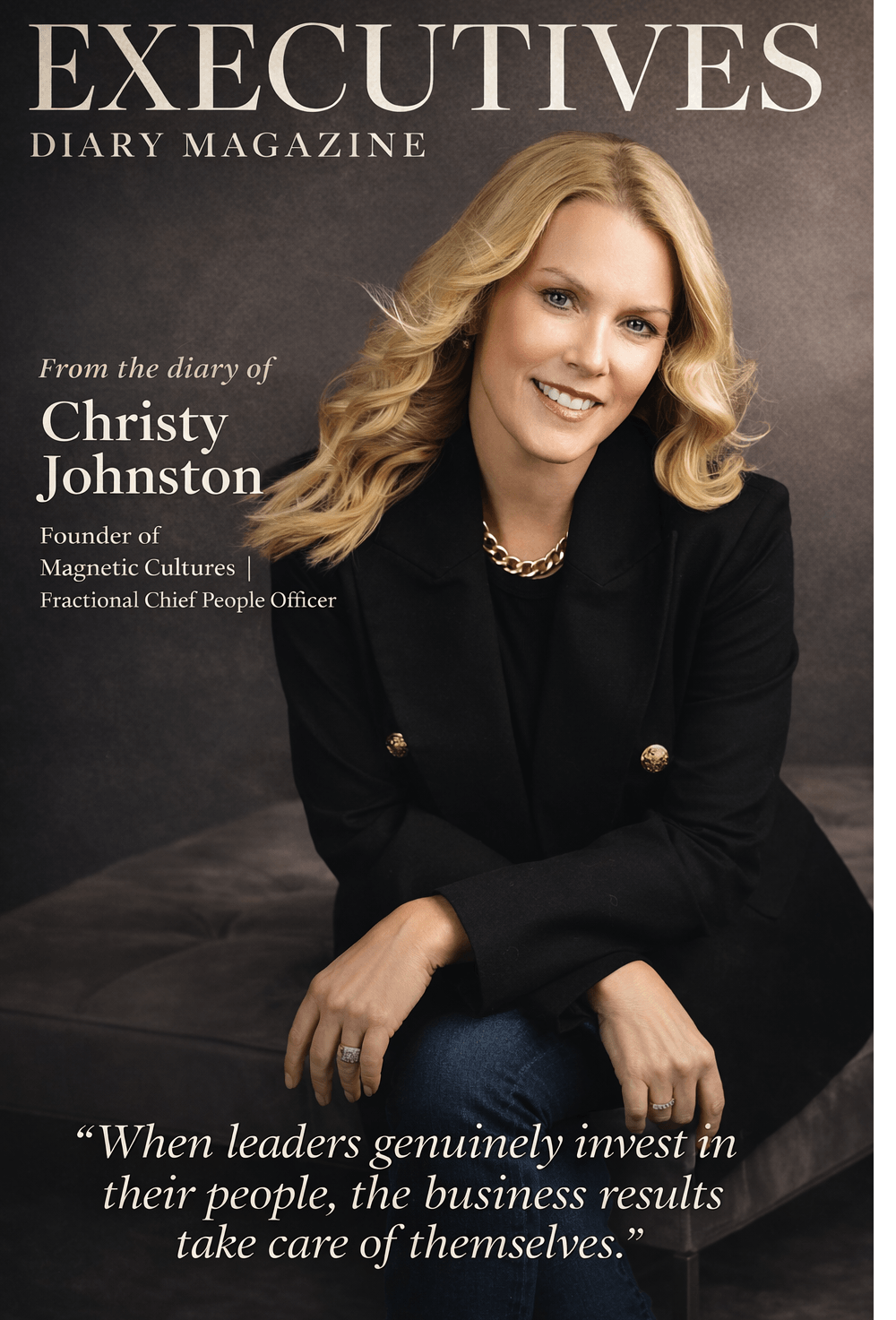
Christy Johnston has spent her entire career seeing exactly that. She is the founder of Magnetic Cultures, a consultancy based in Omaha, Nebraska, built on one foundational belief: when leaders genuinely invest in their people, the business results take care of themselves. As a Fractional Chief People Officer, speaker, coach, and consultant, Johnston works with business leaders who are tired of losing good people and ready to understand why it keeps happening. She does not sell motivation. She delivers a framework. And it works.
The Path to People Strategy
The path that built Johnston did not begin in a boardroom. It began in the world of wellness and human connection, which, in retrospect, makes complete sense. She earned her Bachelor of Arts in Communications and Speech from Graceland University, then went further, completing a Master of Science in Health Promotion with an emphasis in Human Resource Management from Nebraska Methodist College. While there, she served as president of the SHRM student chapter, an early signal that she was not just studying people as a concept. She was already organizing around them.
Her early career moved through recruiting at Aureus Medical Group and marketing at the Wellness Councils of America before she landed at Medical Solutions in 2005. What followed was nearly 17 years inside one of the fastest-growing companies in the healthcare staffing industry. She started as a career consultant, moved into sales management, and by 2009 had been appointed Chief People Officer, a role she held for nine years before stepping into a Senior Director position focused on culture and engagement.
Those years were not easy. They were instructive. She led through recession and rapid growth cycles. She navigated layoffs without losing her sense of what mattered. She built people systems from the inside of an organization that was scaling fast, where the pressure to prioritize numbers over humans was constant and real. She resisted that pressure, not out of stubbornness, but out of conviction. The metrics, she believed, would come. They always came when the people were treated right.
By 2022, she had seen enough from the inside to understand what was broken on the outside. Friends. Family. Colleagues outside her orbit. People she loved spending their Sunday evenings dreading the week ahead. People who were giving their best hours to organizations that returned nothing but a direct deposit. That was the moment. Not a dramatic exit. Not a crisis. Just a clear-eyed recognition that the framework she had spent two decades building could reach further if she stepped outside the walls that had contained it. Magnetic Cultures was born.
Organizational Architecture
Today, Johnston operates at the intersection of people strategy and business performance, and she is precise about what that means. “A Fractional CPO is a strategic partner to the business,” she explains. “Someone who steps in at a senior level to help align people, leadership, and culture with where the business is going.”
That distinction matters to her deeply. She is not describing HR administration. She is describing something closer to organizational architecture. The companies she works with are often growing, often stretched, and often carrying a quiet suspicion that something in their culture is off without being able to name it exactly. Johnston names it. Then she helps fix it.
Her philosophy is direct and, to some executives, counterintuitive. “By investing in talent and engaging them through effective leadership, positive experiences, growth opportunities, and feeling valued, they will in turn perform well and impact business outcomes,” she says. “The metrics become a byproduct of doing things the right way.” That word, byproduct, is one she returns to often. It is not accidental. It is the core argument. Stop chasing the number directly. Invest in the conditions that produce the number. Trust that the people, when genuinely supported, will handle the rest.
She backs this belief with evidence. Google’s Project Aristotle, which analyzed 180 teams, found that the single greatest driver of high performance was not talent or experience. It was psychological safety. Teams operating in environments where people felt safe to speak up and contribute without fear were 2.5 times more likely to be high-performing and 76 percent more engaged. Johnston does not cite this research as decoration. She builds her client work around it.
The Bedrock of Identity
When asked about the biggest mistake leaders make in hiring and retention, she does not hesitate. “Having the right people in the right seats is the biggest mistake I see leaders make today. They don’t always have a clear and full picture of what the role and culture call for.” The hiring problem, she argues, rarely starts with the hire. It starts with a lack of clarity about what the role actually requires and what kind of person the culture will allow to thrive. Then onboarding falls short. Development gets skipped. The person who was supposed to solve a problem quietly disengages instead.
Her faith grounds all of it. When asked what personal value sits at the bedrock of her identity, she does not reach for a professional answer. “I’m a faith-based person who genuinely cares about others,” she says simply. “It’s not about ego. It’s about impact.” That answer explains a lot about how she moves through her work. She is not building a personal brand. She is trying to solve a problem she has watched hurt real people for a very long time.
Johnston’s 5 Lessons for Leaders
- 1. Love Is a Strategy, Not a Sentiment. Psychological safety produces measurable performance gains, and leaders who treat care as soft are leaving real results on the table.
- 2. Clarity Before Hiring. Before posting a role, understand exactly what the position demands and what your culture requires, because a misaligned hire costs far more than a careful search.
- 3. Onboarding Is Not Paperwork. The experience a new employee has in their first 90 days sets the trajectory of their entire tenure, and most organizations underinvest there at enormous cost.
- 4. Culture shows best in the fire. It’s always there, but is highlighted when times are tough. It is visible when pressure is high, deadlines are tight, and things are not going as planned.
- 5. Metrics Follow People. Stop chasing numbers directly. Invest in the conditions that allow people to perform at their best, and the results follow as a natural consequence.
Think back to that Sunday evening. The stone on the chest. The dread of Monday morning arriving whether you are ready or not. Christy Johnston did not build Magnetic Cultures because she read a market report. She built it because she sat across from people she loved and watched that feeling live in their faces week after week. She knew what was causing it. She knew what could fix it. And she knew that fixing it was not soft or sentimental. It was strategic, measurable, and long overdue.
“I want people to know that business is comprised of people,” she says. “We all have a place and want to feel valued and that we matter. Because we do. It’s important for business leaders to understand that it’s very possible to create a win-win situation by treating employees right and seeing very positive business outcomes. It doesn’t need to be a choice of one over the other.”
The Sunday night problem is solvable. It has always been solvable. It just requires a leader willing to start with the people instead of the numbers, and to trust that everything else follows from there.