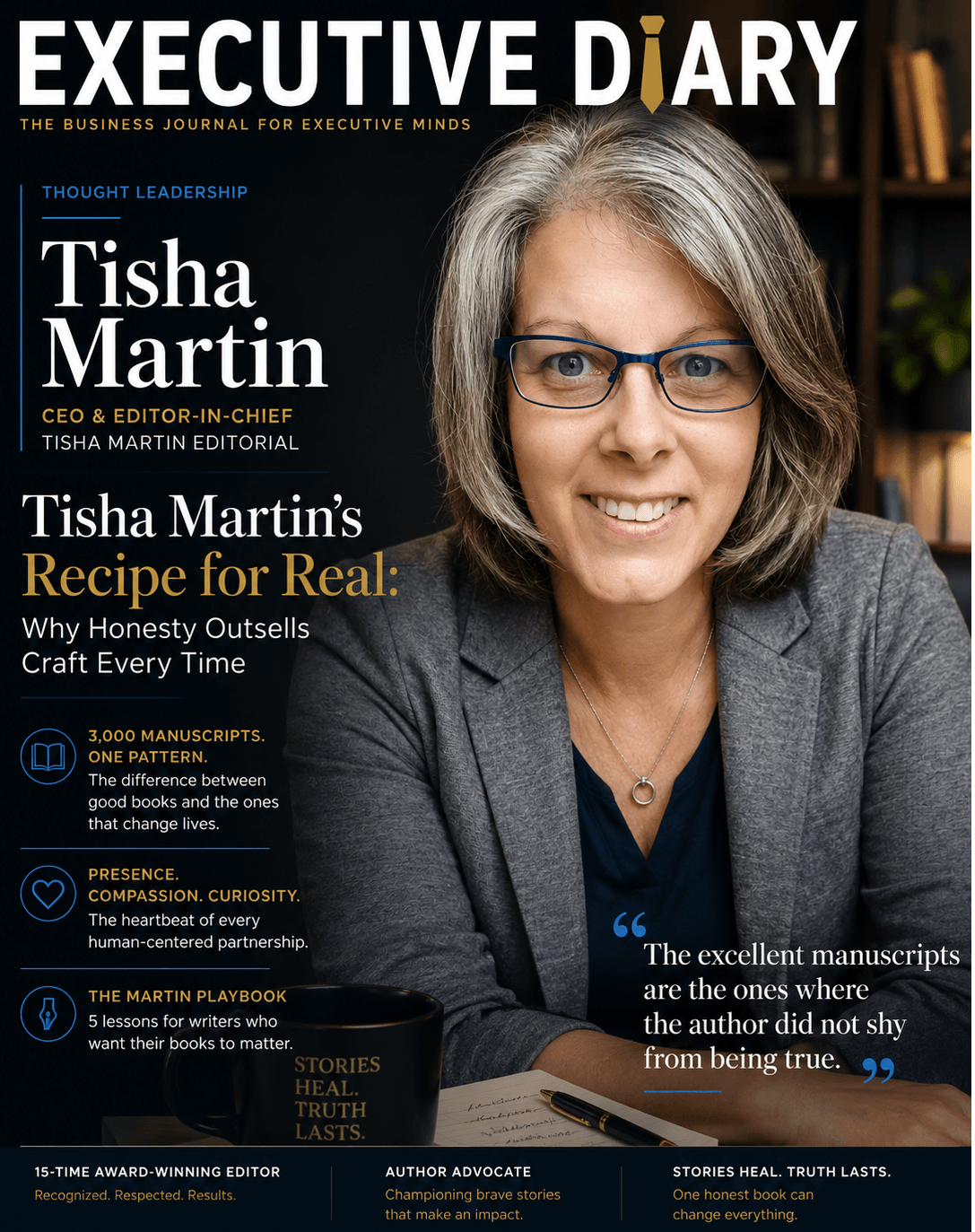
Tisha Martin’s Recipe for Real
Why Honesty Outsells Craft Every TimeA writer sits at her desk on a Tuesday morning. The manuscript has been revised seven times. The structure is tight. The sentences are clean. The grammar is flawless. She reads the opening paragraph and feels nothing. A small, honest voice asks: Did I hold back?
She did. And she knows it.
She’ll throw it away later. The craft was perfect. The truth was missing. No reader will ever care how beautiful a sentence is if the person writing it was too afraid to be vulnerable on the page.
This is the problem Tisha Martin sees more than three thousand times over.
Meet Tisha Martin
She is the CEO of Tisha Martin Editorial and a 15-time award-winning editor who has evaluated over 3,000 manuscripts since 2014. She works with founders and creatives who want to write books that matter. She teaches at universities and writer conferences. She judges national book contests. And yet, the credential that actually defines her is this: she invites writers to be brave.
In a publishing industry obsessed with word counts, file formats, category rules, and market positioning, Tisha has built something radical. A practice built entirely on the belief that excellence on the page comes from one thing and one thing only: the author’s willingness to stop pretending.
The $2K Beginning
At eight years old, Tisha wrote stories. She wanted to be a writer. By fifteen, she had completed a full manuscript. But life moved in different directions for a while. School. Work. The long, grinding passage of becoming an adult when you have almost nothing.
She carried the dream anyway.
At thirty, she had two thousand dollars in the bank and a nearly empty apartment. Most people would have called this a failure. Tisha called it the only opening she needed. She invested in a writer’s conference. She made a loose plan. Five months later, she was editing full-time.
The decision was irrational by any measure. Secure. Smart. Measured. She chose none of those. She moved toward what she knew was true about herself, even when the path looked impossible.
She built her entire editorial philosophy from that single image. Not from theory. Not from credentials. From the honest observation of what actually happens when good work becomes great work.
The Turning Point No One Expects
Nine years into building her business, Tisha sustained a mild brain injury. For someone whose entire work revolves around language, clarity, and the precise orchestration of words, this was a collision with her own vulnerability. She had to slow down. She had to sit with limitation. She had to learn a different way of being present.
This experience rewired how she works with every author who walks through her door.
Growing up, she had watched her siblings navigate life differently abled. She had learned young how to be patient. How to listen. How to adjust. The brain injury didn’t teach her compassion. It made compassion personal. It made accessibility something she could no longer think about abstractly.
“Presence invited me to be wholly present for myself,” she explains, “which in turn invited me to be an even more grounding presence for my authors. I believe this presence, along with curiosity, is the heartbeat flavor of every human-centered partnership.”
This is not language borrowed from business books. This is someone speaking about what she has learned from pain and loss, and still shows.
The Philosophy That Changes Everything
Here is what Tisha has discovered after reading 3,000 manuscripts:
The almost-great ones are technically perfect. They follow every rule. The sentences are polished. The structure is sound. The plot moves. They are excellent in every way except one. The author held back. The author was afraid to be true.
The manuscripts that win. The ones that stay with her. The ones that change how readers see the world. Those come from authors who did not pull back from emotional vulnerability. They invited the reader in from the first line.
“The recipe is not better craft,” she says. “The recipe is not research, tighter structure, or a cleaner voice. The recipe is more honesty. The excellent manuscripts are the ones where the author did not shy from being true.”
This is not theory. She has watched this pattern repeat 3,000 times. She has judged national contests and watched the winners. She has seen what gets published, what stays in print, what readers recommend to their friends. It is never the perfectly constructed book written by someone playing it safe. It is the brave book. The true book. The one where someone said what they actually believe and felt what they actually felt.
Most editors will not tell you this. They will teach you about story structure. About pacing and dialogue and character arc. These things matter. But they are not the difference between a good book and one that matters.
The difference is whether you were willing to be real.
“Stories heal people,” she says simply. “They encourage people. They inform people. They challenge people. They inspire people. And your story might be the one to do it. But only if you do not pull back from the truth.”
She works with founders who are writing to share what they have learned. With memoirists who are writing to process what they have survived. With novelists who are writing to explore what it means to be human. Each one arrives at her door believing they need a better plot twist, a tighter second act, a more compelling voice.
What they actually need is permission to stop pretending.
The Martin Playbook: 5 Lessons
- 1. Honesty on the page is not optional; it is the only thing that separates good work from work that matters. Your reader will forgive imperfect craft. They will not forgive your fear.
- 2. A manuscript is a kitchen, not a machine; it requires presence, attention, and the willingness to taste and adjust. Raw ingredients alone will never make a meal. Something has to happen to them. You have to tend them. You have to learn what heat they need. You have to be willing to change direction.
- 3. Safety is the container in which vulnerability happens; create it through transparency, respect, and genuine curiosity about the author’s voice. An editor is not a gatekeeper. An editor is someone who says: I see what you are trying to do. I believe in it. Now let’s make it real.
- 4. Your particular way of seeing the world is irreplaceable; no other author has your ingredients, which means no other author can tell your story. Stop comparing your manuscript to someone else’s. Stop writing what you think will sell. Write what only you can write.
- 5. The almost-great manuscript is almost great because the author was afraid; the excellent manuscript exists because the author was brave. Craft without courage is technique. Courage without craft is a first draft. The books that change people are the ones where both were present from the first line.
The Real Work
Tisha’s business is built entirely on relationships. Not transactions. Not course models or one-time fees. She works with authors across months and years. She becomes a kind of midwife to their books. She teaches them to be braver. She helps them find the flavor they did not know they had.
She has worked with Deaf authors and cancer survivors. With brain injury thrivers and spiritual seekers. With business leaders trying to distill decades of hard-won knowledge into something that could help others. Each person gets a different kind of attention because each person needs something different.
“Each human, each author has needs,” she says. “It is my pleasure to assist authors where I can, as we create fine books they’re proud of. I work with each author differently, providing the structure and creative agency as they need it. I find it all joy to meet authors where they are.”
This approach has won her 15 awards. It has led to her being invited to judge national contests. It has filled her roster with authors who do not want an editor. They want a witness. Someone who will sit with them in the kitchen while they figure out what they are actually trying to make.
The publishing industry moved fast. It moved toward algorithm and category and market positioning. Tisha moved the opposite direction. Slower. More deliberate. More human. More true.
She started with two thousand dollars and a loose plan. Twelve years later, she has evaluated over 3,000 manuscripts and judges the work of other editors at a national level. But the measure of her success is not in the awards or the submissions or the accolades.
It is in the authors who came to her afraid and left her brave.
It is in the books that exist because Tisha Martin believed in honesty more than she believed in perfection.
It is in the moment when a writer sits at their desk on a Tuesday morning, reads their opening paragraph, and instead of feeling nothing, feels everything. And they do not throw it away because they were willing to be real.
A writer sits at her desk on a Tuesday morning. The manuscript has been revised seven times. The structure is tight. The sentences are clean. The grammar is flawless. She reads the opening paragraph and feels nothing. A small, honest voice asks: Did I hold back?
She did. And she knows it.
She’ll throw it away later. The craft was perfect. The truth was missing. No reader will ever care how beautiful a sentence is if the person writing it was too afraid to be vulnerable on the page.
This is the problem Tisha Martin sees more than three thousand times over.
Meet Tisha Martin
She is the CEO of Tisha Martin Editorial and a 15-time award-winning editor who has evaluated over 3,000 manuscripts since 2014. She works with founders and creatives who want to write books that matter. She teaches at universities and writer conferences. She judges national book contests. And yet, the credential that actually defines her is this: she invites writers to be brave.
In a publishing industry obsessed with word counts, file formats, category rules, and market positioning, Tisha has built something radical. A practice built entirely on the belief that excellence on the page comes from one thing and one thing only: the author’s willingness to stop pretending.
The $2K Beginning
At eight years old, Tisha wrote stories. She wanted to be a writer. By fifteen, she had completed a full manuscript. But life moved in different directions for a while. School. Work. The long, grinding passage of becoming an adult when you have almost nothing.
She carried the dream anyway.
At thirty, she had two thousand dollars in the bank and a nearly empty apartment. Most people would have called this a failure. Tisha called it the only opening she needed. She invested in a writer’s conference. She made a loose plan. Five months later, she was editing full-time.
The decision was irrational by any measure. Secure. Smart. Measured. She chose none of those. She moved toward what she knew was true about herself, even when the path looked impossible.
“Every manuscript is a kitchen,” she says. “A kitchen is where raw things become real. Where ingredients that mean nothing alone become something that nourishes. Where timing and flavor and the willingness to taste and adjust determine whether what comes out of the pot is worth serving.”
She built her entire editorial philosophy from that single image. Not from theory. Not from credentials. From the honest observation of what actually happens when good work becomes great work.
The Turning Point No One Expects
Nine years into building her business, Tisha sustained a mild brain injury. For someone whose entire work revolves around language, clarity, and the precise orchestration of words, this was a collision with her own vulnerability. She had to slow down. She had to sit with limitation. She had to learn a different way of being present.
This experience rewired how she works with every author who walks through her door.
Growing up, she had watched her siblings navigate life differently abled. She had learned young how to be patient. How to listen. How to adjust. The brain injury didn’t teach her compassion. It made compassion personal. It made accessibility something she could no longer think about abstractly.
“Presence invited me to be wholly present for myself,” she explains, “which in turn invited me to be an even more grounding presence for my authors. I believe this presence, along with curiosity, is the heartbeat flavor of every human-centered partnership.”
This is not language borrowed from business books. This is someone speaking about what she has learned from pain and loss, being broken and still shows up.
The Philosophy That Changes Everything
Here is what Tisha has discovered after reading 3,000 manuscripts:
The almost-great ones are technically perfect. They follow every rule. The sentences are polished. The structure is sound. The plot moves. They are excellent in every way except one. The author held back. The author was afraid to be true.
The manuscripts that win. The ones that stay with her. The ones that change how readers see the world. Those come from authors who did not pull back from emotional vulnerability. They invited the reader in from the first line.
“The recipe is not better craft,” she says. “The recipe is not research, tighter structure, or a cleaner voice. The recipe is more honesty. The excellent manuscripts are the ones where the author did not shy from being true.”
This is not theory. She has watched this pattern repeat 3,000 times. She has judged national contests and watched the winners. She has seen what gets published, what stays in print, what readers recommend to their friends. It is never the perfectly constructed book written by someone playing it safe. It is the brave book. The true book. The one where someone said what they actually believe and felt what they actually felt.
Most editors will not tell you this. They will teach you about story structure. About pacing and dialogue and character arc. These things matter. But they are not the difference between a good book and one that matters.
The difference is whether you were willing to be real.
“Stories heal people,” Tisha says simply. “They encourage people. They inform people. They challenge people. They inspire people. And your story might be the one to do it. But only if you do not pull back from the truth.”
She works with founders who are writing to share what they have learned. With memoirists who are writing to process what they have survived. With novelists who are writing to explore what it means to be human. Each one arrives at her door believing they need a better plot twist, a tighter second act, a more compelling voice.
What they actually need is permission to stop pretending.
The Martin Playbook: 5 Lessons
Honesty on the page is not optional; it is the only thing that separates good work from work that matters. Your reader will forgive imperfect craft. They will not forgive your fear.
A manuscript is a kitchen, not a machine; it requires presence, attention, and the willingness to taste and adjust. Raw ingredients alone will never make a meal. Something has to happen to them. You have to tend them. You have to learn what heat they need. You have to be willing to change direction.
Safety is the container in which vulnerability happens; create it through transparency, respect, and genuine curiosity about the author’s voice. An editor is not a gatekeeper. An editor is someone who says: I see what you are trying to do. I believe in it. Now let’s make it real.
Your particular way of seeing the world is irreplaceable; no other author has your ingredients, which means no other author can tell your story. Stop comparing your manuscript to someone else’s. Stop writing what you think will sell. Write what only you can write.
The almost-great manuscript is almost great because the author was afraid; the excellent manuscript exists because the author was brave. Craft without courage is technique. Courage without craft is a first draft. The books that change people are the ones where both were present from the first line.
The Real Work
Tisha’s business is built entirely on relationships. Not transactions. Not course models or one-time fees. She works with authors across months and years. She becomes a kind of midwife to their books. She teaches them to be braver. She helps them find the flavor they did not know they had.
She has worked with Deaf authors and cancer survivors. With brain injury thrivers and spiritual seekers. With business leaders trying to distill decades of hard-won knowledge into something that could help others. Each person gets a different kind of attention because each person needs something different.
“Each human, each author has needs,” she says. “It is my pleasure to assist authors where I can, as we create fine books they’re proud of. I work with each author differently, providing the structure and creative agency as they need it. I find it all joy to meet authors where they are.”
This approach has won her 15 awards. It has led to her being invited to judge national contests. It has filled her roster with authors who do not want an editor. They want a witness. Someone who will sit with them in the kitchen while they figure out what they are actually trying to make.
The publishing industry moved fast. It moved toward algorithm and category and market positioning. Tisha moved the opposite direction. Slower. More deliberate. More human. More true.
She started with two thousand dollars and a loose plan. Twelve years later, she has evaluated over 3,000 manuscripts and judges the work of other editors at a national level. But the measure of her success is not in the awards or the submissions or the accolades.
It is in the authors who came to her afraid and left her brave.
It is in the books that exist because Tisha Martin believed in honesty more than she believed in perfection.
It is in the moment when a writer sits at their desk on a Tuesday morning, reads their opening paragraph, and instead of feeling nothing, feels everything. And they do not throw it away because they were willing to be real.
Tisha Martin Mills is the CEO and founder of Tisha Martin Editorial, LLC, a boutique editing and publishing services firm based in the Midwest. She works with founders, creatives, and authors across memoir, fiction, and narrative nonfiction, helping them write and publish books that heal, inspire, and challenge readers. Tisha has evaluated over 3,000 manuscripts, judged national book contests, and taught at universities and writing conferences nationwide. To connect with Tisha or learn more about her editorial services, visit www.tishamartin.com or send a message through LinkedIn.