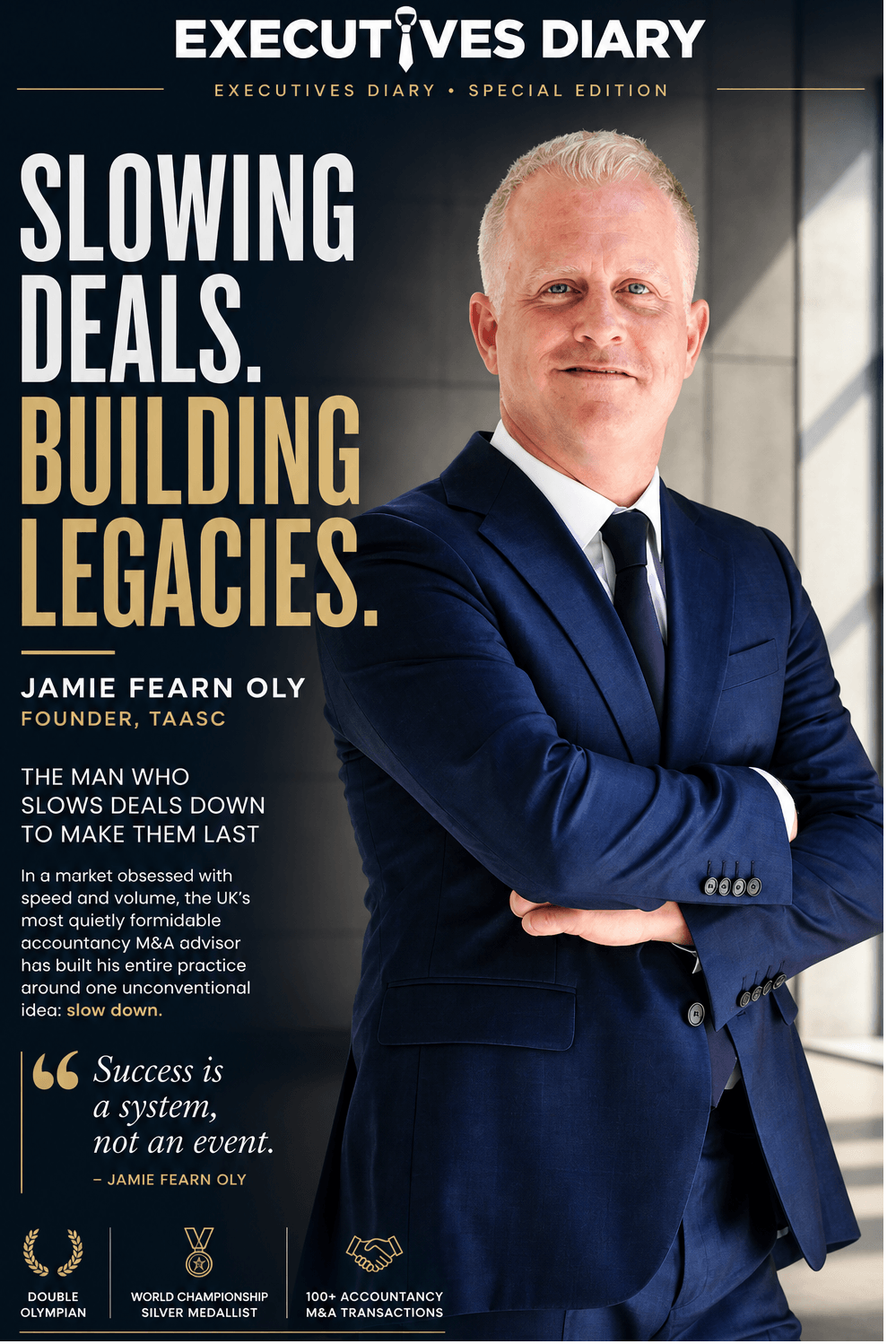
Jamie Fearn OLY: The Man Who Slows Deals Down to Make Them Last
In a market obsessed with speed and volume, the UK’s most quietly formidable accountancy M&A consultant has built his entire practice around one unconventional idea: slow down.
The call comes on a Tuesday afternoon. The numbers are good. The offer is clean. Both sides have shaken hands in the metaphorical sense, and the broker is already talking about completion timelines. Everything looks, to the untrained eye, like a deal.
Eighteen months later, the buyer is dealing with a client base that never transferred the way the model said it would. Three senior staff have left. The seller, who was supposed to step back gracefully, is fielding calls from his old clients because they do not quite trust the new arrangement. Nobody did anything fraudulent. Nobody lied. The numbers were accurate. The deal just was not built for what came after the signing.
This is not an unusual story. In the UK accountancy M&A market, it is close to the norm.
MEET JAMIE FEARN OLY
Jamie Fearn is the founder of TAASC, the Tailored Accountancy Acquisition and Sales Consultancy, and one of the few people operating in UK accountancy M&A who will tell a client not to do a deal. Not because the deal is bad on paper. Because it is wrong for them. A double Olympian and World Championship Silver Medallist turned M&A specialist, Fearn has been involved in over 100 UK accountancy transactions, and what sets him apart from almost everyone else in the market is not his network, not his speed, and not his deal volume. It is his willingness to stop.
THE SYSTEM BEHIND THE SUCCESS
Fearn’s route into M&A is not the one you would expect. He went to his first Olympic Games at sixteen, still in school, a detail that says a great deal about how he is wired. Elite sport at that level demands something specific from a person: not just talent, but the capacity to build and sustain a system under pressure, to iterate on it honestly, and to hold focus when the distractions multiply.
He translated that capacity directly into business. After two decades in banking, finance, commercial services, and sales, he moved into accountancy M&A through a regional director role at a national M&A firm, spending six years building his specialisation and reputation, before founding TAASC in 2023. By that point he had already been involved in over sixty sales and acquisitions of accountancy businesses and had consulted with hundreds of firms across the UK.
The Olympian thread runs deeper than a biography line. Fearn created his own framework for performance, a formula he has iterated over time: Consistency x Purpose x Iteration x Focus = Success. He talks about it not as motivation, but as mechanics. “Success often appears as ‘the event,’ which can be seen by others. But what they don’t see is the work and creation of the system or process that brought it about.”
In M&A terms, that system is TAASC. And the event, the completed deal, is only the visible part of something built long before anyone signs anything.
He also serves as an assessor for the World Academy of Sport’s Athlete Friendly Education Centre programme, working with elite student athletes around the world to help them balance high performance sport with academic demand. It is a role that sharpens his people instincts. Every young athlete carries different pressures, different motivations, different thresholds. Reading that quickly and adapting accordingly is a skill that transfers almost perfectly to the boardroom.
WHERE MOST DEALS QUIETLY BREAK
Ask Fearn what he actually does and he will not lead with deal flow or transaction volumes. He will talk about misalignment. Specifically, the quiet, structural kind that hides behind good numbers and surfaces only after completion.
TAASC’s process begins with what Fearn calls an Alignment Session, a structured conversation designed to surface the gaps that neither party has been honest enough, or specific enough, to examine. He has distilled nearly a decade of deal experience into three red flags he looks for before anything else.
The first is cultural incompatibility. In accountancy, culture is not a soft concern. It drives staff retention, client trust, and referrals. “If one firm is highly corporate, KPI-led, profit-focused, while the other is relationship, service, and community-focused, the numbers may stack up but the people may not.” Fearn watches for different attitudes toward leadership, contrasting service ethics, and anything that signals key staff or core clients might walk after completion.
The second is misaligned outcomes between buyer and seller. This is the one that creates the most damage. A buyer wants aggressive consolidation. A seller says they want an exit but emotionally still wants some control. Nobody makes this explicit. The deal completes. Then the friction starts. “If expectations around decision-making, earn-outs, future involvement, or pace of change aren’t explicit, the deal often unravels post-completion with a power struggle between past and current owners turning hostile.”
The third is dependency risk. A structurally sound deal should be resilient. If revenue is concentrated in a single rainmaker partner or a handful of major clients, the buyer may be acquiring fragility rather than value. Fearn looks hard at founder-dependent client relationships, fee concentration, and whether institutional knowledge is documented or entirely in someone’s head.
What he is doing, across all three of these, is slowing things down in precisely the places where the market moves too fast. That is the point. Speed in M&A is often the enemy of durability.
In the current UK environment, where corporate confidence has deteriorated sharply and earn-out assumptions are being stress-tested against macro pressure, Fearn’s approach is even more relevant. He is clear about what it demands. “In a more challenging market, the smarter focus is deal structure, certainty, and long-term fit. A slightly lower valuation with the right buyer, stronger funding, and a clear and thoughtful integration plan can outperform a higher initial offer that creates operational strain and doesn’t deliver after the sale is agreed.”
He talks about “Day 365 success” as the real metric. Not the headline price at signing. Not the multiple on completion. Whether the business is genuinely stronger, more stable, and more valuable one full year after the deal closes. That reframe is simple. It is also the thing most consultants in this market are structurally prevented from caring about, because they earn their fee at completion and move on. TAASC does not move on. That is the architecture of the whole thing.
Fearn also has a particular perspective on founders who are struggling to separate their identity from the firm they are selling, a problem he encounters constantly. “Your business is something you built. It is not who you are, though to many it seems to feel that way.” He encourages sellers to spend as much time planning for life after the transaction as they do preparing for the sale itself. What does the next chapter look like? When that question has a real answer, letting go of what came before becomes significantly easier. It is not therapy. It is practical deal preparation.
THE FEARN PLAYBOOK: 5 LESSONS
- 1. Structure is not complexity, it is the removal of uncertainty. A well-built deal slows down in the right places, makes alignment explicit across financials, culture, and future direction, and reduces friction long after the ink has dried.
- 2. Success is a system, not an event. Fearn’s formula, Consistency x Purpose x Iteration x Focus, applies equally to elite sport and high-stakes M&A. What looks like a single outcome is always the product of a deliberate, repeatable process.
- 3. In a weaker market, preparation outperforms price. When confidence drops, firms that come to market with a clear financial narrative, visible future earnings, and stable client relationships maintain leverage. Those chasing headline price alone inherit risk.
- 4. Misalignment is not a surprise, it is designed in from the start. Post-completion friction almost always traces back to expectations that were never made explicit: around future roles, earn-outs, pace of change, and definitions of success after Day One.
- 5. Your identity should be larger than the company you built. Founders who can separate themselves emotionally from their firm make better commercial decisions, negotiate more clearly, and build a more compelling future after the transaction.
WHAT THE MARKET GETS WRONG
Back to that Tuesday afternoon. The handshake, the clean numbers, the broker already talking about timelines. From the outside, it looks like a deal. From where Jamie Fearn sits, it looks like a starting point. One that still has most of its important questions unanswered.
The UK accountancy M&A market is not short of people who can put deals together. It is short of people willing to ask whether a particular deal should be put together at all, and who have the credibility and the discipline to say no when the answer is wrong.
Fearn built that credibility across two Olympic Games, over 100 transactions, and a career-long commitment to the unglamorous work of preparation. He does not sell speed. He sells something harder to find and considerably more valuable.
He sells outcomes that hold.