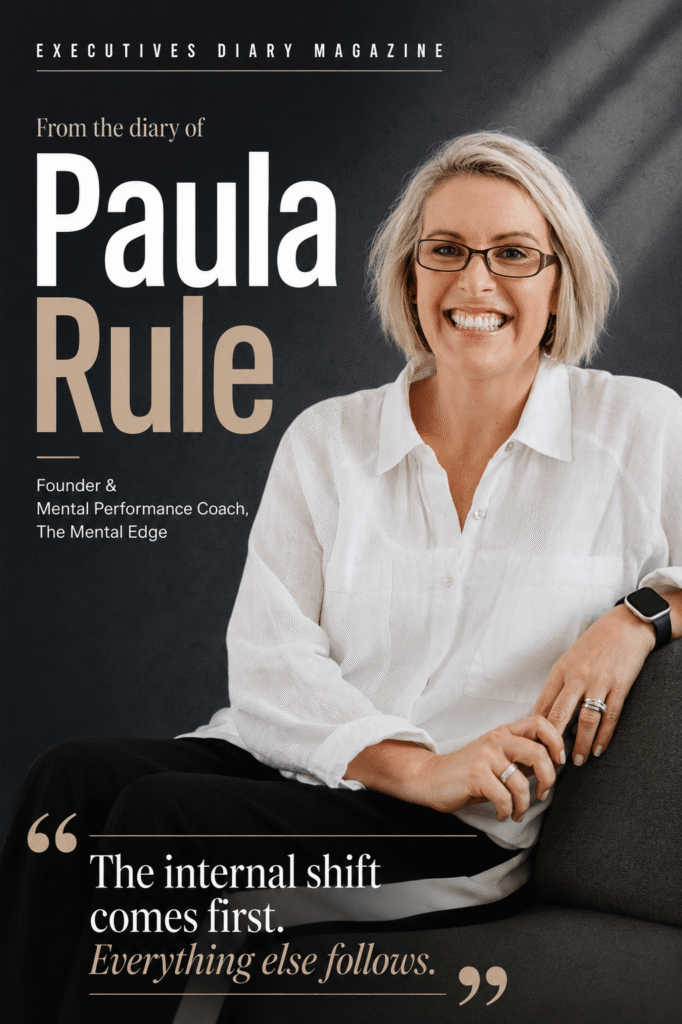
Who is Paula Rule?
Paula Rule is the Founder of The Mental Edge, a specialist performance coaching practice based in Christchurch, New Zealand. She operates as a mental performance coach for women who have mastered their craft but remain managed by their internal narratives. While many in the professional development space focus on external strategies or generic motivation, Rule works on the internal architecture of the human mind. She serves leaders, founders, and high-stakes professionals by translating the rigorous methodologies of elite sports into the language of the modern boardroom. Her mission is simple. She helps capable people perform at their best without it costing them their health, their relationships, or their sense of self.
The lift remains stationary for three seconds before the doors slide open. Those three seconds feel like an hour. Inside the metal box, a senior vice president adjusts her blazer for the tenth time. She has memorized every data point on the slide deck. Her preparation is flawless. Her expertise is undisputed. Yet, as the numbers on the display tick upward, her heart rate follows.
A familiar sensation begins at the base of her throat. It is the cold, sharp realization that while her spreadsheets are ready, her mind is starting to scatter. She is privately white-knuckling a career that looks effortless from the outside. By the time she reaches the top floor, the person walking into the boardroom is not the elite strategist she was this morning. She is a version of herself diluted by tension and filtered through a lens of quiet hesitation. The gap between what she is capable of and how she is about to perform has just become a costly reality.
The Evolution of a Performance Architect
The foundations of Rule’s career were laid on the sports fields and in the classrooms of Canterbury. After completing her education at the University of Canterbury and the Christchurch College of Education, she spent fourteen years at Rangi Ruru Girls’ School. It was here, particularly during her eight years as a Mental Skills Coach, that she began to decode the mechanics of pressure. She worked with student athletes who were navigating a brutal intersection of academic expectation and elite competition. In that environment, there was nowhere to hide. Results were visible on a scoreboard or a stopwatch.
Rule watched as talented individuals crumbled under the weight of their own expectations, while others, perhaps less gifted, found a way to thrive. She realized that the difference was rarely a lack of skill. It was a lack of mental tools. This realization led her to develop the S.O.A.R. Programme, a holistic high performance framework that addressed the whole person rather than just the athlete. She integrated everything from hormonal health and breathwork to media training. She was not just coaching people to win games. She was teaching them how to exist under the intense scrutiny of a high stakes environment.
The transition from the field to the corporate sector was a natural progression fueled by a startling observation. The doubt she saw in a teenage athlete before a national final was identical to the doubt she saw in a CEO before a global merger. The mind does not distinguish between a physical arena and a professional one. Pressure is pressure. Rule spent years building The Mental Edge as a parallel venture, slowly accumulating evidence that her sports-based methodologies were the missing piece in professional leadership. Eventually, she reached her own crossroads. She had to choose between the safety of a stable role and the risk of her own vision. She chose to walk the talk.
Bridging the Gap Between Capability and Performance
Rule’s current work is a direct challenge to the grind culture that has dominated the professional world for decades. She rejects the idea that higher performance requires more tension. Instead, she argues that the most consistent performers are those who lead from a place of calm and clarity. This is not a soft approach. It is a biological one. When she speaks to a client about their internal architecture, she is talking about the neurological loops and self-talk cycles that dictate every decision they make.
“The internal shift comes first. Everything else follows.”
Rule believes that many professional problems are actually mindset problems in disguise. A leader who hesitates to give feedback or an executive who second-guesses a bold strategy is not suffering from a lack of knowledge. They are suffering from an unchecked mental narrative. She works with women to identify these stories before they become facts. By the time a client reaches Rule, they are often tired of watching the wrong version of themselves show up to important moments.
“I genuinely believe that the most underrated leadership skill is self-awareness.”
This awareness is the cornerstone of her philosophy. She teaches leaders to audit the state they are in before they walk through any door. If a leader enters a room with frantic energy or unresolved stress, that state acts as a contaminant. It affects the culture, the communication, and ultimately the results of the team. Rule provides the tools to interrupt that transfer. She equips her clients with practical circuit breakers, such as the physiological sigh, to reset the nervous system in seconds.
“The state a leader arrives in doesn’t stay with them. It transfers.”
This concept of emotional contagion is why Rule focuses so heavily on the individual before the organization. If the individual is not regulated, the organization cannot be either. She uses her experience with elite athletes to show executives how to reframe nerves as signals rather than obstacles. To Rule, nerves are a sign that something matters. The goal is not to eliminate the feeling, but to ensure the feeling is not the one driving the car.
“Technical capability alone isn’t enough.”
In her view, the future of the workplace belongs to those who treat mental performance as a non-negotiable asset. She sees a growing recognition among organizations that burnout and disengagement are expensive performance problems. They are the result of capable people lacking the tools to manage the load they are carrying. Rule is moving the conversation toward sustainability. She wants to ensure that when women step into leadership, they have the mental agility to stay there without losing their joy in the process.
“You can’t coach someone to a place you’re not willing to go yourself.”
This personal integrity drives her coaching style. She is known for being practical and challenging because she has lived the patterns she seeks to break. She openly shares her own history of playing small to protect herself from the possibility of failure. By naming these patterns, she gives her clients permission to do the same. This creates a space where performance is not a performance, but a genuine expression of one’s highest capability.
The Rule Playbook: 5 Lessons
Lesson One: Audit your arrival state before every interaction to ensure you are contributing to the room rather than contaminating it.
Lesson Two: Separate your identity from your performance labels so that feedback and setbacks no longer feel like personal verdicts.
Lesson Three: Use the physiological sigh to activate the parasympathetic nervous system and regain calm during high-pressure moments.
Lesson Four: Identify the quiet stories running in your background that create hesitation and name them out loud to strip them of their power.
Lesson Five: Stop waiting to feel ready before taking action because growth only happens in the space where doubt and movement coexist.
The Return to Clarity
We return to the boardroom. The meeting is in full swing. The tension is high. But this time, the executive is not white-knuckling her chair. When she feels the familiar spiral of second-guessing begin, she catches it. She notices the thought, labels it as a coping strategy that no longer serves her, and takes a deliberate, quiet breath. She shifts her focus away from her own performance and toward what she wants to give to the people in the room. The gap between her talent and her presence disappears.
Paula Rule has spent her career proving that the mind is a trainable asset. She has taken the grit of the sports field and the precision of the boardroom to create a new standard for leadership. It is a standard where success is not measured by how much you can endure, but by how well you can lead yourself through the pressure. By focusing on the internal architecture, she allows women to reclaim the energy they used to spend on survival and invest it in their impact. The most powerful version of a leader is not the one who pushes the hardest, but the one who has learned how to perform from a place of clarity.
True high performance is the ability to walk into any room and remain completely yourself.