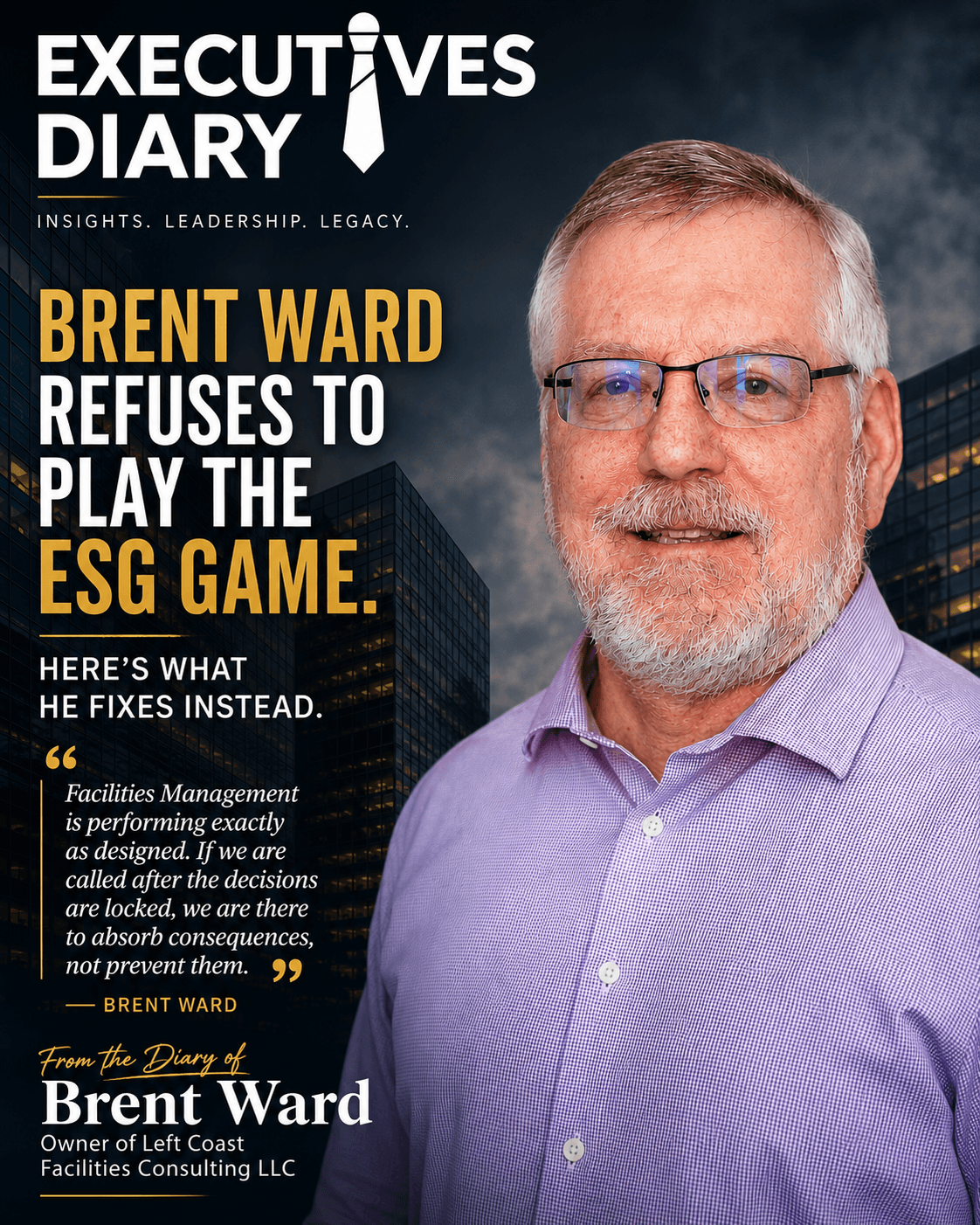
Brent Ward Refuses to Play the ESG Game. Here’s What He Fixes Instead.
Corporate sustainability consulting has a profitable secret. Most of it is expensive theater.Companies pay consultants millions to generate reports that look impressive in boardrooms while their actual buildings hemorrhage energy and cash. Environmental, social, and governance frameworks multiply like paperwork, creating compliance checkboxes that have little connection to whether a boiler runs efficiently or a roof stops leaking.
Brent Ward sees this performance for exactly what it is, and he wants no part of it.
The Consultant Who Says No to Easy Money
Brent Ward CFM, FMP, SFP, CFT is the owner of Left Coast Facilities Consulting LLC in Vancouver, Washington. He works with small and medium-sized organizations to define what their facilities actually need, manage complex projects, and eliminate energy waste before it locks into decades of operating costs. When potential clients ask him to handle their ESG reporting, he points them toward specialists who enjoy that work.
The School of Hard Mechanical Reality
Ward’s refusal to chase ESG contracts was not born from ideology. It was earned through decades in roles most executives never see. He was raised in a construction family, working on sites at 9 years old and worked construction until he started in the facilities arena as a maintenance technician at Evergreen School District in Washington, spending over eleven years cataloging building systems room by room, writing coating specifications, and learning fire alarm programming by doing the work himself.
Public schools operate without endless capital budgets for theoretical sustainability initiatives. They demand rigorous maintenance management, strict cost control, and systems that function reliably when children and staff depend on them. Ward learned to identify and label capital equipment inventory, reformat computerized maintenance management systems, and build preventive maintenance schedules that actually prevented problems.
From maintenance technician, he advanced to maintenance coordinator, managing capital projects, then moved to a Facilities Supervisor role at Columbia Credit Union and Facility Manager at Educational Opportunities for Children and Families. At EOCF, he managed facilities maintenance, lease negotiations, emergency preparedness, new construction, renovations, and built a student transportation department from scratch. He chaired the organization’s Green Team, implementing practical sustainability measures for an organization serving children and families, not shareholders seeking compliance credentials.
Each role taught him a fundamental lesson about how buildings succeed or fail. Grand architectural visions often collapse when they meet the daily reality of maintenance. Energy-efficient designs become expensive mistakes when they ignore lifecycle costs. Emergency preparedness systems work perfectly until the power goes out on a holiday weekend.
The Design Problem That Breaks Everything
Today, Ward runs Left Coast Facilities Consulting to attack a systematic failure that costs organizations millions. Most institutions treat facilities management as cleanup work. They finalize budgets, set timelines, commit to designs, then hand the resulting problems to facilities teams to manage.
Ward knows this sequence guarantees failure. He aligns with IFMA colleagues like FMCC President Grant Sommerfeld, who argues that facilities management is not underperforming. It is performing exactly as designed by a broken system.
This is why Left Coast Facilities Consulting focuses on early intervention and lifecycle thinking. Before a remodel, expansion, or new construction moves forward, Ward wants the energy mathematics on the table. How will design choices lock in utility costs, maintenance hours, and replacement schedules for the next twenty to thirty years?
The Energy Management Reality Check
In Ward’s view, the most critical design issue facing facilities management right now is energy management. Not as environmental posturing, but as a financial strategy. He consistently encounters a specific misconception that costs organizations fortunes: executives believe that building or remodeling for low energy consumption costs too much upfront, so they choose cheaper initial options that become expensive forever.
Ward pushes clients to examine the complete picture: higher efficiency equipment, better building envelope performance, and intelligent control systems that eliminate years of waste from a building’s operational life. The utility savings do not just improve sustainability reports. They free operating budgets for staff, programs, or growth.
The Politics Problem That Derailed an Industry
This practical focus explains Ward’s deliberate exit from ESG consulting. He watched carbon neutrality and ESG reporting become what he calls “such a political quagmire in the US” that most of the activity has little connection to whether buildings actually perform better.
This is not a retreat from sustainability. It is a strategic focus on the levers he can actually control: design choices, maintenance practices, asset management, and emergency preparedness. By avoiding the reporting theater, he concentrates on the mechanical and operational decisions that determine whether a building supports or undermines an organization’s mission.
The IFMA Advantage That Clients Never See
Ward’s deep involvement with the International Facility Management Association provides his clients access to global expertise they could never afford directly. As a longtime member, IFMA Foundation Board of Trustees member former Vice President of the Non-Profit Council, and current FMCC Treasurer, he participates in the International Facilities Management conversation every day, not once annually at a conference. He speaks at both US conferences and spoke at the Europe conference this year.
For small and medium-sized organizations, this matters significantly. They lack in-house strategy teams modeling future building codes or energy pricing trends. They have a facilities person, constrained capital budgets, and too many urgent problems demanding immediate attention.
Ward brings them access to institutional thinking that large corporations take for granted, then adapts it to what they can actually execute with their resources and constraints.
Crisis Leadership That Prevents the Crisis
Ward has managed facilities through genuine emergencies, from school districts to medical testing laboratories. He learned that successful crisis management happens long before the crisis arrives. When systems fail at 2:00 a.m. on a holiday weekend, no one has time to invent processes or debate response plans.
However, Ward also understands that circumstances change and data evolves. Rigid adherence to failing plans causes more damage than admitting mistakes early.
For Ward, this philosophy applies directly to how organizations should treat their buildings. Admit when a design or system choice is failing, acknowledge it quickly, and fix it before throwing more money at a fundamentally flawed approach.
Bobby R. LaRon, a workplace leader at CBRE and IFMA Global Board member, describes Ward as “one of the sharpest minds” in facilities management, particularly in preventive maintenance and asset management. In practical terms, this means Ward excels at knowing precisely what organizations own, where critical systems are located, and what those assets will cost if neglected.
The Game That Actually Determines Winners
In a consulting market saturated with ESG narratives and compliance frameworks, Brent Ward has chosen to compete in a different arena entirely. He sells operational reality: buildings that cost less to run, fail less frequently, and reliably support the work they house.
For the small and medium-sized organizations that find their way to Left Coast Facilities Consulting, the attraction is not that Ward refuses to play the ESG game. It is that he understands which game actually determines whether they succeed or fail over the long term. The organizations still operating comfortably in ten years will be the ones that invited people like Ward into the room before the concrete was poured, the contracts were signed, and the consequences became permanent.
Key Takeaways / Playbook
- 1. Early Intervention: Bringing facilities experts into the room before decisions, timelines, and budgets are locked down to prevent absorbing systemic design consequences.
- 2. Lifecycle Mathematics: Running long-term operational numbers honestly to address short-term ROI, rather than settling for cheaper upfront choices that remain expensive forever.
- 3. Decisive Data Leadership: Gathering critical operational metrics to implement decisions cleanly, with the flexibility to quickly change course if data reveals a flaw.