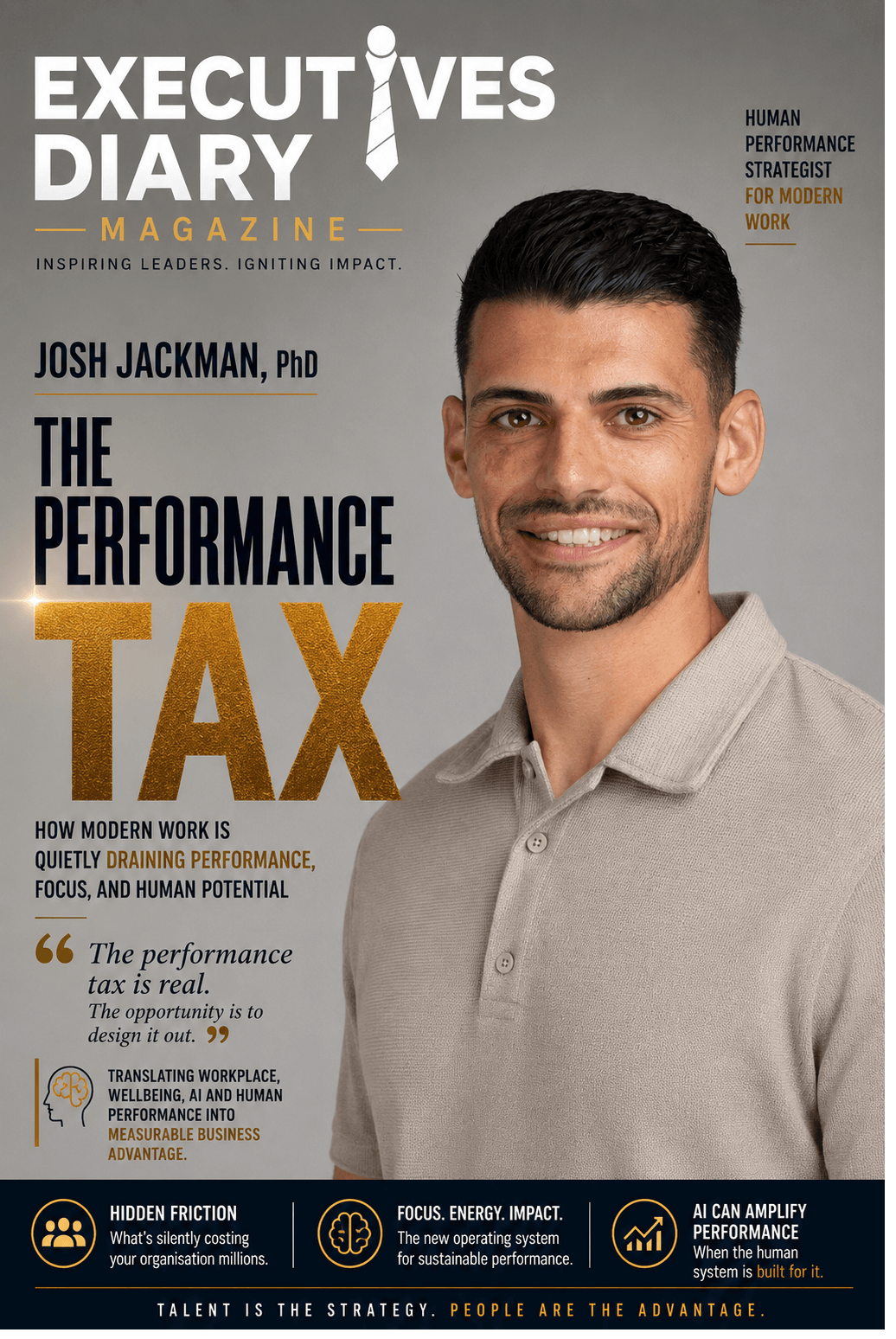
The Performance Tax
How Josh Jackman, PhD Helps Leaders See Where Modern Work Is Draining Their Best People.When the Numbers Look Fine and the People Are Not:
By the time most executives notice a performance problem, it shows up in the numbers. Slower decisions. Missed deadlines. Rising attrition. The usual response is to push harder, buy more tools, or reshuffle the org chart.
Josh Jackman, PhD, starts somewhere far less dramatic. He walks the floor, studies the calendar, measures the air quality, and counts the interruptions. Then he shows leaders something uncomfortable: the real problem is not effort or intent. It is a quiet, compounding performance tax built into how work happens every day.
Research shows that after an interruption, it takes an average of 23 minutes and 15 seconds to regain full focus. Multiply that reset time across hundreds of people and thousands of days, and you see why AI tools and new offices are not delivering the promised productivity gains. The human system they land in is already running on fumes.
The Scientist Who Reads Rooms Differently
Josh Jackman looks like someone you would trust with a difficult decision. Calm delivery. Precise language. No theatrics. As a Human Performance Strategist for Modern Work, he combines a PhD in exercise physiology, Chartered Scientist status, and nearly 15 years of applied research and advisory work for organisations like GSK, AstraZeneca and Cisco. He is now focused on independent advisory work that helps organisations translate workplace, wellbeing, AI and human performance into measurable business advantage.
His work sits at the intersection of human performance science, corporate real estate, and AI-enabled work. At its core, it answers one hard question: how do you raise performance without burning people out?
From Formula 1 to Workplace Science
That question did not start in a boardroom. It started in a lab.
Jackman’s early career was built in environments where performance is non-negotiable. At GSK’s Human Performance Lab, he worked with Premier League and Formula 1 teams, supported Olympic athletes, and validated performance technologies that needed to work at world-class level. Marginal gains were not a buzzword there. They were the job description.
The PhD that followed, delivered through Middlesex University in partnership with GSK, took that same precision into applied research. He led experimental studies on how the body responds to different environments and exercise conditions, then translated that evidence into accessible insights for both internal stakeholders and public audiences.
That mix of scientific depth and clear communication would become his trademark.
From Effort to Evidence
The pivot came when he moved from sport science into workplace and corporate real estate. At ART Health Solutions, he helped build what they called Workplace Science. Not opinion. Not mood boards. Data.
The team measured how offices affected stress, cognitive performance and wellbeing across sites and continents. The flagship project was GSK’s London headquarters, which recorded increased daily physical activity, reduced stress, and improved cognitive performance for people using the space. These were not just self-reported sentiment. They were measured outcomes. The project won the British Council for Offices Innovation Award and became a reference point for healthy workplace design globally.
That distinction matters. Effort defends budgets. Outcomes change strategy.
By the time he became Chief Operations Officer at ART Health Solutions, Jackman was leading the integration of science, commercial reality and board-level thinking. He helped scale the company from startup to securing multi-million-pound revenue and investment, as well as strategic partnerships with CBRE, IWBI and JLL. The methodology he helped build was used on six continents.
When ART Health Solutions later wound down, Jackman saw it not as the end of the mission, but as evidence of how much work remained to be done. “I believe we made a dent in the world. We showed that science and data can and should be used to create better workplaces and better lives. That work does not disappear just because the company logo does.”
It is not sentimental. It is a statement of unfinished business.
Diagnosing the Performance Tax
If you strip away the acronyms, Jackman’s current proposition is simple: modern work is draining performance faster than most leaders realise, and he helps leaders diagnose where performance is being lost, estimate its impact, and prioritise what to change
Through his independent advisory practice, and building on recent project work with CBRE, Jackman helps organisations diagnose the performance tax in how work happens, then prioritise targeted changes. That might involve environmental conditions, schedule design, meeting norms, attention management, leadership behaviours or the way AI is integrated into the working day. The output is not a motivational poster. It is a clearer set of operating conditions for sustainable performance.
He calls the biggest drain “invisible friction”: poor acoustics, back-to-back meetings, constant digital noise, unclear priorities, minimal autonomy, subpar environmental quality. None fatal in isolation, but together they compound into something that no engagement survey will capture.
Why AI Makes This More Urgent, Not Less
The point becomes especially urgent as organisations accelerate AI investments. Gallup’s recent State of the Global Workplace report confirms what Jackman sees in practice: engagement is still poor, wellbeing is fragile, and the productivity gains many hoped AI would unlock are not showing up.
“AI can amplify performance, but it can just as easily amplify fatigue, confusion and poor habits if that is the system it lands in,” Jackman warns. “The real differentiator will be whether organisations invest in human capability as seriously as they invest in tools.”
As a member of the WELL Faculty and 2025 IWBI Award recipient, Jackman now helps push workplace standards toward cognitive and psychological outcomes that matter in an AI-integrated workforce: focus, recovery, connection, trust, decision quality.
His executive performance programmes are not framed as coaching in the soft sense. They are, in his words, “a personal operating system for energy, focus, recovery and leadership influence”. Leaders learn to protect deep work, manage their own physiology under pressure, and create team conditions that support attention instead of shredding it.
The same logic applies to real estate decisions. Office space, in Jackman’s view, is not a static asset or cultural symbol. It is a performance platform. He advises clients to stop asking how many days people should be in the office and start asking a better question: what work are we expecting people to do here, and what conditions do they need to do it well?
You can see the through line from elite sport. Start with the performance you need, then work backwards into routines, environments and recovery. The difference is that in corporate life, those systems are rarely designed with the same rigour. They grow by accident.
Stop Paying the Tax
Which brings us back to the performance tax. The quiet cost in every needless notification, every cramped meeting room, every poorly ventilated office, every “quick question” that fragments an afternoon.
Josh Jackman, PhD, is not asking leaders to care about wellbeing as a moral extra. He is asking them to recognise that they are already paying for this invisible friction, every quarter, through slower thinking, weaker decisions and avoidable turnover.
The tax is real. The question is whether you are ready to stop paying it.
Key Takeaways / Playbook
- 1. Invisible Friction Matters: Poor acoustics, constant digital noise, and back-to-back meetings compound to deplete attention and impact output.
- 2. The Reset Window: Reclaiming full focus after an interruption takes an average of 23 minutes and 15 seconds.
- 3. Human Systems First: AI and workplace tools can only deliver performance gains if the underlying human system is running efficiently rather than running on fumes.