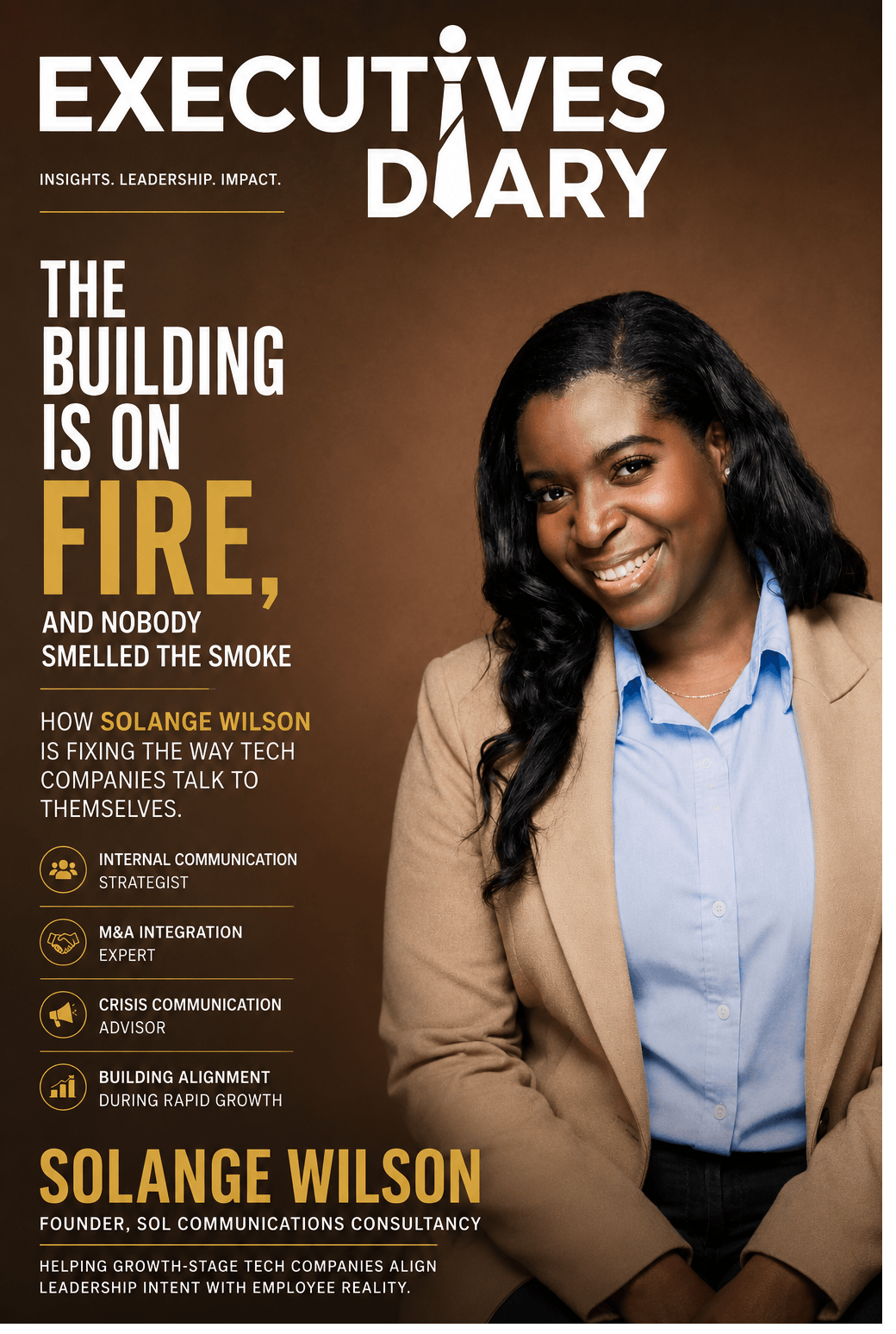
The Building Is on Fire, and Nobody Smelled the Smoke
How Solange Wilson is Fixing the Way Tech Companies Talk to Themselves.When the Applause Dies Down
The celebration photos are still pinned to LinkedIn. The Series B announcement generated hundreds of congratulatory comments. The headcount tripled in eight months, and the board loves the trajectory.
But walk the halls of that same company six weeks later, and something feels wrong. The all-hands meetings have become performance art. Nobody asks real questions anymore. The senior engineer who used to challenge everything now nods along silently. Decisions that once took an afternoon now disappear into committee purgatory because nobody knows who actually signs off.
From the outside, it looks like a winning tech company. From the inside, it feels like something is quietly breaking. That gap between what leadership thinks is happening and what employees actually experience every day is where most scaling companies fracture. It is also exactly where Solange Wilson does her best work.
The Strategist in the Gap
Solange Wilson is the founder of SOL Communications Consultancy and an internal communications strategist who works with growth-stage tech companies during the moments when misalignment carries real business risk. She does not polish press releases or manage social media accounts. She builds the internal communication infrastructure that keeps leadership intent and employee reality from becoming two separate, competing stories. When founders finally put words to what they have been feeling, when they can finally name that something is off inside their organization, she is the strategist they find.
From Saba to the Fault Lines
Her path to this work was not accidental, and it was not comfortable.
Growing up on Saba, a small island in the Dutch Caribbean with its own distinct culture and English language educational system, Solange learned early what it meant to exist between cultures. Later, navigating predominantly white academic and corporate environments in the Netherlands, she experienced firsthand what it felt like to be visible and invisible simultaneously. That tension of being in the room but not fully represented now sits at the core of how she reads organizations and identifies the fault lines that leaders miss.
Her academic training was not theoretical padding for a consulting website. At Hanze University, studying International and Intercultural Communication, then at Tilburg University completing her MSc in Communication and Information Sciences, she went deep into the questions most companies still treat as afterthoughts. Her thesis examined a ruthless, practical question: when the Dutch police face a crisis, what actually works in public communication? Facts or emotion? Formal tone or relatability? Aligned messaging or conflicting objectives? It was not research for a grade. It was training in how messages land when stakes are high and people are scared.
What the Floor Taught Her
Rather than moving directly into advisory work, Solange took a different path. During her time leading internal communications in a large-scale retail environment, she observed firsthand what happens when communication infrastructure is not built to match the pace of an organization. She saw how unclear or late messages create confusion, how confusion creates disengagement, and how disengagement quietly empties a room of the talent that makes a business work.
She learned something there that most executives completely miss.
In that retail environment, she watched what happens when messages are unclear, late, or delivered from a distance. Confusion becomes conflict. Conflict becomes disengagement. Disengagement becomes talent walking out the door. That cause-and-effect loop became the foundation of everything she builds now.
When she launched SOL Communications Consultancy, it was not a personal branding exercise. It was a decision to sit at the table where those destructive loops begin, before they can take hold.
Where Growth Starts to Hurt
Today, Solange works with growing tech companies at the precise moment when success starts to strain their internal structure. When headcount multiplies, decision-making becomes murky, and founders realize for the first time that Slack channels and monthly all-hands meetings are not a communication system. They are just tools, and tools without strategy create chaos.
Her entry point is rarely a polished brief from a strategic planning session. It is usually a founder or executive who can only describe what they are feeling in fragments. Things like, “We are moving slower than we should be,” or “The team feels off, but nobody is saying anything specific,” or “We announced the restructure three weeks ago and now everything is weirdly quiet.”
The first thing she does is refuse to accept the surface explanation.
Through diagnostics and internal communication audits, she traces how information actually moves through the organization. Not how leadership thinks it flows, but how people on the ground experience it. She identifies who really makes decisions, not who appears on the org chart. She tests which communication channels carry weight and which ones everyone quietly ignores.
Then she names the thing leaders have been circling around but could not articulate.
Where Mergers Break Before They Begin
Translation, in Solange’s framework, is not about simplifying corporate language. It is about understanding the emotional and cultural fault lines that sit beneath every announcement. A merger described as “exciting synergy” in the press release can feel like an existential threat to people who were already questioning their job security.
Her approach to M&A integration makes this visible in ways that deal teams consistently overlook. When most acquisition teams focus on legal structures and financial modeling, she is mapping the human risk. Two companies means two cultures, two unspoken sets of rules about what gets rewarded and what gets punished. If leadership assumes the acquiring company’s culture simply absorbs the other by default, she knows exactly what follows.
She builds integration communication plans that start before the contracts are signed. Who hears what information, in what sequence, from which leaders, and with what context. She insists that executives are visible, present, and human, especially when the message is difficult to deliver.
Before the Headlines Hit
Her crisis preparedness work follows the same preventative principle. She is not the consultant you call at 2am when social media is already exploding. She is the person who ensures that when something does go wrong, you are not scrambling to figure out who speaks, what they say, and how you protect organizational trust while managing the crisis.
Scenario mapping, role clarity, response readiness. For Solange, these are not consulting buzzwords. They are the three pillars that determine whether companies survive reputational hits intact or bleed credibility in public.
In one engagement with a global children’s gaming platform navigating serious digital safety concerns, Solange developed a crisis communication plan in collaboration with senior communications leadership. The experience shaped her understanding of how quickly organisational trust can fracture when messaging becomes defensive or unclear, and how preparation before a crisis is the only thing that protects it.
The lesson stayed with her because crisis communication is rarely only about what an organization says after something has gone wrong. It is about whether the right people have already agreed on what accountability sounds like, what the public needs to hear, and how to respond without hiding behind polished language. For Solange, the work confirmed that trust is not protected by speed alone. It is protected by clarity, preparation, and the discipline to communicate before confusion fills the space.
The Marker and the Floor
That insistence on alignment between communication and behavior also appears in her advisory work with foundations and nonprofits. Board members accustomed to reacting emotionally in public forums learned through her counsel what it meant to represent an organization rather than just themselves. She is direct when the situation requires it. She brings the same directness to her advisory relationships, helping leaders distinguish between strategic responses and reactive ones.
She has been described as the Olivia Pope of internal communications. Not because she steps in after emergencies have already taken over the room, but because her work is built around making sure organisations are prepared before pressure arrives. By the time a difficult moment surfaces, her clients already understand what needs to be said, who needs to say it, and how to communicate without confusion, delay, or defensiveness.
“I don’t stop until it’s mapped,” she says about her approach to complex organizational challenges. When asked to theoretically tackle a merger between Nike and Adidas, she grabbed a marker and filled an entire whiteboard with the communication strategy, cultural fault lines, integration risks, and leadership sequencing. Then she got on the floor and kept mapping until every layer was clear.
That methodology defines how she approaches every engagement. She does not offer generic templates or standard corporate playbooks. She gets into the specific complexity of each organization, maps every fault line, and builds solutions that work for that particular culture and challenge.
Infrastructure, Not Decoration
What connects all of this work is her fundamental refusal to treat internal communication as corporate decoration. For Solange, it is operational infrastructure. When it functions properly, decisions land clearly, culture holds together under pressure, and people know how to move forward without waiting for another memo. When it fails, companies crack from the inside while everyone outside still assumes they are thriving.
The building is not on fire when Solange Wilson walks into your organization. Her work is the reason it stays that way.
Key Strategy Framework
- 1. Diagnostics over Templates: Tracing exactly how information moves dynamically through teams on the ground rather than relying on standard corporate structures.
- 2. Preventative Integration: Mapping human risk and cultural alignment elements well before corporate structural merges are finalized.
- 3. Structural Infrastructure: Designing operational communication networks so decisions land intentionally and culture withstands growth.