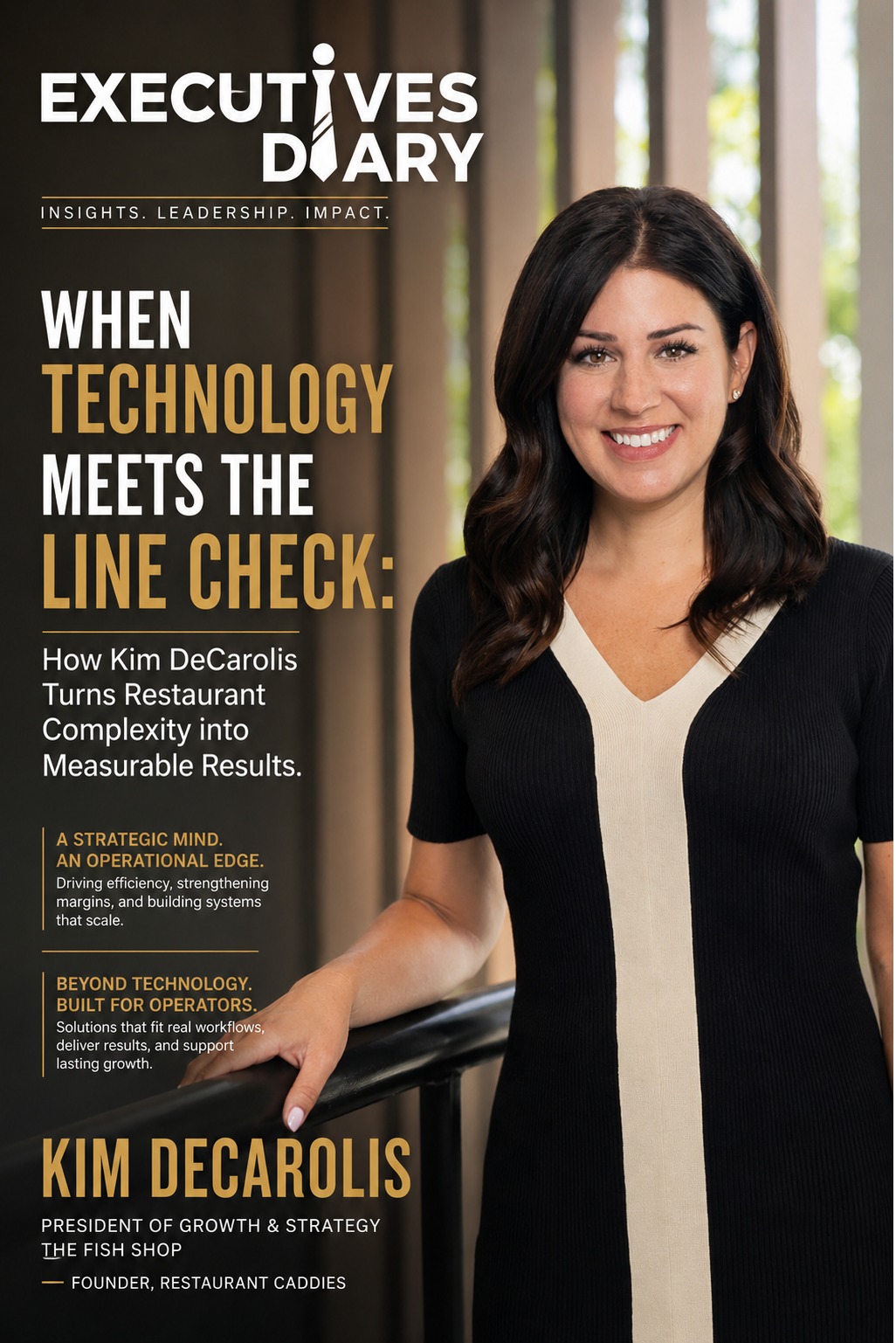
When Technology Meets the Line Check
How Kim DeCarolis Turns Restaurant Complexity into Measurable ResultsWhen the Numbers Finally Told the Truth
Most restaurant brands don’t fail because they lack ambition. They fail because nobody asked the right questions early enough. When Kim DeCarolis and her partner Jeremy Theisen walked into The Fish Shop, the fast-casual seafood brand founded in Pacific Beach in 2010, they weren’t hired to validate what was working. They were hired to find what the business didn’t know it didn’t know. What they found, buried inside vendor contracts, technology stacks, and operational workflows, was more than $200,000 in annualized savings waiting to be claimed. The brand hadn’t been careless. It had simply never had someone look at the whole picture at once.
That is precisely the kind of problem Kim DeCarolis has spent a career learning how to solve.
The Executive Who Reads the Whole Room
Kim DeCarolis is the President of Growth and Strategy at The Fish Shop and the founder of Restaurant Caddies, a consultancy she built to give growing restaurant brands the kind of disciplined, experienced guidance that most can’t afford to keep on staff full time. She is one of the few operators in the industry who has sat on both sides of the table long enough to understand what actually breaks when ambition outpaces infrastructure, and why the gap between a great concept and a scalable business is almost always an operational problem dressed up as a strategy problem.
From Floor Manager to Franchise Architect
Kim DeCarolis grew up professionally in environments where the details were the job. Her early career included floor management at retail, personal banking at JPMorgan Chase, and a marketing communications role at ANXeBusiness, a PCI compliance firm in Southfield, Michigan. None of those roles were glamorous. All of them taught her something specific about how organizations actually function at the point where strategy meets execution.
Her degree in marketing from Central Michigan University, supplemented by a semester studying in Rome, gave her a foundation. But it was the progression through compliance, risk management, and enterprise sales that sharpened her instinct for operational accountability. At ANXeBusiness and its successor NuArx, she learned how to build long-term client relationships inside industries where trust is the entire product. She learned how to sell complex solutions to skeptical operators. She learned that the gap between a vendor’s pitch and a client’s reality is almost always wider than either party admits.
That education carried her into restaurant technology, where she spent nearly a decade helping some of the industry’s most recognized platforms find their footing inside real operations. At Punchh, she rose to Senior Vice President of Sales, helping restaurant brands understand how CRM and loyalty data could translate directly into repeat visits and check lift. At SevenRooms, she worked with hospitality operators on guest engagement and reservation management. At PathSpot, she sold hygiene visibility technology to operators who needed to see what was happening across locations before a problem became a liability.
Each of those roles added a layer. Not just knowledge of the technology, but knowledge of where technology fails. “The most common mistake I see is that operators start with the technology instead of the problem they’re trying to solve,” she says. “They’re sold on features and dashboards before they’ve clearly defined the business challenge or how success will be measured.”
That conviction didn’t come from a whiteboard. It came from watching the same pattern repeat across platforms, brands, and markets for more than a decade.
Building What Scales, Not What Sells
When Kim DeCarolis joined Amniscient as Vice President of Sales in 2025, she was helping bring computer vision AI to retail, automotive, manufacturing, and agriculture. It was a logical extension of everything she had learned about technology adoption in high-complexity environments. The principles don’t change when the industry does. Operators need solutions that remove friction, not add it. Frontline teams need tools that fit their workflows, not tools that require their workflows to change around them.
But her most visible work right now is happening at The Fish Shop and through Restaurant Caddies, the firm she co-founded with Jeremy Theisen to offer what she describes as integrity-driven guidance across digital marketing, technology, operations, and franchise growth.
The work at The Fish Shop is a case study in how that guidance operates in practice. When DeCarolis and Theisen came in, they didn’t arrive with a predetermined solution. They arrived with questions. They reviewed technology platforms, vendor relationships, marketing programs, operating costs, and franchise readiness. They tracked unit-level profitability, vendor costs, and customer engagement data before recommending a single change.
The technology consolidation and vendor contract renegotiations that followed produced more than $200,000 in annualized operating savings. That number matters not just as a financial result but as a signal to prospective franchise operators that the underlying unit economics are sound. A great concept with weak margins is a hard sell. A great concept with strong margins and documented systems is a different conversation entirely.
In parallel, The Fish Shop launched a loyalty program, and DeCarolis was careful about how she measured its success. “We monitored enrollment, guest engagement, and repeat purchase behavior to ensure adoption before expanding program features,” she says. “The loyalty platform created a stronger connection with guests while providing valuable customer data to support future marketing efforts.”
The distinction matters. A loyalty program that gets launched and forgotten is a cost. A loyalty program with a feedback loop attached becomes a growth asset. That difference, between deploying a tool and actually using what it tells you, is where most brands leave value on the table.
Her board membership with Women in Restaurant Leadership and her long tenure on the Informa Restaurant Leadership Council reflect the same instinct applied at an industry level. She has been recognized as a Top 30 Woman in Restaurant Leadership for 2024, a distinction that speaks to the breadth of her influence across a sector where her peers are paying attention.
The Question That Doesn’t Go Away
The Fish Shop already had what many brands spend years trying to build: a genuine culture, a product guests return for, and a community-first identity that can’t be manufactured. What it needed was the infrastructure to carry those strengths into new markets without losing what made them matter in the first place.
“What excites me most is that the business already had an exceptional culture, product, and community-first mission,” DeCarolis says. “Our role has been to build the infrastructure that allows those strengths to scale while preserving the values that make The Fish Shop unique.”
That is the work Restaurant Caddies was built to do. Not to replace what a brand already does well, but to make sure the systems underneath it are strong enough to hold the weight of what comes next.
In a restaurant industry full of operators chasing the next technology platform, Kim DeCarolis keeps asking a simpler question: does this actually help the person standing at the line?
The ones who can answer that question honestly are the ones worth following.
Key Takeaways / Playbook
- 1. Problem Before Platform: Avoid starting with technology integrations before clearly identifying the real operational issues or baseline performance measurements.
- 2. Comprehensive Analysis: True growth assets and hidden operational savings come from looking systematically at unit economics, vendor terms, and tools combined.
- 3. Sustainable Scale: Prioritize structural integrity that safeguards a brand’s unique identity and core community culture as infrastructure expands.