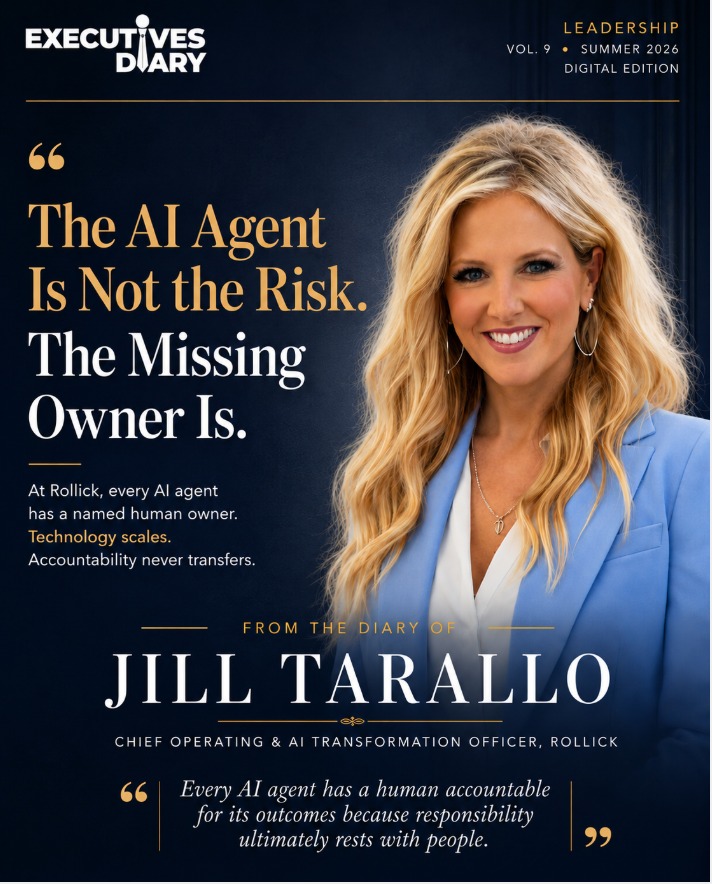
Jill Tarallo has put autonomous agents on Rollick’s org chart. Every one of them has a human name attached to the outcome.
Make the decision, support the decision, or stay outside it entirely. Before an AI agent goes live inside Rollick, it is assigned one of those three roles, and a named human owns what it produces. Jill Tarallo built the sequence in that order deliberately. “Most AI transformations start with the technology. Ours began with the work,” she says. The belief she is arguing against is that installing a capability also disposes of the responsibility for it.
Jill Tarallo is Chief Operating and AI Transformation Officer at Rollick, a SaaS company named to the Inc. 5000 three consecutive years.
Ownership Is the One Thing That Never Transfers
Capability can be bought. Ownership cannot. That distinction is the load-bearing wall under Tarallo’s operating model, and the clearest test of it at Rollick was a decision about people rather than software.
The company needed engineering capacity, and the conventional route was sitting there: contract the work to a firm that supplies developers on demand. Tarallo does not dismiss that route. “Outsourcing is a valuable strategy when you need specialized expertise, flexibility, or speed. But when a capability becomes central to your competitive advantage, it eventually has to become part of your company,” she says. Rollick built instead, standing up its own technology center in Hyderabad, incorporated as Rollick Outdoor India Pvt. Ltd.
What she was buying was not cheaper capacity. “We didn’t want a team writing code for us. We wanted a team building the future with us.” The mechanism was a deliberate transfer of context rather than a transfer of tickets, and the shift she describes is in what the team became willing to do. “By hiring directly, investing in our people, creating a shared culture, and giving everyone the business context behind the work, they became more than developers. They became innovators, problem-solvers, and leaders who were personally invested in our success,” Tarallo says.
None of that shows up as a line item, which is her explanation for why the decision reads as expensive on a spreadsheet and cheap in retrospect. “Institutional knowledge, leadership, culture, and innovation don’t appear on a balance sheet, but they become some of a company’s most valuable assets over time.”
THE SAME TEST, APPLIED TO MACHINES
Agents reached the Rollick org chart under that same rule, and the order of operations is what separates it from a tooling rollout. “Before we introduce an AI agent, we break a function down into decisions, not tasks. Tasks are easy to automate; judgment isn’t,” Tarallo says. Only once the decisions are pulled apart does the triage run, and it has three outcomes: the agent makes the decision, supports it, or stays outside it entirely.
The classification is not a safety layer bolted on afterward. It is the org design. “Every organization is now architecting three kinds of work: human-led, AI-led, and human-AI collaboration. Competitive advantage comes from intentionally designing for each.”
Where the agents sit follows from that. They are placed next to the people they augment rather than above them, handling repetition and speed while the humans hold context, judgment and consequence, and none of them is allowed to run unattached. “Every AI agent has a human accountable for its outcomes because responsibility ultimately rests with people,” Tarallo says. The accountability is not a policy the organization adopted after deployment. It is a precondition of deployment.
What a COO Can Steal From an Org Chart That Includes Agents
For the operator sitting on AI pilots that have not converted into results, the method is a classification exercise before it is a technology one. Three kinds of work get designed on purpose, human-led, AI-led, and human-AI collaboration, and inside the collaborative category every decision is sorted into one of the three agent roles. Everything below follows from that sort.
Key Takeaways / Playbook
- First, decompose the function by decision rather than by task. Tasks are the obvious automation candidates and the reason most pilots stall, because a function stripped of its tasks still contains all of its judgment calls and none of them have been assigned. Write down the decisions before anyone scopes a tool.
- Second, sort each decision three ways and name the accountable human in the same session, not after the pilot proves out. An agent that makes a decision, an agent that informs one, and an agent that has no business near one are three different governance problems, and the owner is what makes the difference legible to the rest of the company.
- Third, when an outcome disappoints, interrogate the structure that produced it instead of the incident. Tarallo runs a single question at that moment: “Why did the system produce this outcome?” The distinction she draws is between two kinds of fix, and only one of them compounds. “Solving today’s issue matters. Improving the system changes tomorrow’s results.” That habit is harder than it sounds for anyone who was promoted on the strength of resolving things personally, which is the trade Tarallo names as the hinge of the whole job. “As responsibility grows, the biggest mindset shift is recognizing that your greatest contribution comes from designing an organization where exceptional people can consistently do their best work.”
- Fourth, celebrate the chain rather than the closer. Tarallo’s Bell Principle, the practice of ringing a bell for a company win, is deliberately not attached to the individual who booked it. “The bell isn’t rung because one person closed a deal or completed a project. It’s rung because people across the organization chose excellence together.” The reason to run it is mechanical rather than sentimental. “Culture is built in the moments, not the mission statement. What leaders celebrate becomes what teams repeat.”

The through line, in her framing, is that none of this is a technology decision at all. “Every AI decision we make either protects humanity or quietly erodes it.”
Who Is Jill Tarallo?
Jill Tarallo is the Chief Operating and AI Transformation Officer of Rollick, a SaaS marketing technology company serving powersports and outdoor recreation manufacturers and dealers, and she is based in Alpharetta, Georgia, with a Certificate of Specialization in Strategy from Harvard Business School.
She joined Rollick in 2017 as Vice President of Operations, became Senior Vice President of Operations and St. Louis general manager in 2018, and has held the chief operating seat since October 2020, adding AI transformation to the title. Across that tenure the company was named to the Inc. 5000 list of America’s fastest-growing private companies in 2022, 2023 and 2024, placed at No. 115 on the Financial Times ranking of America’s fastest-growing companies in 2023, and took the Powersports Business Nifty Fifty award three times. She served as general manager through the integration of the Avala acquisition and led the establishment of the Hyderabad technology center.
Outside Rollick, Tarallo is founder and chief executive of Angels In Wonderland, LLC, the advisory practice she has run since 2016, an investor and advisor to Graphio.ai, and an executive member of the Forbes Business Council. Inside the COO Forum, the peer association for chief operating officers and second-in-command executives, she built the Texas chapter and chaired it from 2022 to 2026, chairs the Strategic AI COO Certificate Program, and now chairs the selection committee. She studied applied agentic AI for organizational transformation through MIT Professional Education and is a graduate of the EOS Integrator Masterclass.
She is a contributing author to LeadHERship: Inspiring Women Leading With Purpose, where her chapter is titled The Choice: Leading With Humanity in the Age of AI, and she wrote the foreword to THRIVE: Beyond Outsourcing. She volunteers with Special Olympics and Atlanta Ronald McDonald House Charities. The argument has not moved across any of it: the work can be handed off, and the ownership of it cannot.