
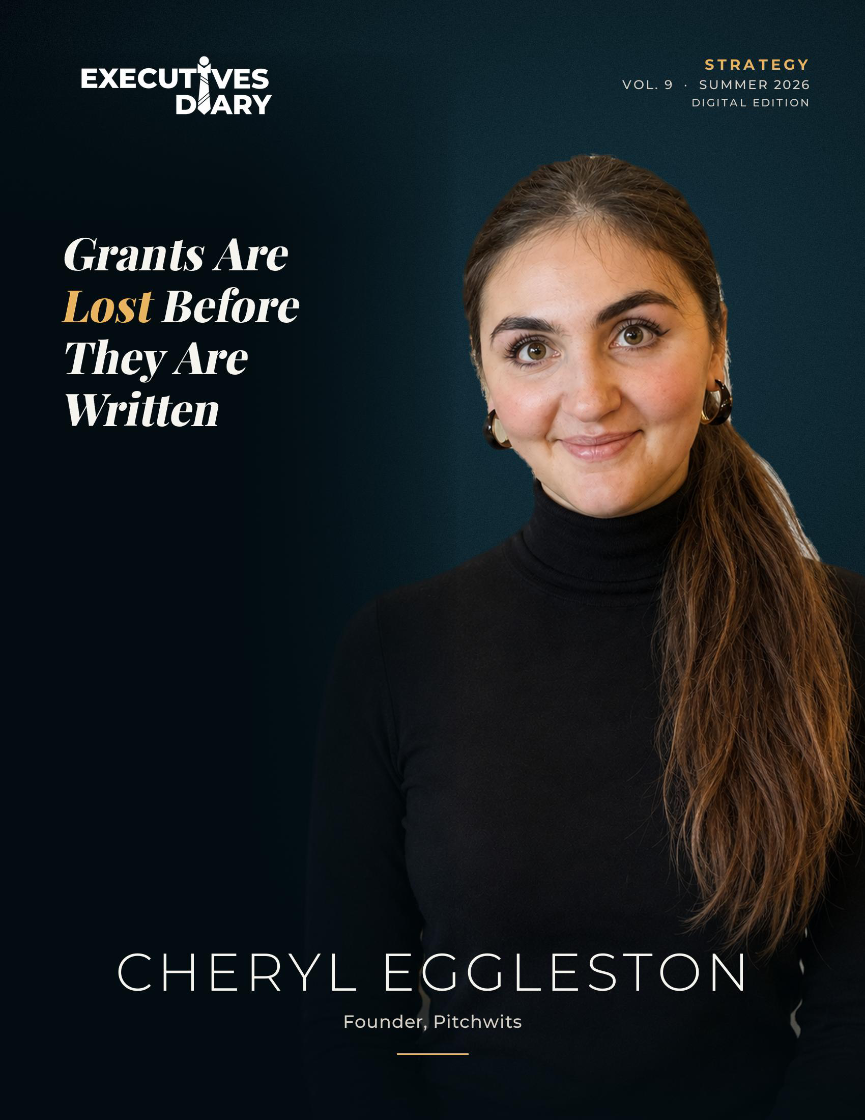
Cheryl Eggleston
Funding Intelligence & Strategic Grant EngineeringThe Moment the Rules Changed:
For years, the grant funding world operated on a simple enough premise: find the right competition, write a compelling application, and the odds would follow. It was templatable work, and for a while, that was enough. Then everyone learned the template. Competent became the floor, not the ceiling, and the founders who kept losing were not losing because they wrote badly. They were losing because they started too late, in the wrong place, with the wrong thesis about what funders actually wanted. Cheryl Eggleston watched this happen from close range. Then she built something to fix it.
Funding Intelligence, Not Grant Writing:
Cheryl Eggleston is the founder of Pitchwits, a London-based platform built to help early-stage innovators secure R&D grants and investment at the right time, in the right sequence, from the right sources. She has spent more than five years inside the grant funding system at a level most founders never see, overseeing more than $200 million in UK, EU, and US funding won for early-stage teams. Pitchwits is what she built when she concluded that the system’s core problem was not execution. It was intelligence.
From Oxford to the Funding Engine:
Eggleston studied English at the University of Oxford, graduating in 2018. The degree was not a detour. It was the first layer of a very specific set of skills that would eventually make her unusually good at a problem most people frame entirely in financial terms. Language under constraint, the way meaning is built and lost inside a limited structure, would become one of her most precise professional instruments.
She moved directly into investment and capital markets research at Third Bridge Group, where she spent two and a half years working in private equity research. The work put her inside a world of expensive, high-quality data: Bloomberg terminals, Pitchbook subscriptions, expert interview libraries sitting behind paywalls. She learned how to interpret financial information, not just access it. She learned that access and understanding are not the same thing. That distinction would matter later.
The pivot to grant funding came at Grantify, where Eggleston spent just over four years in a sequence of roles that expanded in scope each time. She joined to work on quality assurance, hiring and managing a team of twenty UK and EU funding consultants specialising in fintech, AI, and energy. She then moved into heading the grant funding function, expanding Grantify’s consultancy services into the EU and US. By the time she was leading a global customer success and consulting division of sixty-five staff across ten countries, she had a clear view of the entire system: where it worked, where it failed, and why the failure almost always happened before the application was ever written.
Then, in April 2025, she founded Pitchwits.
What $200 Million in Funding Taught Her About Where the Work Actually Lives:
The insight that drives Pitchwits is not complicated to state, but it is difficult to act on. By the time a grant competition opens, many of the questions that will determine the outcome have already been answered, months earlier, in how the R&D itself was shaped. The application is not the problem. The problem is everything that happens before it.
This is not a philosophical point. It is a diagnostic one. When Pitchwits evaluates whether a team is ready to compete for a grant, the question is not whether they can write a strong application. The question is whether the R&D has been designed with the funder’s theory of change in view, whether the team has done the unglamorous groundwork to establish credibility, and whether the project carries the right kind of tension. “A fundable project has to carry enough live risk to justify public money, and be held by a team that reads as a competent, high-quality safe pair of hands. Exciting and trustworthy at the same time.”
Get that tension wrong in either direction and no amount of drafting skill recovers it. Eggleston and her team have become precise at spotting the signals early. If a founding team wants funding for exactly the project they already have, unchanged, that is usually a no. Not because the project lacks merit, but because the alignment work that separates a competitive bid from a credible-but-average one cannot be done in the weeks before a deadline.
The sequencing question sits underneath all of it. Grants are frequently treated as a softer, more forgiving alternative to equity. Eggleston pushes back on that framing hard. The implication is that grant strategy deserves the same rigour as investment strategy, and that founders who treat it as a fallback option are making a significant miscalculation.
Pitchwits addresses this through a combination of funding intelligence and a purpose-built AI workstation. The platform aggregates and interprets public grant funding data, aligns it to fund strategy reports, government budget movements, and shifts in the political landscape, then delivers something Eggleston calls a “simulated competition.” Rather than simply matching a founder’s R&D pipeline to a competition scope, Pitchwits models the likely field: which themes will be oversubscribed, which are technically in scope but already heavily funded, and where a specific team’s capabilities would be rarest and most competitive. The output is not a recommendation. It is a strategic read on where a particular team can win.
The AI agents built into the platform are designed with the same philosophy. Eggleston is pointed about what she is building against. Pitchwits does not optimize for user satisfaction at the moment. It optimises for assessor satisfaction months later, when the application is in front of a real panel. The platform’s “Judge” agent mimics grant assessor processes, adding layers of pushback and stress-testing rather than smoothing toward an easy output. The friction is deliberate. It is where the work gets done.
Pitchwits is an NVIDIA Inception member, a recognition that places it among a select group of AI startups working at the edge of what the technology can do in specialised, high-stakes domains.
The Innovators Who Cannot Afford to Get This Wrong:
There is a founder Eggleston has in mind when she talks about why Pitchwits exists. Not a category of founder, a specific situation. A team with genuinely important R&D, a narrowing runway, and a funding strategy built on assumptions that are no longer accurate. Chasing grants when they need equity for speed. Raising equity when a grant could fund technical proof first. Entering competitions that are oversubscribed in exactly the area where they are strongest, at exactly the wrong moment. The innovation does not fail because it was bad. It fails because the funding process consumed the time and resources that should have gone into the work.
Eggleston founded Pitchwits on a single conviction: that the funding process should not be the reason a good idea stops. The $200 million figure in her background is not a credential she leads with. It is the accumulated evidence of what she learned watching the system work, and watching it fail, from the inside.
The question she built Pitchwits to answer is not “how do you write a better grant application?” It is “how do you make sure the right innovation reaches the funder who was built to fund it?” That is a harder problem. It is also, she would argue, the only one worth solving.