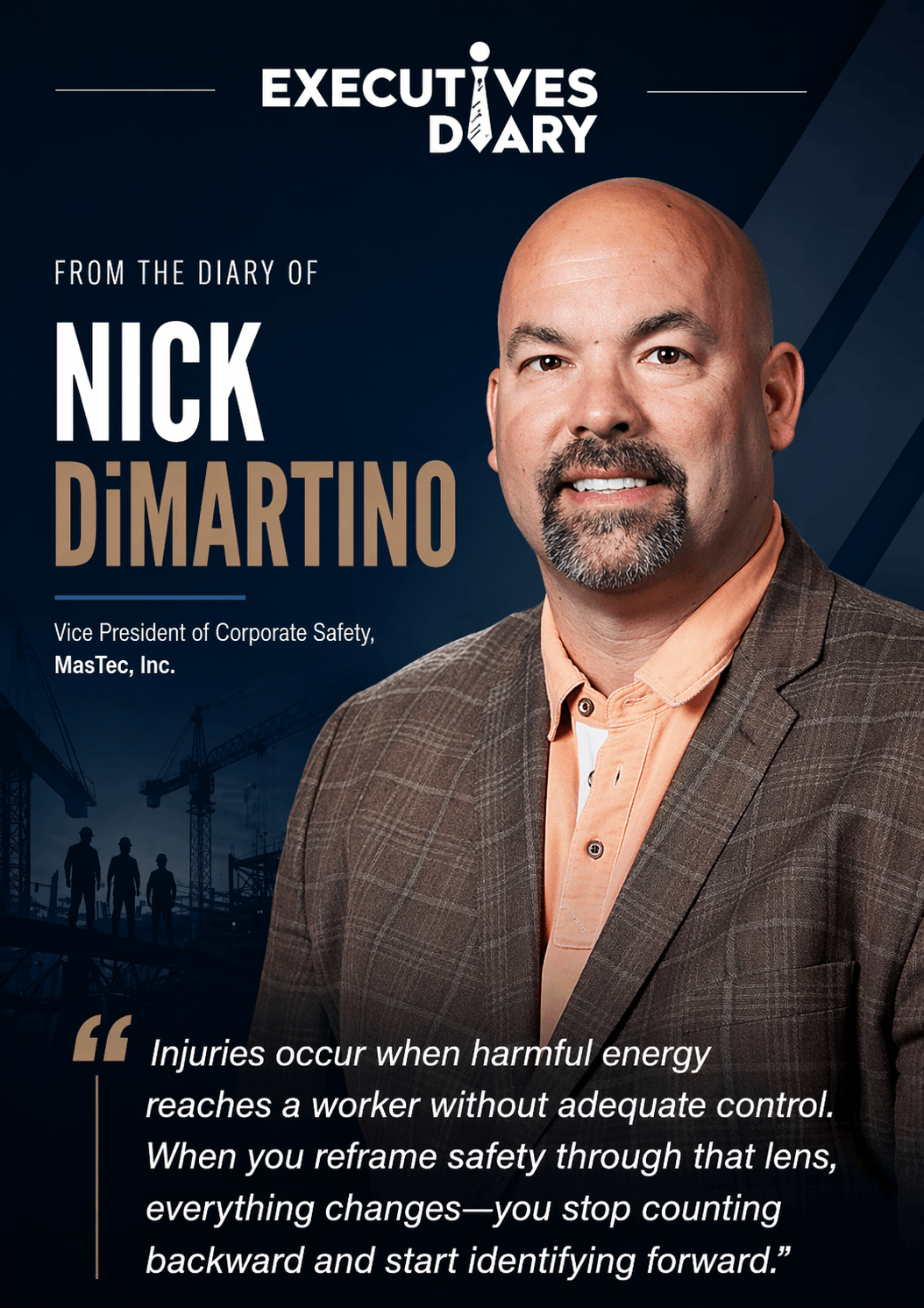
Nick DiMartino
Energy-Based Safety and the Significant Reduction That Changed EverythingA supervisor stands at the edge of a construction site at dawn. The sun is still low. The crew is gathering. He has a clipboard with the day’s work: heavy equipment moving, high-voltage lines overhead, multiple contractors working in proximity. He knows the schedule is tight. The client wants progress. The pressure is always there.
He also knows that somewhere on this site today, there is energy—gravity, motion, pressure, electricity—that could kill someone if the wrong person is in the wrong place at the wrong time. He cannot see it yet. The hazard has not materialized into an incident. It exists only as a condition. A possibility. A gap between what should happen and what could happen if the system fails.
This is the world safety leaders actually live in. Not in reports or dashboards. Not in the metrics that boards review in quarterly meetings. But here. In the gap between planning and execution. Between control and chaos. Between the person who goes home at the end of the day and the person who does not.
Most safety programs exist to count what has already gone wrong. They are mirrors looking backward. But what if the only safety metric that matters is the one no one is measuring?
Meet Nick DiMartino
Nick DiMartino is the Vice President of Corporate Safety at MasTec, a Fortune 500 construction and infrastructure company. His title is corporate safety. His actual work is something far more specific: he is the person who proved that the future of safety depends on seeing what has not happened yet.
For 27 years, Nick has built safety cultures across industries as varied as automotive, petrochemical, power, renewables, and infrastructure. But the last decade at MasTec forced him to ask a question that most safety professionals never ask out loud: What if everything we measure is wrong?
How a Safety Professional Learned to Think Like a Scientist
Nick’s path to this question was not straight. It began in 1993 at Slippery Rock University of Pennsylvania, where he earned a degree in Safety and Environmental Management. He was trained to do what the field demanded: manage compliance, track incidents, build awareness programs, reduce injury rates.
For the first fifteen years of his career, he did exactly that. He worked as a Safety Director at Aker Construction, managing 35 safety professionals across major power projects that employed thousands of workers and budgets that reached into the billions. He moved through roles at companies like Songer Steel Services and NAES Power Contractors, each one adding layers to his understanding of how large organizations actually operate in the field.
In 2012, he became Vice President of Health, Safety, Environmental & Security for Amec Foster Wheeler’s Global Power Group, responsible for HSSE operations across three continents. He was credentialed. He had earned his CSP and CHST certifications. He knew the industry inside out.
But something was missing.
In 2016, when Nick joined MasTec, he stepped into a leadership role within an already expansive and complex operational environment. Over the next decade, he oversaw a transformation where incident frequency rates decreased significantly, even as the company’s total scale and footprint increased rapidly. This approximately three-quarters reduction in incident rates represents thousands of workers who went home safe. Families not shattered. Lives not changed forever by preventable harm.
Yet even as that metric improved, Nick began studying research from the Construction Safety Research Alliance, the only industry-funded research group focused exclusively on advancing the science of safety. He read peer-reviewed journals. He studied Dr. Matt Hallowell’s work on energy-based hazard recognition. And he realized something that most boards will never understand: traditional injury rate metrics are statistically invalid predictors of future performance.
He had spent two decades building a house on sand.
The Shift From Counting to Predicting
Today, Nick’s philosophy rests on three interlocking priorities that represent a complete departure from how most organizations think about risk.
The first is energy-based safety. Rather than asking “How many incidents did we have?” the question becomes: “Where are the high-energy exposures in our operations, and do we have the controls in place to protect our people even when something goes wrong?” This is not semantics. This is a fundamentally different way of thinking about the physics of harm.
The second priority is building controls and capacity to fail safe. This means designing systems where a single human error cannot produce a catastrophic outcome. Layered controls. Engineered safeguards. Organizational structures that absorb mistakes before they become fatalities. The research Nick studies suggests that approximately 40% of high-energy hazards in the field still lack adequate safeguards. That is unquantified liability sitting on corporate balance sheets, invisible to most boards.
The third is predictive leading indicators. Instead of dashboards that measure TRIR and DART—lagging indicators that tell you what already happened—Nick has shifted MasTec toward quality-driven metrics that measure pre-job planning, safety observations, and leadership engagement. These are signals of how the business is actually performing before an incident occurs.
“The board’s role is to ensure the organization invests in preventing harm, not just responding to it,” he says. “Reactive safety programs respond to harm. Proactive ones prevent it.”
Nick translates all of this into three currencies that boards actually care about: financial exposure, operational continuity, and reputational risk. A significant and sustained reduction in incident rates over ten years is not just a safety accomplishment. It is a competitive advantage. It is workers’ compensation costs dropping. It is contracts won and renewed because safety performance demonstrates that this company knows how to manage risk.
The Visibility That Changed Culture
When Nick talks about building safety culture during rapid organizational scaling, he does not cite programs or training modules. He talks about showing up.
“Visibility means leaders show up in the field—not to inspect, but to listen,” he explains. “When frontline workers see a VP of Safety in their boots on a job site asking questions instead of pointing fingers, the culture message travels faster than any memo ever could.”
This is not performative. Nick’s presence on job sites is consistent. His standards do not flex under schedule pressure or client demand. The moment workers see safety treated as negotiable, the culture collapses. Nick’s entire leadership approach is built around holding that line while supporting the field leaders who hold it with him.
The other pillar is trust. Organizations that punish candor are flying blind. Workers know the difference between a leader who wants to learn what went wrong and a leader who wants to assign blame. Nick has spent 27 years creating reporting environments where near-misses are shared without fear. That data is gold. It tells you where the system is failing before someone gets hurt.
“Consistency means standards do not flex,” he says. “Trust means creating an environment where workers share concerns without fear. That is how you see the gaps before they become catastrophes.”
At MasTec, visibility, consistency, and trust are not values on a poster. They are operating principles that shape every resource decision, every policy, and every leadership choice Nick makes.
The Bedrock: Dignity
Early in his career, Nick watched highly credentialed safety professionals deliver technically correct programs that workers completely ignored. The programs were built for compliance, not for people. Workers knew the difference. They always do.
Over 27 years and across industries as varied as automotive, petrochemical, renewables, and infrastructure, Nick learned what actually works. The most effective safety leaders are not the ones with the most certifications. They are the ones who are trusted.
And trust is earned by showing—consistently, in the field, in the boardroom, and everywhere in between—that you genuinely believe the person in front of you matters more than the metric on the dashboard.
“Dignity,” he says simply. “Every worker deserves to go home the way they arrived. That is not a slogan. It is the frame through which I evaluate every policy, every resource decision, and every leadership choice I make.”
In May 2025, Nick became a grandfather. That milestone sharpened something in him that no credential ever could. He now advocates for workers in rooms they are not in. That is both a responsibility and a privilege. It is the reason he sits on the board of the Construction Safety Research Alliance. It is the reason he speaks about energy-based safety at the board level. It is the reason he believes safety professionals belong at the table when strategy is decided.
The DiMartino Playbook
- 1. Hazard Over Incidents: Stop measuring what already happened. Use leading indicators like energy assessments to see what is about to happen.
- 2. Visibility is Leadership: Show up in the field and listen more than you direct. Credibility is built in boots, not memos.
- 3. Unflexing Standards: Never let safety become negotiable under schedule or client pressure. Culture erodes the moment you flex.
- 4. The Dignity Metric: Build your philosophy on the belief that every person deserves to go home the way they arrived.
The Bridge That Needed Building
The opening scene on that job site at dawn—the supervisor standing in the gap between what should happen and what could happen—is the world Nick has spent his entire career trying to change.
Most boards do not see that gap. They see injury counts. They see TRIR numbers. They see safety as a cost center, a compliance obligation, a line item that competes with production for resources. Nick changed that conversation at MasTec by translating the invisible language of energy-based risk into something boards could understand, measure, and act on.
But his real legacy is different. The next generation of safety professionals will have a seat at the table because someone proved they belonged there. Boards will be stronger. Companies will be safer. And workers will be better protected because safety leadership was finally given the strategic authority it has always deserved.
That supervisor at dawn will still feel the pressure. The schedule will still matter. But now he stands in a system designed to see the hazards before they become harm. That is what happens when someone refuses to count the obvious and builds the bridge between the boardroom and the field instead.