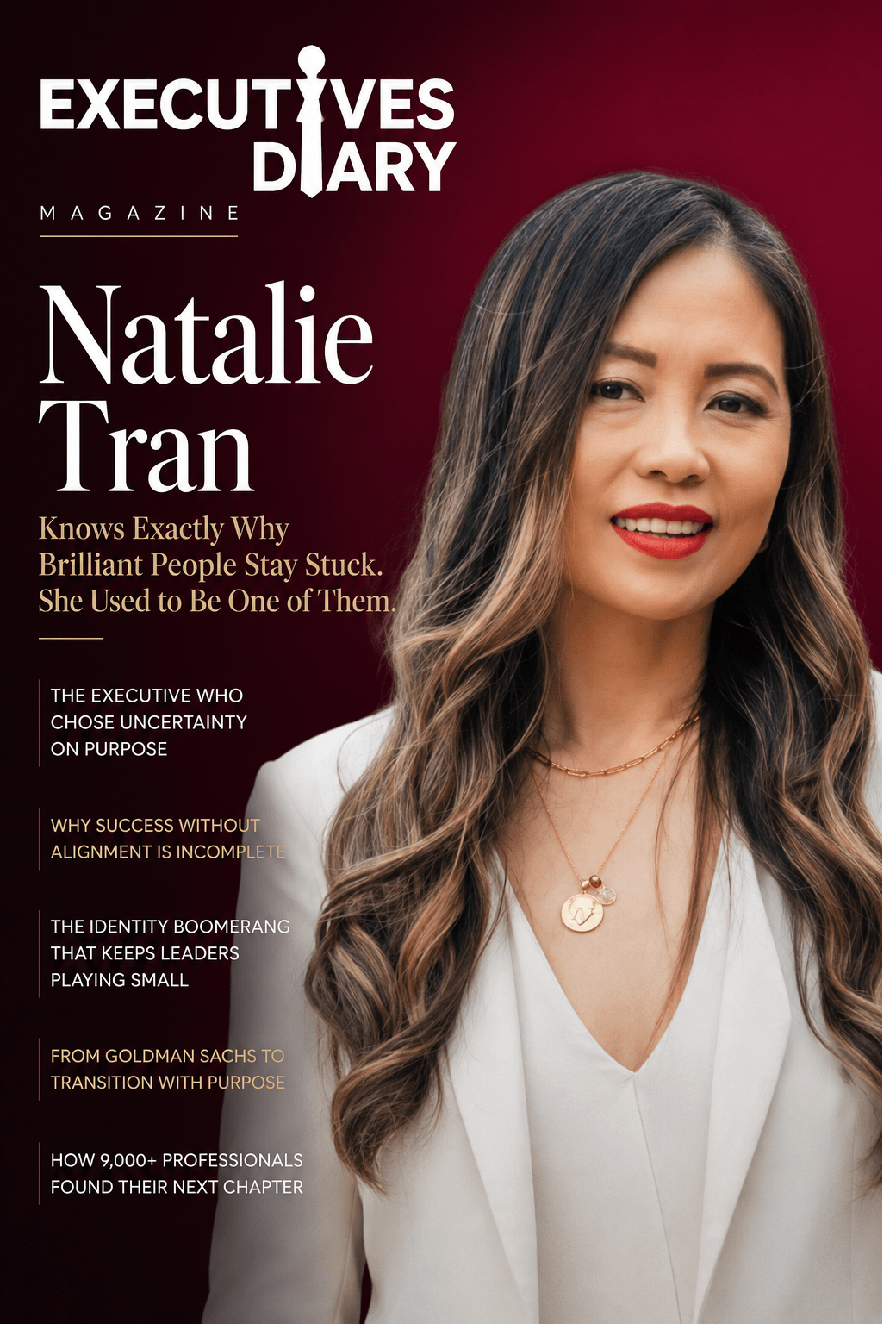
Natalie Tran Knows Exactly Why Brilliant People Stay Stuck. She Used to Be One of Them.
There is a particular kind of professional paralysis that only high achievers understand. It does not announce itself in performance reviews or quarterly assessments. It lives quietly behind an impressive title, a well-appointed office, and a LinkedIn profile that makes former colleagues assume you have everything sorted. The external markers suggest success. The internal reality whispers something entirely different.
Natalie Tran had built exactly the kind of career that other careers are measured against. Executive Director at Goldman Sachs Asset Management. A Chartered Accounting qualification earned at Deloitte. A decade managing institutional client relationships and operational delivery across Australia and New Zealand, overseeing consultant relationships and contributing to successful mandates at significant scale. By any external measure, she was winning.
She was also burnt out, disconnected, and quietly certain that she had been climbing the wrong wall entirely.
The Strategist Who Rewrote the Playbook
Natalie Tran is the founder of Transition With Purpose, a Melbourne-based career strategy practice that has guided more than 9,000 professionals through the most disorienting moments of their working lives. She is also the host of the Transition With Purpose Podcast and a senior consultant at Right Management, where she specializes in helping executives translate deep experience into market-relevant positioning. Her work sits at the intersection of career strategy, personal branding, and the psychology of professional identity, addressing the gap between internal performance and external market value.
The Executive Who Chose Uncertainty on Purpose
The career that built Natalie Tran reads like research, though it did not feel that way while she was living it.
She began following the traditional blueprint for high achievement. Bachelor of Commerce at the University of Melbourne. Chartered Accountant qualification at Deloitte, where she developed the analytical precision that would define her next decade. The finance world rewarded her progression. She moved into institutional funds management and eventually reached Executive Director at Goldman Sachs Asset Management, managing complex client relationships, leading RFPs, and overseeing new business submissions that contributed to successful mandates across Australia and New Zealand.
From the outside, the trajectory looked inevitable. From the inside, something fundamental was eroding.
What followed was a decision that most senior executives quietly admire and publicly question. She left without a plan B. No carefully staged sabbatical. No adjacent role waiting in the wings. She chose uncertainty on purpose.
The transition period that followed would have puzzled her former colleagues. She retrained in wellbeing, coaching, and personal development. She became certified in Pilates, anti-gravity yoga, and personal training, teaching across boutique studios, osteopathic clinics, and commercial fitness centers throughout Melbourne. She worked with bodies in pain, nervous systems on high alert, and clients rebuilding physical confidence one session at a time.
From Goldman Sachs boardrooms to reformer beds might appear to be a dramatic detour. In reality, it was an immersion in how humans actually change, as opposed to how they say they will change. Working with physical resistance taught her something no finance career could have provided: transformation happens in the body before it happens in the mind.
“The biggest translation challenge was moving from a world where credibility was often established through titles, institutions and technical expertise, into a space where trust is built through story, presence and lived experience,” she explains.
That translation challenge, which she navigated personally, became the foundation for everything that followed. She founded i-Aspire Performance Coaching in 2013, working with individuals and teams on strengths profiling and leadership development. She joined Right Management in 2015, coaching executives through redundancy and career transition. By 2021, when she launched Transition With Purpose, she was not starting over. She was arriving with a decade of research on how successful people get unstuck.
The Work That Reframes Everything
Ask Natalie Tran what problem she really solves, and she will not begin with resumes or LinkedIn optimization.
“Most of the people I work with are already highly capable. They are not stuck because they lack experience. They are stuck because their identity is still anchored to a past chapter that no longer fits where they want to go.”
This insight explains why a significant portion of her client base consists of long-tenured leaders who have spent 15 to 20 years in one organization. When restructures, leadership changes, or personal decisions force them into the external market, many discover they are profoundly disoriented. Their reputation was strong, but it lived inside one company. Their network was deep, but mostly internal. Their job search strategy was outdated, and they struggled to articulate achievements because, to them, they were simply doing their job.
Tran is clear that these are not competency gaps. They are communication gaps, and more fundamentally, identity gaps.
Her approach centers on what she calls the “Identity Boomerang,” a concept that describes what happens when professionals finally start gaining real momentum in a new direction, only to unconsciously pull themselves back just as things begin working. The subconscious beliefs attached to an older version of themselves start firing: Who am I to do this? What if people judge me? What if I actually succeed?
Her response is not to push harder through willpower. It is to get curious about the resistance. She teaches clients to ask what part of them feels unsafe, what belief they are still carrying, and what the next version of themselves would actually choose. Then she asks them to lead from that future identity before it feels comfortable.
The practical architecture of her work includes proprietary frameworks like EPIC and SHIFT, which integrate self-awareness, authority branding, and visibility systems for sustainable career growth. Through Transition With Purpose and her work at Right Management, she has delivered hundreds of workshops and webinars for corporates, professional associations, and outplacement programs across Australia.
Her perspective on networking challenges conventional transactional approaches. She teaches a framework called BUILD: Background research, Understanding their world, Identifying opportunities, Leading with value, and Developing the relationship consistently.
This philosophy shapes how she positions LinkedIn for clients. She does not treat it as an online resume but as what she calls a “personal landing page” and “discoverability engine.” The goal is to move from passive reputation to active market positioning, especially critical in an era when up to 80 percent of roles are filled through the hidden job market before most candidates see an advertised position.
The rise of AI has only sharpened the need for this kind of strategic positioning. Tran is direct about where AI helps and where it harms in career transitions. She will use it for market research, salary benchmarking, and ATS optimization. She draws a firm line at outsourcing authenticity.
“AI can speed up the admin of a job search, but it cannot decide what success looks like for you now, or speak with your voice, or build the relationships that open the right doors.”
This connects to another concept she uses frequently with senior leaders: human ip. The idea that the real advantage executives hold in the age of AI is not their technical skill alone, but the pattern recognition, contextual judgment, and adversity-earned wisdom built through lived experience.
She pushes clients to document this in ways their organizations can leverage. After major challenges, she encourages a simple reflection process: what happened, what they noticed before others did, what decision they made and why, what they would repeat or never repeat, and what it teaches the team.
“When these insights are shared through reflection sessions, mentoring, playbooks and team debriefs, they become Human IP that compounds. The wisdom stays in the organization instead of walking out the door when one leader leaves and it also becomes part of the story, value and positioning they can carry into their next career transition. .”
The results of her approach are concrete and measurable. Through her programs, clients have landed senior roles, launched successful consulting practices, and built personal brands that attract inbound opportunities without cold applications. The 9,000 professionals who have moved through her transition programs represent a decade of proof that the methodology works at scale.
Choosing the Right Wall
Natalie Tran opened this story as someone who had built a career that looked like success and felt like profound misalignment. She closes it as someone who has spent more than a decade helping others recognize the difference between climbing faster and climbing the right wall entirely.
The professionals who seek her guidance are not failing. They are brilliant, experienced, and deeply capable. That is precisely why they are stuck. They have optimized for external validation for long enough that internal alignment feels foreign. What Tran offers is not a new set of tactics but a fundamental recalibration of the question itself.
The Executive Director who left Goldman Sachs with no plan B now specializes in giving other leaders something more valuable than a safety net. She offers them the language and structure to honor the truth they have been quietly carrying: that success without alignment is, at best, incomplete.
The bravest move is not always climbing higher. It is being willing to become someone new at the exact moment everyone else thinks you have arrived.
Key Frameworks / Playbook
- EPIC & SHIFT: Proprietary structures integrating deep self-awareness, authority branding, and visibility systems for long-term career growth.
- BUILD Framework: Rethinking transaction networking via Background research, Understanding their world, Identifying opportunities, Leading with value, and Developing relationships.
- Human IP Development: Capturing experiential wisdom, contextual judgement, and pattern recognition so execution insight compounds within an organization rather than leaving with individual personnel.