Everyone Agreed with the Change. Nobody Changed. Then Ren Chang, Soo, Walked In.
Chief Emergence Alchemist at Interlock & InfinityThe slide deck was flawless. The town hall went smoothly. Heads nodded at all the right moments. Three months later, nothing had moved. Not because people were hostile or the strategy was wrong, but because agreement and action live in completely different worlds, and most organizations have spent decades confusing the two.
This is the expensive gap where corporate initiatives go to die. And it is exactly where Ren Chang, Soo, does his most important work.
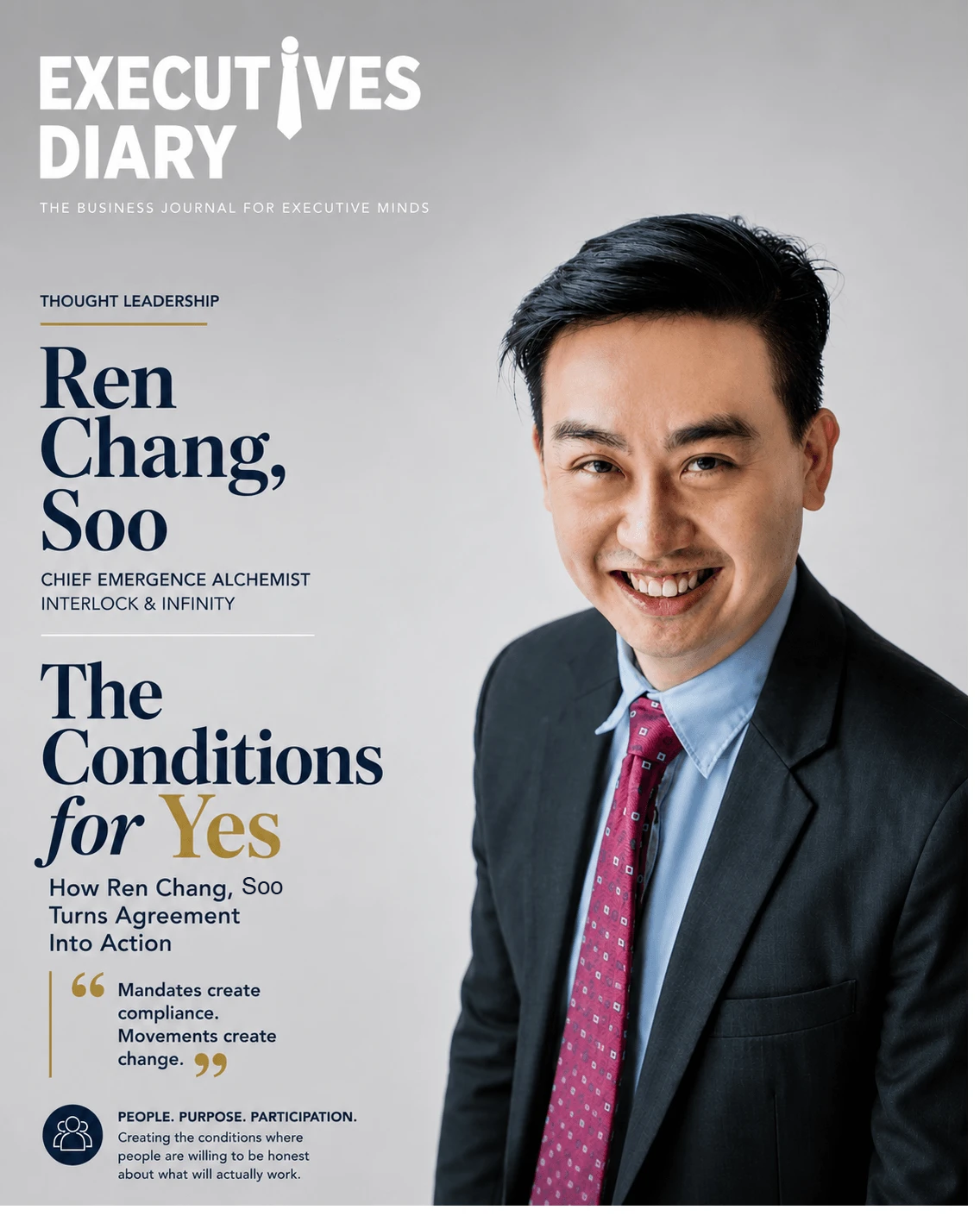
Ren Chang, Soo, is Chief Emergence Alchemist at Interlock & Infinity, a Malaysia-based practice that helps organizations create conditions where people genuinely say yes to change. He is also a Teaching Lead at IDEO U and creator of the Disney Design Thinking newsletter. What defines him is not a method or a title, but a belief that the hardest part of change is not designing the solution but creating the conditions where people are willing to be honest about what will actually work.
The Wrong Sort of Person for the Room
That belief did not arrive from a textbook. It grew from years of feeling like the wrong kind of professional in rooms that rewarded volume over depth.
His path looks restless on paper: telco engineering at Universiti Putra Malaysia, where he built RFID wristbands for theme parks. Then a Master’s in Management Psychology at the University of Nottingham, researching how personality and emotional intelligence shapes performance among Malaysian banking sales staff. After that came corporate stints that defy neat categorization: IT business analysis, human capital consulting, talent management, design thinking, a tech startup, eventually Head of Risk Strategy, Innovation and Culture at RHB Banking Group.
At every stop, he heard the same feedback. “You’re too quiet.” “Put yourself out there more.”
He would attend networking events and hide near the catering tables. “I’m the one refilling my water glass three times just to have somewhere to stand, wondering when I could leave quietly,” he admits. His CliftonStrengths profile confirmed what he already suspected. Woo sat dead last at number 34. For years, he thought that was a career liability.
Until he noticed what had quietly taken its place at the top. Relator. The strength that pulls someone away from breadth toward depth. The one that makes you leave conferences early because you have run out of small talk, then stay up half the night in a conversation that finally gets to what matters.
he reflects.
That filter reshaped his entire approach to work. Each role added a layer of understanding about why people behave the way they do under pressure, inside systems, and in the presence of change they did not ask for. His time in risk management raised eyebrows among friends who asked, “What are you doing in risk?” The awards answered for them. Under his leadership, RHB won Winner for Risk Culture at the ASEAN Risk Awards in 2025, along with multiple other regional recognitions.
he explains.
The Space That Fixed Itself
When he left his senior role at RHB and stepped out as an independent, something clarifying happened. The corporate title disappeared. He was not sure when he reached out to Money20/20 RiseUp Asia about continuing as a mentor, whether they would still want him.
They said yes. Then they asked him to moderate a panel on career pivoting.
“I realized my identity was never the title. It was the pattern of how I showed up. Complex problems need people who have lived in multiple worlds,” he says.
That pattern is now explicit through Interlock & Infinity, which he co-founded with partners Aaron and Jessica. They use LEGO® SERIOUS PLAY® and CliftonStrengths to help organizations see themselves clearly and decide what to do about it.
The method sounds deceptively simple until you see it work. The method serves the moment, not the other way around. That belief has shaped the way he designs conversations, especially when the real need is not tighter control, but enough space for the right questions to surface.He does not arrive with a fixed method. He arrives with a question: what does this moment actually need? When a client once asked for a half-day design thinking workshop, he said no. Not because he could not deliver it, but because after listening, he realized design thinking was not what they needed. They needed clarity on what stakeholders in the financial services system valued most. He proposed LEGO® SERIOUS PLAY® instead. That instinct, to listen before prescribing, shapes every engagement.
“The method should serve the moment. Not the other way around,” he says. That belief has shaped the way he designs conversations, especially when the real need is not tighter control, but enough space for the right questions to surface.
At a global manufacturing company’s annual summit, that meant using Open Space Technology with 150 leaders, from the CEO down. The previous year, a tightly controlled facilitation format had left tension in the room and conflict unresolved. This time, the work required a different container. He introduced the principles, created the conditions for leaders to choose the conversations that mattered most, and then stepped back.
“For three hours, I did almost nothing. The leaders set their own agenda, formed their own groups, and chased their own questions. By the end, they had real action plans and, more importantly, rediscovered shared ownership,” he describes.
What surprised the CEO was not only the quality of the action plans, but the energy behind them. Once leaders were trusted to name the real issues and gather around the questions they cared about, ownership returned to the room. The result was not manufactured agreement. It was participation with consequence.
he explains.
His Disney Design Thinking newsletter applies the same principle through storytelling. Elsa’s “conceal, don’t feel” becomes a case study in corporate innovation labs. Belle transforming the Beast becomes a framework for leading change without certainty. Raya extending her gem piece first becomes an examination of trust when there are no guarantees.
“If I tell a leader ‘you are shutting down dissent,’ they will argue. If they recognize themselves in Elsa or Belle, they lean in. They discover their own diagnosis instead of having it imposed on them,” he notes.
As a mentor for over 5,000 students from 80+ countries through the USAII Global AI Hackathon, he focuses not on technical capability but on human need. He reminds them of IDEO’s famous mouse redesign, when a four-hundred-dollar prototype became a twenty-dollar product not through raw power but by watching real hands struggle.
“The best AI won’t be the smartest. It’ll be the one that disappears into everyday use. AI can’t sense what users can’t articulate. It can’t sit with ambiguity when everyone wants answers,” he observes. As teams automate administrative layers, they risk losing the connective tissue that made collaboration human. “Automation amplifies whatever culture you already have. If the connection was fragile, AI speeds up the drift. The real work is protecting the human moments while everything else accelerates.”
The Conditions for Yes
Across all his work, whether in boardrooms or classrooms, hackathons or conference halls, Ren Chang, Soo, is doing the same quiet thing. He is asking what conditions would make the truth speak up, and then removing anything that gets in the way.
Everyone agreed with the change. Nobody changed. His work starts where that sentence ends, in the space between public agreement and private commitment, where the real transformation either happens or dies.
Because the hardest part of leading change is not getting people to say yes in public. It is designing a world where their behavior finally matches the yes they were too afraid to say out loud.