
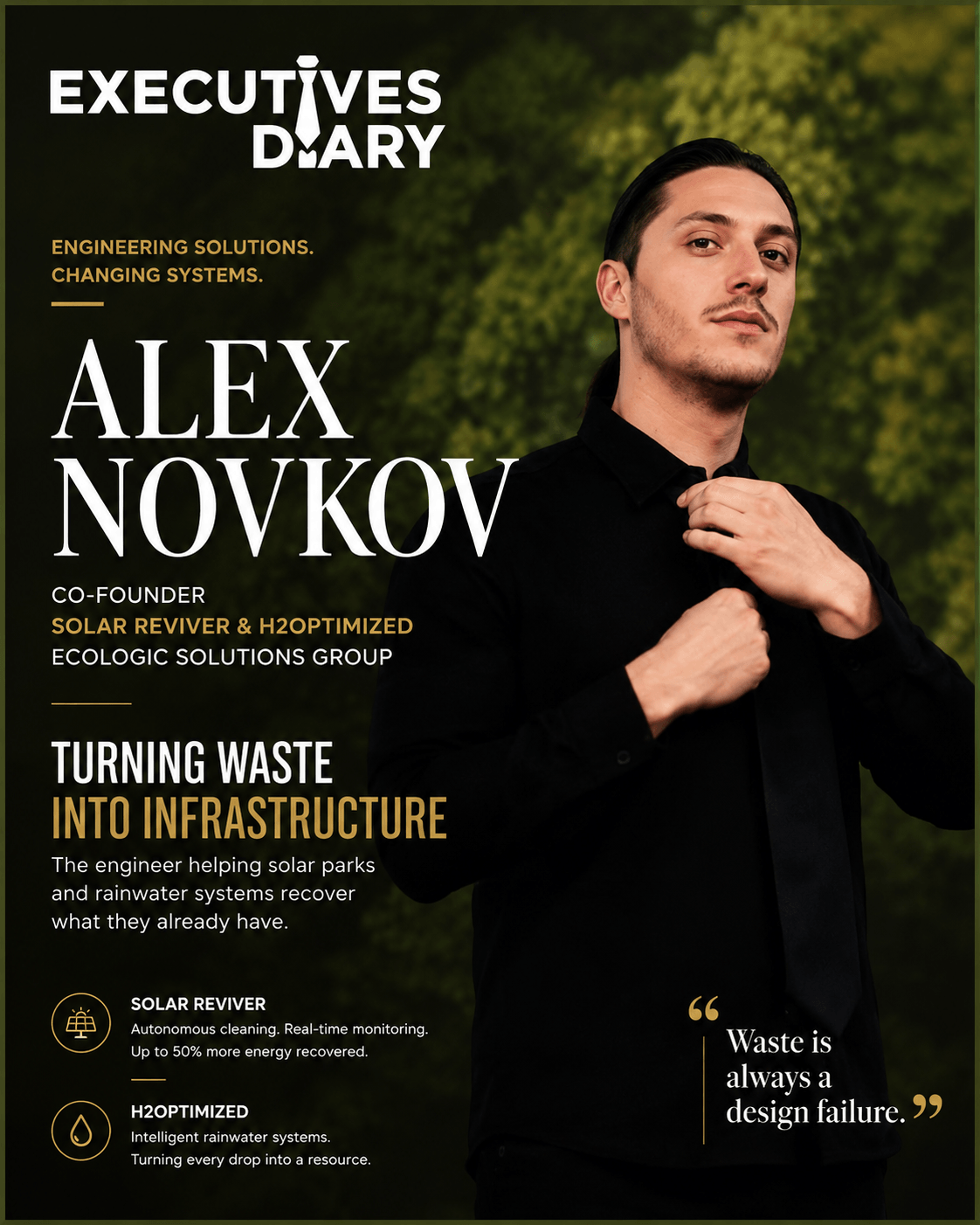
Alex Novkov
Teaching Bulgaria’s Solar Parks and Rainstorms to Stop Wasting What They Already Have.When Infrastructure Ignores Mathematics
On a flat field outside Sofia, rows of solar panels stretch toward the horizon under a thin layer of dust and environmental buildup. To most observers, it looks like any other industrial solar park. To Alex Novkov, it looks like a mathematical error being repeated at massive scale. Those panels, designed to capture and convert sunlight into electricity, are quietly losing up to half their potential output simply because no one has solved the basic problem of keeping the glass clean.
A few months earlier, this same park hosted a full day of testing. An autonomous robot moved methodically along the panel rows, cleaning and monitoring each surface while collecting performance data. When the results came back, they told a story that the solar industry knew but had never adequately addressed. The dirty panels were throwing away measurable kilowatts. The cleaned ones recovered their full capacity.
That machine is Solar Reviver. The engineer behind it is also working to convince businesses that the rain falling on their roofs represents a second utility system they have never bothered to connect. That second solution is H2Optimized. Both emerge from the same fundamental observation: we are surrounded by resources we have decided, without much engineering analysis, to treat as waste.
The Student Who Builds Industrial Solutions
Alex Novkov is the Co-Founder of Solar Reviver and H2Optimized, operating under EcoLogic Solutions Group, and a Master’s student in Automation at the Technical University of Sofia. At first glance, he does not fit the typical profile of an industrial partner that solar park operators or infrastructure clients expect to meet. He moves between university laboratories, international accelerator programs, and live industrial deployments with the same methodical focus. What defines his work is not the unusual combination of roles, but the underlying philosophy that drives both his academic research and his companies: engineering problems require engineering solutions, and waste is always a design failure.
Building Systems Before Building Credentials
The foundation was established early, during his years at a vocational high school specializing in electronics and automation. While many classmates focused on passing exams, Alex was already reaching for tools, building prototypes, and testing concepts in the physical world. That hands-on approach carried directly into his Bachelor’s degree in Automation at the Technical University of Sofia and into early professional roles as an Automation Engineer at RoboClub.bg and a lecturer in problem-solving at Software University.
The teaching position proved particularly formative. Standing in front of students who expected clear, actionable answers forced him to move beyond theoretical knowledge toward practical application.
Solar Reviver began in March 2023, when Alex and his co-founder Teodora Savcheva were still first and second-year university students. The technical challenge was straightforward but unsolved at scale. Dirty solar panels lose efficiency dramatically, with dust, pollution, and environmental buildup reducing photovoltaic output by up to fifty percent. The solar industry understood this problem but had not developed an adequate solution. Manual cleaning is expensive, inconsistent, and logistically complex across large industrial installations.
Alex and Teodora built an autonomous robot to handle the task without human intervention, incorporating continuous monitoring through a mobile application that tracks panel condition and cleaning effectiveness. Real-world testing, conducted in partnership with Gate Institute inside a functioning industrial solar park, validated the engineering. The visual evidence was unmistakable: panels before and after cleaning showed dramatic differences in condition and, more importantly, in measurable energy output.
H2Optimized followed in April 2025, applying the same systematic approach to a different resource challenge. If solar energy was being lost through inefficiency, water was being lost through indifference. Rainwater falls on cities and industrial sites, runs off surfaces, and disappears into drainage systems where it is treated as a disposal problem rather than a supply opportunity. H2Optimized is an intelligent system for the collection, purification, and automated management of that water, designed for both industrial and residential applications.
Proving the Concept at Industrial Scale
The decision to consolidate both ventures under EcoLogic Solutions Group was announced at Industrial Tech Forum 2025. The consolidation was not about branding or organizational convenience. It reflected a deeper strategic recognition that both technologies address the same fundamental issue: resource efficiency in energy and water systems.
“Consolidating our ventures under EcoLogic Solutions Group has significantly improved our market position by allowing us to unify our expertise, resources, and vision under one ecosystem focused on sustainable engineering solutions,” Alex notes. The unified structure allows them to approach solar park operators, municipal infrastructure projects, and industrial clients with a comprehensive portfolio rather than individual point solutions.
In May 2025, H2Optimized competed at the SCION Accelerator Demo Day in Sofia against a technically sophisticated field of climate and nature-tech teams. The project secured second place, but for Alex, the recognition represented something more significant than an award. “The late nights, the uncertainty, the constant iteration, the technical challenges, the testing, and the pressure of building something meaningful from the ground up, all of it led to this moment.”
The SCION program provided more than validation. It created direct connections to investors, introduced partnerships with chemists and infrastructure engineers, and positioned H2Optimized within a network of climate-focused organizations including Rezolv Energy and other program supporters. These relationships are now supporting the technical development and deployment strategy for the water management system.
The Social Impact Award program added an international dimension to Alex’s work. As a participant and later as an alumni panelist, he competed alongside founders addressing climate challenges across different geographies and scales. The experience, including gatherings in Ljubljana, Slovenia, reinforced his conviction that technical solutions can create both business value and environmental impact simultaneously. “Every opportunity to learn from proven specialists and experienced founders is incredibly valuable and should always be embraced.”
In early 2026, Alex was nominated among the top students from all universities in Bulgaria for the national Student of the Year awards, achieving second place in the Technical Sciences category. The recognition reflects not just academic performance, but the integration of his research with real-world application. “My studies in Automation feed directly into our products. University gives me access to research, labs, and people who think deeply about control systems. The startups force me to apply that knowledge under real pressure.”
Engineering the Future of Resource Management
Today, Solar Reviver has completed successful deployments in operational industrial solar parks, where documented footage clearly demonstrates the contrast in panel condition before and after automated cleaning. In those real-world conditions, productivity gains of at least fifty percent on previously compromised panels represent not theoretical environmental benefits, but recovered revenue for park operators.
H2Optimized is simultaneously advancing on three fronts: technical development through collaborations with chemists and infrastructure engineers, deployment partnerships with organizations managing buildings and industrial sites, and market education through a comprehensive water awareness campaign that brings concrete data and examples to businesses and the general public.
The combined offering positions EcoLogic Solutions Group to address multiple aspects of the same sustainability challenge. A commercial or industrial client can now optimize both energy production efficiency and water resource management on the same site, creating integrated solutions rather than separate environmental initiatives.
Alex’s current focus extends beyond the Bulgarian market. He is actively seeking strategic partnerships and international expansion opportunities, positioning EcoLogic Solutions Group as a recognized force in sustainable engineering and climate-tech solutions. The goal is not simply to scale existing products, but to demonstrate that environmental technology can compete entirely on operational efficiency and financial returns.
The Mathematics of What Falls From Above
The question Alex Novkov continues to pursue is both simple and systematic: why do we accept such massive inefficiencies as standard industrial practice? Solar panels lose half their output to accumulated dust. Cities route millions of gallons of usable rainwater directly to drainage systems. Both problems have engineering solutions that have been tested, validated, and proven at industrial scale.
What remains is the more complex work of partnerships, international deployment, and convincing enough decision-makers that efficiency is not an environmental luxury but a business necessity. Alex approaches this challenge with the same methodical focus he brings to hardware design and software development. Every inefficiency represents a measurable loss that can be prevented through better engineering.
Some entrepreneurs wait for market conditions to align with their vision. Alex Novkov looked at what was already falling from the sky and decided that was an opportunity enough to start building the systems to capture it.
Key Takeaways / Playbook
- 1. Automation in Solar: Operational testing indicates dirty solar panels drop up to 50% in efficiency; autonomous cleaning cycles safely recover full production capacity.
- 2. Systematic Water Engineering: Treating urban and industrial stormwater run-off as a utility supply rather than an engineering waste hazard provides reliable on-site secondary resources.
- 3. Consolidated Eco-Efficiency: Unifying climate-tech verticals under an integrated structural engine allows infrastructure operators to simultaneously fix both localized energy and fluid loss.