Lisa Fenton
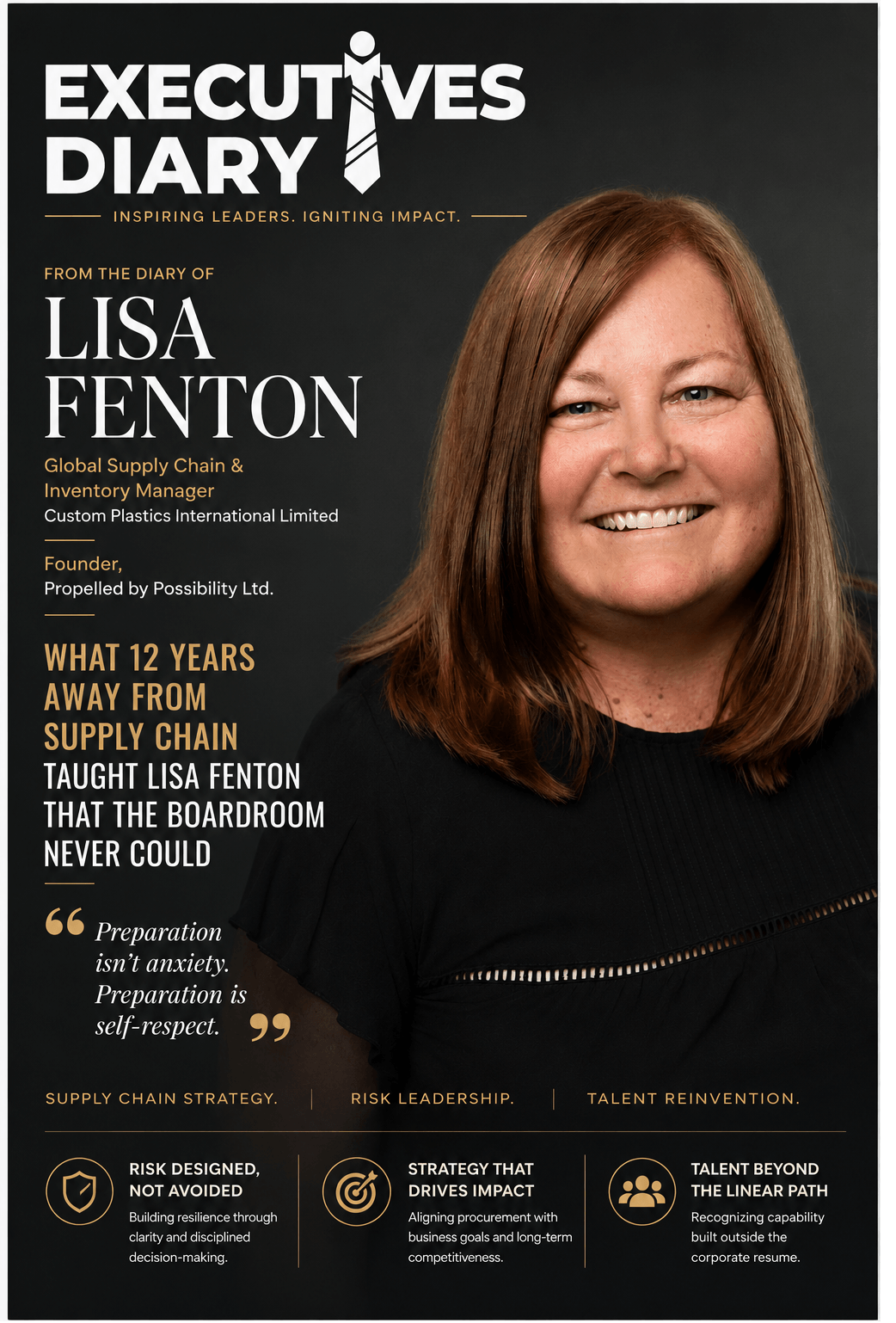
What 12 Years Away From Supply Chain Taught Lisa Fenton That the Boardroom Never CouldThe Risk That Became Strategy
Most executives point to failed deals, collapsed mergers, or brutal quarters when asked about their biggest professional risks. Lisa’s biggest risk looked like a kitchen table, three young sons, and a deliberate choice to walk away from a career she had spent years building. No safety net. No guaranteed return path. Just a clear-eyed decision that positions her to redefine industry standards.
She knew the math. A 12-year absence from procurement would mark her as outdated, disconnected, too far behind to catch up. What the math didn’t capture was the quiet erosion of professional identity that comes when your former expertise no longer has a place to land. There were years when she assumed the industry had moved on without her – and that the door might never reopen. She accepted that risk fully, including the possibility that the decision was permanent. What she discovered, and what the industry is still learning to recognize, is that those 12 years became the most clarifying leadership development of her career.
The question isn’t how she survived the gap. The question is why organizations keep treating career pauses as liabilities when people like Lisa prove the opposite.
The Executive Who Reframed Everything
Lisa is Global Supply Chain and Inventory Manager at Custom Plastics International Limited and founder of Propelled by Possibility Ltd., based in Ontario, Canada. She leads enterprise procurement and risk management in complex, regulated manufacturing environments while building a platform that challenges how organizations think about talent, capability, and the true cost of linear career expectations.
Building Capability Before Building Titles
Fenton’s early career followed a methodical progression that supply chain organizations reward. She started at Hubbell Canada in 2009 as a Customer Service Representative, but treated the role less as an entry point and more as a systems observation post. Within months, she had created templates to streamline inquiry processes for her entire team, reducing response times and improving customer experience.
That instinct to fix broken processes before anyone asks became her signature. She was promoted into demand planning, then joined Rapala VMC in 2011 as a Supply Chain Analyst. Over the next eleven years, she built a track record defined by specific, measurable outcomes. She negotiated reduced minimum order quantities with primary vendors, generating $144,000 in savings while hitting corporate inventory turnover targets. She cut freight spend by $216,000 through direct negotiations with logistics partners.
Promoted to Lead Planner, then Supply Chain Manager, each role added complexity and scope. As Lead Planner, she directed implementation of 14 software process improvements across Operations, Customer Service, and Customs, reducing manual transactions by 71 percent and saving $34,000 annually. As Supply Chain Manager, she administered a $7 million inventory with 12,000 SKUs, turning more than three times per month.
The Pause That Sharpened Focus
Those 12 years weren’t idle time. They were a different kind of executive development program. Not all of that development was intentional or elegant. There were long stretches without feedback loops, professional language, or validation- only consequences. The absence of external benchmarks forced her to rely on judgement rather than reinforcement, a discipline that was learned under pressure, not chosen. Risk management under real constraints. Negotiation without formal authority. Decision-making with long-term consequences and no corporate safety net beneath the outcomes.
When she decided to return, she didn’t just hope for opportunities. She conducted a gap analysis on herself, the market, and where she could create differentiated value. Even with preparation, re-entry was not frictionless. Some conversations ended quickly once timelines were disclosed. Others required her to prove current capability before past credibility was acknowledged. She treated each interaction as data, not rejection, but the signal was clear: nonlinear paths are still poorly understood.
She researched companies, studied salary data, and analyzed role evolution. She created her own network card because, as she puts it, opportunities move through people.
She arrived at Hubbell not as someone recovering lost ground, but as someone who had spent a decade developing judgment that linear careers rarely produce.
Translating Strategy Into Commercial Reality
At Custom Plastics International, Fenton leads enterprise sourcing and supply chain risk management across a highly regulated manufacturing environment. She balances cost discipline with long-term competitiveness while integrating complex chemical and material compliance requirements directly into sourcing strategies. Her scope includes PFAS, REACH, RoHS compliance, EU Classification, Labelling and Packaging (CLP), and responsible minerals due diligence through CMRT and EMRT protocols.
She partners directly with executive leadership, integrating procurement strategy with business strategy rather than letting them run in parallel. That distinction matters more than it sounds.
In practice, this means building teams around defined decision rights, transparent data, and genuine accountability. When people understand the purpose behind governance controls, they innovate within them rather than around them. Disciplined structure enables flexibility at scale.
The Platform That Challenges Assumptions
Fenton’s thought leadership runs parallel to her operational work. She writes for Supply Professional magazine on why supply chain change management belongs in every organization’s core capability stack. She addresses talent wars, the gap between academic credentials and professional designations, and the practical ways organizations create capability gaps by failing to re-integrate experienced professionals.
Her talent stewardship work stems directly from her own experience.
Recognition did not arrive immediately. For years, the work outpaced the visibility. The operational wins were real, but they occurred quietly- inside organizations are more focused on results than narratives.
In 2024, Supply and Demand Chain Executive recognized her as a Trailblazer through their Women in Supply Chain award. Trade Finance Global named her to their Women in Trade list. These recognitions reflect work that is simultaneously operational and cultural, technical and human.
For organizations navigating transformation, regulatory pressure, or talent attrition, the real question isn’t whether non-linear leaders are at risk; it’s whether you can afford to keep designing a leadership model that excludes them.
The Answer Hidden in Plain Sight
The most powerful part of Lisa Fenton’s story isn’t that she returned from a 12-year career pause. It’s that she refuses to treat that return as the central narrative. Her real work sits where supply chain strategy, risk discipline, and human sustainability intersect.
She proved that when you prepare before you arrive, you’re not returning to your old career. You’re stepping into one that finally matches what you’ve become. Not every organization is ready for this model of leadership. Not every leader will recognize it immediately. But the cost of ignoring it is becoming harder to justify.
The boardroom taught her how organizations talk about risk and talent. Twelve years away taught her what those concepts cost when the stakes are personal.
Her leadership now lives in the gap between theory and reality, where the most capable executives are often those who earned their authority without the title and built their credibility without the platform.