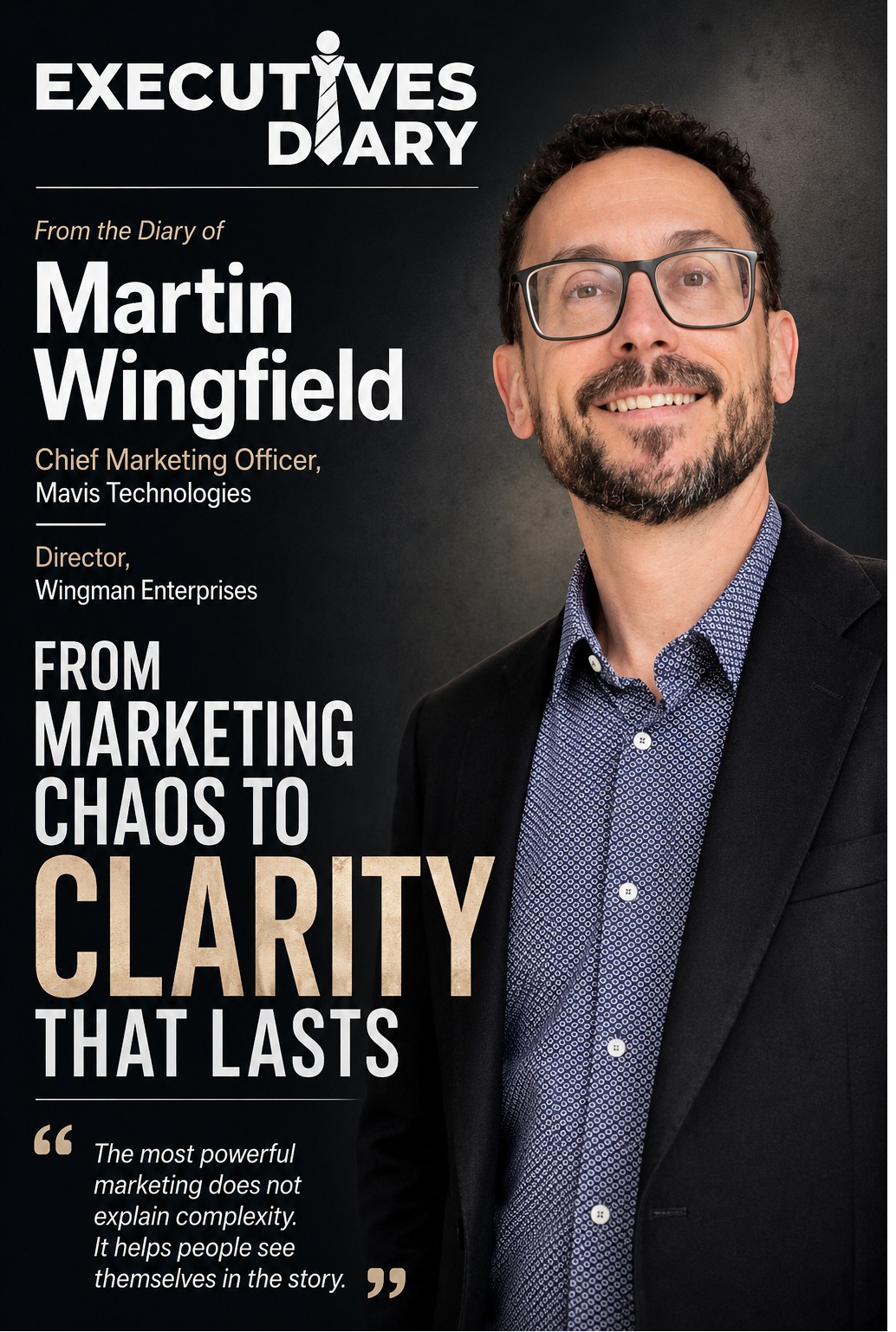
Martin Wingfield
From RNIB to AI Smart Glasses: How Martin Wingfield Turns Marketing Chaos into Clarity That Lasts.Taking a pregnancy test is a private, personal moment. Most women buy a test, take it home, and read the result themselves. However, for blind and partially sighted women, that privacy simply does not exist. The product design offers no accessible way to interpret the outcome of one of life’s most consequential questions. When Martin Wingfield and his team at RNIB decided to highlight this gap, they expected awareness. They did not expect their campaign to reach over one billion people worldwide, or that it would eventually inspire manufacturers to develop accessible testing for COVID-19 and other serious diseases. One overlooked product. One story told with precision. One campaign that proved accessibility creates impact far beyond its intended audience.
The Specialist Who Makes Complex Organizations Clear
Martin Wingfield is Ex-Director of Brand, RNIB and Director of Wingman Enterprises, based just outside London, England. He has spent thirty years learning how to walk into organizational complexity and leave behind something that actually holds. My job is to turn chaos into clarity, and to make sure that clarity actually survives after I leave the room, he explains. Whether he is working with the UK’s largest sight loss charity or a start-up building AI-driven smart glasses, the challenge remains consistent: how do you make complicated organizations speak with absolute precision about what matters most?
From Agency Trenches to Purpose-Driven Impact
The foundation for that approach was built across London’s marketing agencies, where Wingfield spent his first fifteen years managing campaigns that had to deliver measurable results under intense pressure. Starting at Carlson Marketing Group in 1998, he rose from account executive to account director, working with clients including Royal Bank of Scotland, Hewlett Packard, Harrods, and Nestlé across direct mail, digital, loyalty programs, and integrated campaigns.
Subsequent senior roles at TMW, Partners Andrews Aldridge, and Kitcatt Nohr Digitas deepened his understanding of how large organizations make decisions and where campaigns typically break down between strategy and execution. At Partners Andrews Aldridge, he managed teams responsible for accounts worth over £1 million, including Airmiles and SMA Nutrition. The work required him to coordinate online, direct mail, press, and CRM campaigns while managing the training and coaching needs of 80 staff members.
A contract role leading content strategy for AXA’s brand and online team added another layer, overseeing digital content across websites, social media, and major advertising campaigns. Each role taught him something different about organizational dynamics, but they all reinforced the same lesson: the most successful work always returned to a simple, emotional truth that cut through internal politics and industry jargon.
Nine Years of Learning What Really Matters
The transition to purpose-driven work came in 2016 when Wingfield joined RNIB as Interim Head of Strategic Marketing. What began as a short-term assignment became nearly nine years and a masterclass in applying commercial marketing discipline to complex social challenges. Rising to Head of Brand and eventually Director of Brand, he led mass communications for the UK’s largest sight loss charity, managing a team responsible for reaching diverse audiences with limited resources.
The accessible pregnancy test campaign became the clearest expression of his philosophy. Rather than leading with statistics or abstract advocacy, his team partnered with agency T&P to surface a deeply personal story that was impossible to ignore. The strategy was based on a deep understanding of the issues faced by people with sight loss, and then surfacing the most creatively compelling stories, Wingfield recalls. Our agency was brilliant at this. The campaign’s billion-person reach was remarkable, but its real impact came afterward: manufacturers began developing accessible tests for serious conditions, turning a single creative idea into ongoing industry change.
Alongside the campaign work, Wingfield led an 18-month brand refresh that tested every aspect of his organizational skills. The process began with six months of comprehensive audience research, mapping the nuanced needs of blind and partially sighted people who could not be treated as a single demographic. Working closely with T&P’s Head of Art Marc Donaldson, the team embedded best-in-class accessibility principles into every visual and communication touchpoint.
The internal stakeholder management was equally complex, requiring alignment across digital, property, helpline operations, and fundraising teams. These projects are expensive for any charity, but in this case it was needed, and it was paramount to tell that story, he explains. The refresh included rigorous measurement frameworks to prove the new brand outperformed the old one, plus comprehensive internal communication explaining why the investment was necessary.
Making AI Technology Human
In late 2024, Wingfield took on the challenge of launching Mavis Technologies, a start-up building AI-driven smart glasses for blind and partially sighted people. The transition from established charity to early-stage technology company required him to apply his clarity principles to an entirely new context: making sophisticated AI accessible to people whose lives depend on the technology working reliably.
Having a strong brand that’s built to last includes focusing on the customer benefit rather than sometimes complicated tech, which comes with jargon, he notes. Rather than leading with algorithms and features, his marketing strategy centers on independence, confidence, and everyday life. He has developed strategic partnerships to extend the company’s reach without inflating budgets, and insists on marketing that keeps human benefit at the center of every decision.
Through Wingman Enterprises, his consultancy, Wingfield also works with charities of all sizes and creative agencies facing their own versions of organizational chaos. His approach is collaborative rather than prescriptive, using a four-step framework where the first stage is to discover where things are breaking down. I don’t believe in an overly formulaic way of working with a rigid format, he explains. Understanding what drives success and what the barriers are to that is the first step. When this is done properly, the solutions become much easier to develop.
Where Clarity Creates Independence
The pregnancy test campaign will follow Martin Wingfield throughout his career, but not because of its impressive reach numbers. It matters because it proved that the most powerful marketing does not explain the complexity of an organization or its technology. Instead, it shows people a truth they had not seen before, told with enough precision and conviction to change how entire industries think about who they serve.
That principle connects every phase of his work, from managing loyalty programs for high-street retailers to launching AI-powered assistive technology. The tools change, the budgets vary, but the fundamental challenge remains the same: can you make complicated organizations speak clearly enough that ordinary people see themselves reflected in the work?