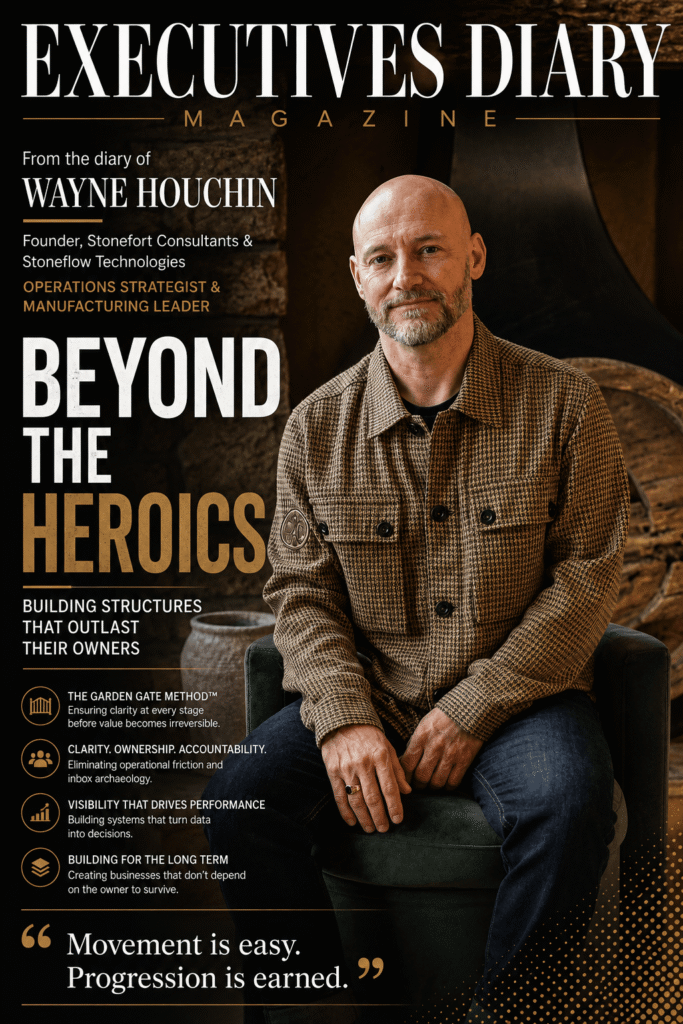
Who is Wayne Houchin?
Wayne Houchin is an operations strategist, manufacturing leader, and founder of Stonefort Consultants and Stoneflow Technologies. With more than three decades of experience across engineering, manufacturing, supply chain, and operational leadership, he has built a reputation for helping SMEs reduce hidden operational friction through clarity, accountability, and structured process design. His work now extends into the development of the StoneSuite ecosystem, including Stonelog, Stonebrief, Stonepulse, and Stoneflow, focused on improving visibility, ownership, and operational intelligence within modern businesses.
The warehouse floor in Northern Ireland is a noisy place, but the most dangerous sounds are the ones you can’t hear.
It isn’t the clatter of a forklift or the hiss of a pneumatic line that signals a business is in trouble. It is the quiet, polite silence of a room full of competent people assuming they are all on the same page.
We have all been in that meeting. The project is ambitious, the customer is prestigious, and the energy is high. Someone asks if the team is ready to move forward. There is a collective nod. It feels like progress. It feels like momentum.
In reality, it is often the moment the margin begins to disappear.

Wayne Houchin has spent more than thirty years watching this scene play out from nearly every angle imaginable. He did not begin his career inside a boardroom analyzing spreadsheets and strategy decks. He started on the shop floor, driving forklifts and working inside the operational reality that keeps manufacturing businesses alive.
From there, he worked his way through the ranks to become an Operations Director, navigating some of the most disruptive business conditions in recent history, including Brexit, fractured supply chains, labor shortages, and the global pandemic.
The conclusion he arrived at after decades inside engineering and manufacturing environments directly challenges the modern obsession with “moving fast and breaking things.”
In operational businesses, moving fast without clarity does not just break things.
It quietly embeds cost that may never be recovered.
The Illusion of Movement
Most businesses do not collapse because of a dramatic single failure.
They deteriorate through drift.
This is what Houchin describes as the “almost right” trap.
A project is ninety percent defined, so the build begins.
A supplier is mostly reliable, so capacity is committed.
A timeline is optimistic, so the promise is made externally before the business is internally prepared to deliver it.
“Movement is easy,” Houchin says. “Progression is earned.”
The distinction is subtle but critical.
Movement is the frantic activity that fills the average workday: endless email chains, WhatsApp messages, rushed meetings, and reactive conversations across departments. It feels productive because everyone is busy.

But if that movement is not anchored to genuine readiness, it simply becomes the process of moving uncertainty from one department to another.
When work progresses on partial definitions and assumed alignment, organizations create operational debt. Eventually, that debt has to be paid.
Usually, the payment arrives in the form of supplier firefighting, expensive rework, delayed shipments, strained customer relationships, emergency travel, or exhausted leadership teams trying to recover visibility after problems have already escalated.
By the time the issue becomes visible, the business is no longer managing the project itself.
It is managing the consequences of decisions it never realized it had made.
The Garden Gate Constraint
To combat this operational drift, Houchin developed what he calls the Garden Gate Method™. The concept is rooted in a simple physical metaphor: work should move through clear stages, and organizations should not pass through the next gate until they genuinely possess the key. The methodology is explored in greater detail in his book, The Garden Gate Method, available here:
Inside many SMEs, those gates are often left open far too early.
Value becomes irreversible before the business realizes the underlying definition was incomplete. The moment a design is frozen, specialized material is ordered, or production capacity is committed, the organization has already stepped beyond the point where mistakes remain inexpensive.
If clarity was missing at the gate, “almost right” quickly becomes permanently expensive.
Through Stonefort Consultants, Houchin’s work has focused on helping businesses reduce this hidden operational friction. His philosophy is not about layering companies with more bureaucracy. In many ways, it is about removing unnecessary complexity.
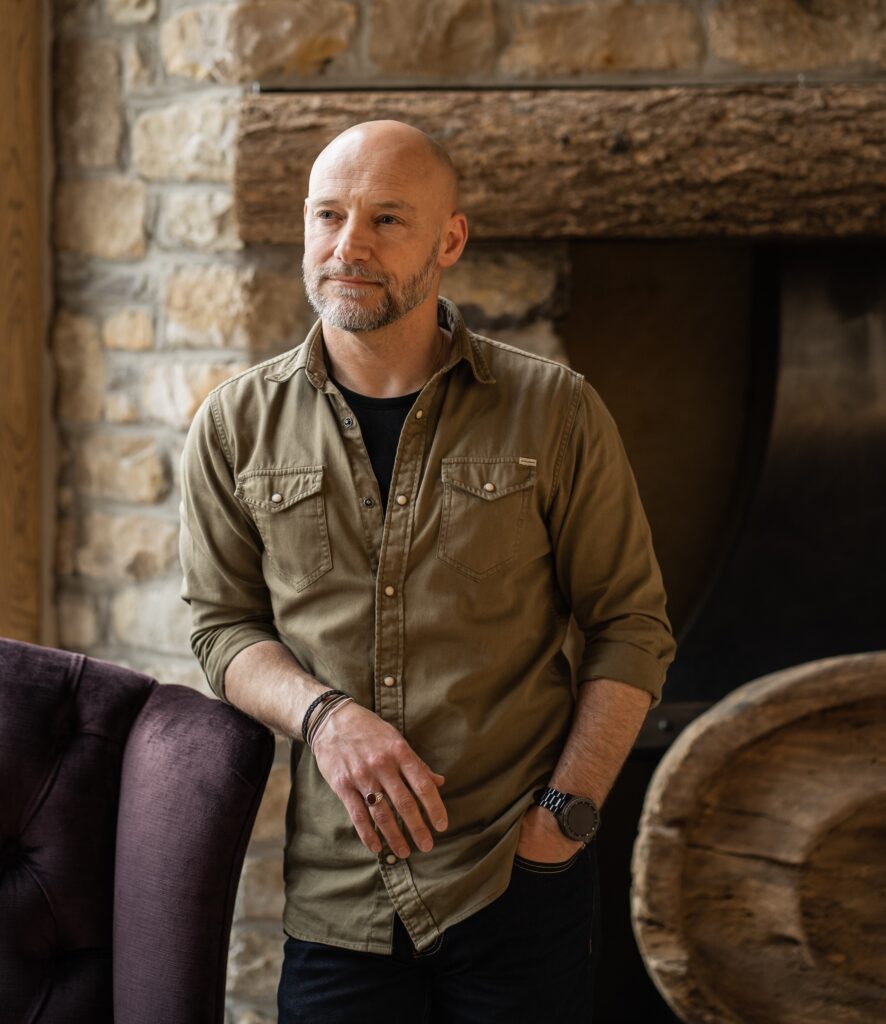
The goal is to eliminate the “heroics” that keep disorganized businesses functioning.
“If a business only works because the owner sits in the middle of every decision,” Houchin explains, “that isn’t a system. It’s a personality.”
This becomes especially dangerous when exceptions arise — quality concerns, supplier issues, dispatch delays, finance queries, or customer escalations that consume leadership attention for hours at a time.
Without structure, businesses often fall into what Houchin calls “inbox archaeology,” where managers spend large portions of their day searching through email threads and disconnected conversations trying to reconstruct what was agreed, who owns the issue, and what still needs to happen.
“If nobody owns it, it owns you.”
Turning Operational Thinking Into Infrastructure
What has become increasingly clear in recent months is that Houchin’s ideas are evolving beyond consultancy and operational philosophy into structured systems themselves.
Through Stoneflow Technologies and the wider StoneSuite ecosystem, many of the principles developed through years inside operational environments are now being translated into practical tools designed to improve visibility, ownership, and process control inside SMEs.
One of the clearest examples is Stonelog, which has progressed significantly and is now moving toward live pilot activity.
The platform was developed after repeatedly seeing the same operational pattern inside growing businesses: quality issues, supplier concerns, returns, customer queries, and operational exceptions becoming fragmented across emails, spreadsheets, messaging apps, and individual memory instead of being managed visibly in one place.
In many businesses, problems do not disappear.
They simply become scattered.
By the time leadership identifies the full picture, the cost, delay, and frustration are already embedded into the organization.
Stonelog is designed to create a structured environment where operational exceptions are captured with clear ownership, visible status progression, and supporting evidence attached directly to the issue itself.
The objective is not simply software efficiency.
It is organizational clarity.
The same philosophy is shaping the evolution of Stonebrief, particularly through its developing Windsor Framework application.
Following Brexit, the Windsor Framework was introduced to simplify trade movement between Great Britain and Northern Ireland. In practice, however, many businesses navigating those movements are discovering that administration, data requirements, and compliance responsibilities can quickly become operationally difficult to manage.
Houchin believes the issue is not necessarily the rules themselves.
“The challenge is often the burden, the risk, and where they sit.”
In many situations, suppliers in Great Britain are required to provide increasing levels of information and references, while the Northern Ireland importer still carries significant responsibility if anything is inaccurate, incomplete, or missing.
Stonebrief is being developed to create structure around that information flow.
The supplier knows exactly what information is required.
The importer knows exactly what has been completed.
Everything is retained, visible, and auditable.
For exporters, the benefit is reducing administration friction and uncertainty.
For importers, it is improved visibility, stronger operational confidence, and a clearer audit trail.
Meanwhile, Stonepulse and Stoneflow are evolving into what Houchin describes as the “intelligence layer” behind the wider suite.
Stonepulse focuses on identifying operational patterns and highlighting targeted improvement opportunities using captured business data. Stoneflow operates at a broader level, helping organizations recognize where process review, mapping, or structural redesign may be required before inefficiency and cost become embedded into day-to-day operations.
The direction has recently gained external validation through competitive Techstart NI grant support, secured to take Stonebrief through MVP development while also supporting the AI proof of concept behind Stonepulse and Stoneflow.
Yet despite the expanding technology layer, Houchin remains consistent in how he frames the bigger picture.
This is not fundamentally a technology story.
It is a visibility story.
Building for Pressure, Not Perfection
Clarity is easy when business conditions are calm.
The true test of any operational structure is how it performs under pressure: when shipments are delayed, deadlines tighten, staff are unavailable, suppliers are struggling, and customers are demanding immediate answers simultaneously.
This is why Houchin’s thinking places such a heavy emphasis on reducing reliance on memory.
In high-pressure environments, memory is often the first system to fail.
Businesses built on “we’ll sort it out as we go” eventually begin gambling on people’s ability to remain perfect every day under imperfect conditions.
Houchin learned this lesson firsthand during a technically demanding customer program where every individual involved was competent, experienced, and well-intentioned. The failure was not a lack of talent.
The failure was operational drift.
Teams moved forward optimistically rather than realistically, assuming alignment instead of forcing clarity. The resulting friction did not simply cost money.
It cost morale, energy, confidence, and trust.
That experience reinforced one of Houchin’s strongest beliefs: clarity must always take priority over comfort.
It is uncomfortable to stop a meeting and admit the organization is not actually ready to proceed.
It is far more comfortable to preserve momentum and hope issues can be solved later.
But comfort, in operational environments, is often an early warning sign of future loss.
A Legacy of Calm
Ultimately, Houchin’s work is not just about improving profitability or operational performance.
It is about changing how work feels for the people inside the business.
Many SMEs normalize stress, firefighting, and constant escalation as unavoidable parts of growth. There is often a badge of honor attached to late nights, emergency recoveries, and leaders “saving the day.”
Houchin sees those heroics differently.
To him, they are symptoms of structural weakness.
A well-run business should not rely on exhaustion to survive.

It should operate through visible ownership, stable process flow, and deliberate operational clarity.
In many ways, the ideal operational system is slightly boring.
Decisions are explicit.
Responsibilities are visible.
Risks are acknowledged early.
Value does not outrun readiness.
And the owner can finally step back, not because they care less, but because the structure beneath the business has become strong enough to support itself.
From the warehouse floor to the boardroom, Houchin’s career has been shaped by one recurring observation:
Most operational cost is not found in the work people can immediately see.
It usually sits behind it, hidden inside assumptions, fragmented ownership, unclear communication, and small compromises repeated often enough to become culture.
If his legacy becomes a world where fewer businesses are held together by the frayed nerves of their owners, he will likely consider that success.
The Houchin Playbook: 6 Lessons
Clarity over comfort: Force difficult conversations early to avoid expensive recovery later.
Movement is not progression: High activity often hides a lack of true readiness.
Explicit ownership matters: If responsibility belongs to “everyone,” it usually belongs to no one.
Identify the point of no return: Understand exactly when value becomes irreversible and ensure the gate remains closed until definition is stable.
Eliminate heroics: If senior leadership must constantly intervene for operations to function, the process itself is broken.
Never assume alignment: Positive confirmation matters. Always ensure the internal understanding matches the external reality.
Margin is rarely lost in dramatic explosions.
More often, it is quietly traded away through small assumptions.