Culture Is Not a Poster Campaign: Margaret Brown’s 35-Year Case for Leadership That Actually Works. When Values Live Only on Walls Culture is not a slogan on a wall. In Margaret Brown’s world, it shows up in how the leaders show up. The leaders who hire her usually start with the same request. They want a “high performing culture,” clear values, engaged people. They often have framed values statements on the walls and on their websites. What they rarely have is what happened in one North Sea business with Margaret’s support : employee turnover falling from 12 percent to under 1 percent.
That gap between what leaders say they value and what people actually feel every day is where Margaret Brown has built a 35-year career. According to Gallup’s most recent research, disengaged employees cost the global economy $10 trillion in the year 2025 – 26 – up from $8.9 trillion the previous year, equating to 9 percent of global GDP . Not a billion – a trillion. And yet the values within many organisations remain perceived by their employees as ‘just a poster campaign’.
The Coach Who Measures Culture in Millions
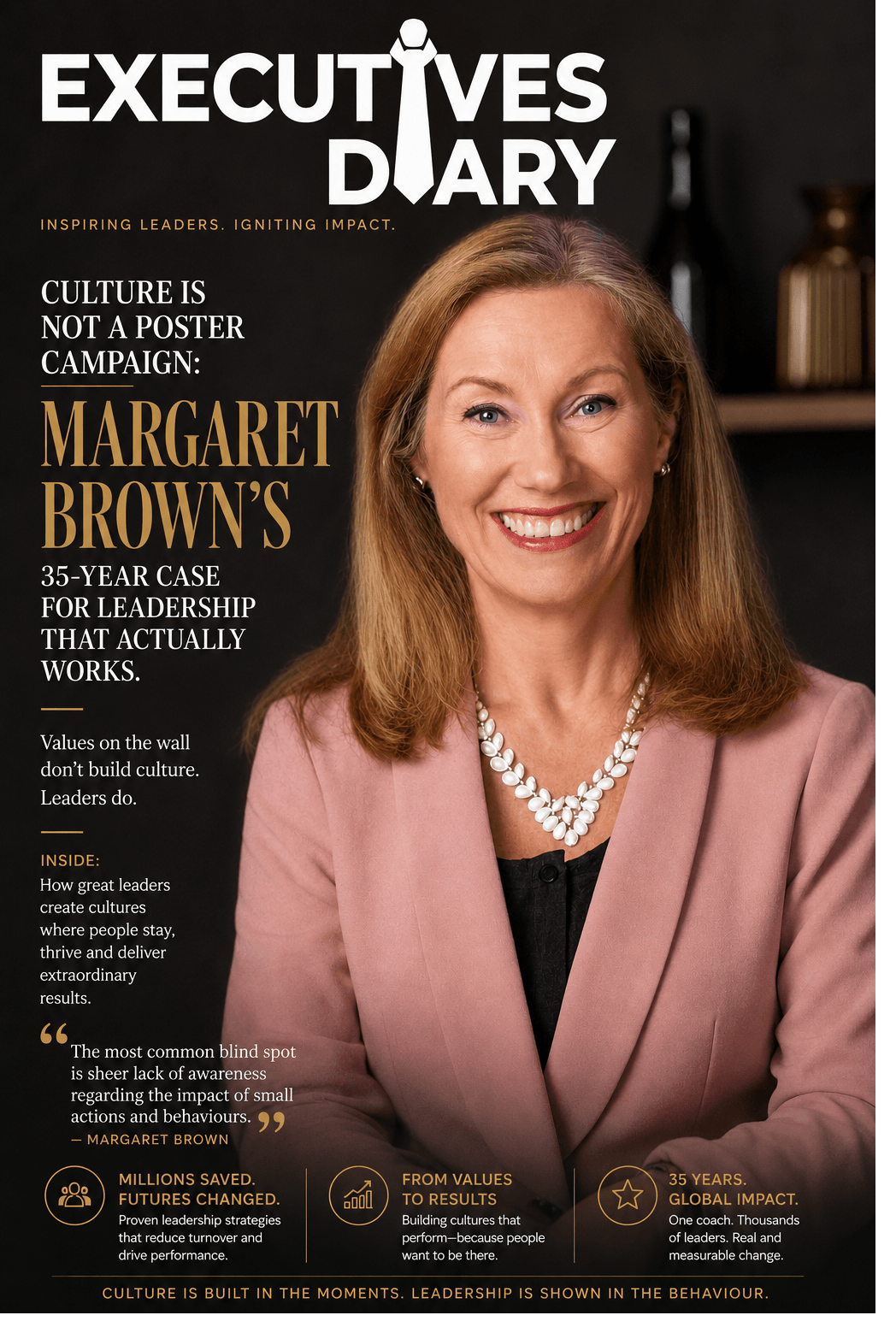
Margaret Brown is the founder of Margaret Brown Consulting Limited, an award-winning certified executive coach, bestselling author of Culture Pays, and one of the most experienced leadership development specialists working today. Based in Aberdeen, Scotland, she has coached senior leaders across every continent, helping organisations become places where people stay, grow, and deliver superior results because they genuinely want to be there.
From Aberdeen Classrooms to Global Boardrooms
Margaret’s foundation was built at the University of Aberdeen, where she earned a Bachelor of Education focusing on English Literature and Educational Psychology. That combination would prove essential. Understanding how language shapes perception and how human psychology responds to authority became the twin engines of everything she built professionally.
Her consulting practice was launched in in September 1991, long before “employee engagement” became a conference theme. She was running 360-degree feedback sessions, offsite leadership workshops, and large employee conferences primarily within the oil and gas sector. The industry is traditionally numbers-focused and the so-called ‘soft skills’ received little or no attention. This suited Margaret perfectly as it meant results had to withstand scrutiny.
Then, in her fourth decade of consulting, Margaret did something most professionals only dream about. While maintaining key client relationships she enrolled at Gray’s School of Art in Aberdeen and completed a BA Honours in painting. Four years of critiques, experimentation, and blank canvases, and completing her final year whilst the world wrestled with remote work and uncertainty.
The connection is not metaphorical. A blank canvas can be daunting or exciting, depending entirely on the leader holding the brush. The best artists begin with a vision but allow it to evolve as they layer colour, texture, and form. Margaret now brings that same mindset into boardrooms, encouraging leaders to see culture as something they constantly shape, not a finished product in a brand manual.
The Work That Demonstrates What Numbers Are Possible
Margaret Brown’s results are specific enough to make conventional HR approaches uncomfortable. She has helped leaders measurably reduce employee turnover in multiple client organisations, representing millions of dollars saved in recruitment costs, training expenses, lost productivity, and lost institutional knowledge.
Her work with one major North Sea operator in 2024 illustrates this at scale. Following another reorganisation and facing a tired, sceptical workforce, Margaret gathered over 60 pages of feedback within four weeks from offshore and onshore teams. She then designed a two-day leadership workshop around five specific objectives: unite the team, rebuild trust, develop leadership skills, anchor behaviour in stated values, and commit to a positive future.
According to the North Sea Vice President , the result was not a feel-good offsite but a line in the sand. “The principles that you helped my team and I to develop are still alive and well within the team and making a difference every day.” That distinction between a programme and a culture shift defines Margaret’s approach. A programme ends. A culture shift becomes the new normal.
Her work with a leading renewables organization followed similar patterns. Their CEO noted that Margaret “listened, planned meticulously, shared ideas and delivered every session with knowledge, lots of best practice and humour,” while ensuring teams left with practical tools that actually get used.
The framework underlying this work is Margaret’s LeaderShift model, a five-element structure that gives leaders a practical reference point without reducing people’s leadership to a checklist. “The key to such success is truly listening to what employees want and need to deliver excellence and remain loyal and productive,” she says. “Feedback is the lifeblood of both implementing and sustaining positive change.”
She shows leaders how to “catch people doing good things” and make recognition specific and frequent. But she is equally direct about the economic stakes. “The most common blind spot is sheer lack of awareness regarding the impact of small actions and behaviours, whether positive or negative. A genuine and specific ‘thank you’ from a senior leader is an instant energiser for an employee, whilst an eye-roll or slight shake of the head when someone is speaking can be enough to sap their confidence.”
The CEO Who Still Makes Tea
Margaret references Sara Davies’ insight that “the CEO should not be above making the tea.” It captures everything she believes about leadership that actually works. The higher you sit in an organisation, the greater the gravitational pull of your behaviour on everyone below you. Small gestures of respect build loyalty that no competitor can breach. Dismissive moments destroy trust that takes years to rebuild.
This is not soft skills philosophy. This is hard economics. Companies with engaged workforces consistently outperform their peers in profitability, customer satisfaction, and talent retention. They have access to the same technology, infrastructure, and market conditions as their competitors. Culture becomes the differentiator that determines which organisations thrive and which ones hemorrhage their best people.
Margaret is currently extending this work through open masterclasses designed to reach senior leaders and founders who want to maximise retention and become recognised as ‘great places to work’ – a strategy that helps them attract top talent and achieve a clear competitive advantage. . The approach is deliberate: demonstrate value first, build trust through results, then offer deeper engagement for those ready to commit to genuine change.
The $$10 trillion figure is not an abstraction. It represents the accumulated cost of leaders who believed the poster was enough, multiplied across every sector and continent, year after year. Margaret has spent 35 years in the gap between what organisations declare and what their people actually experience.
Values that live only on walls are not values. They are expensive decorations for problems that require daily attention, genuine feedback, and leaders willing to examine their own habits with the same rigor they apply to their balance sheets.
LeaderShift Model Objectives
- 1. Unite the Team: Aligning individual efforts toward a singular corporate path.
- 2. Rebuild Trust: Restoring institutional faith through actionable structural adjustments.
- 3. Develop Leadership Skills: Equipping internal authorities with metrics-backed communication methods.
- 4. Anchor Behaviour: Securing corporate reactions directly to stated core values.
- 5. Commit to a Positive Future: Instigating an enduring cultural evolution that outlasts static programs.