When the Room Stops Performing
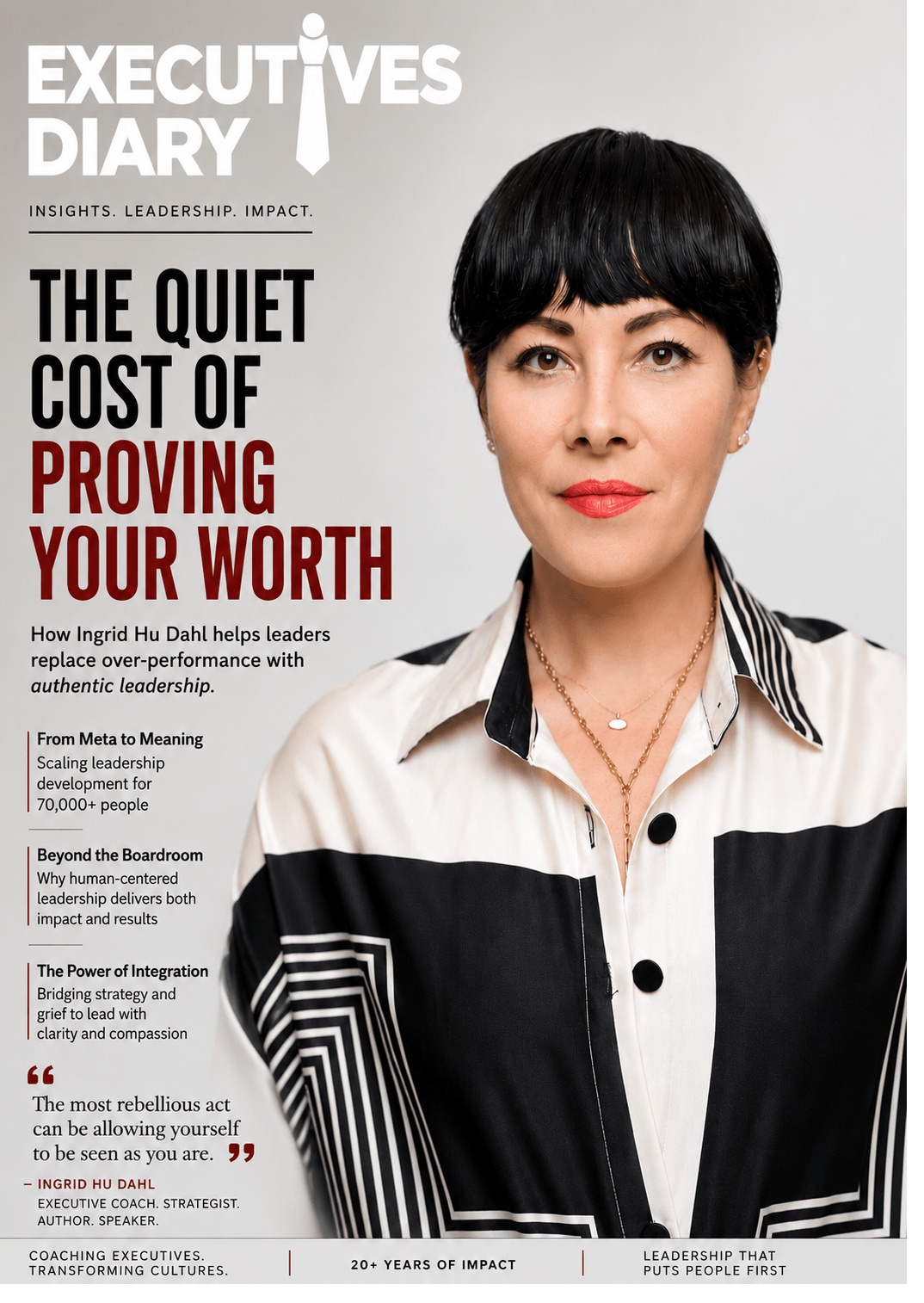
There is a particular kind of silence that falls over executive teams when someone finally admits what everyone already knows. Not the silence of confusion or the silence of judgment. The silence of relief. Seventy thousand people have participated in leadership programs that Ingrid Hu Dahl co-designed at Meta, and the numbers tell one story: 98 percent favorability, 95 percent completion rates, measurable culture shifts across global teams. But the more revealing story lives in that silence, in the moment when a room full of senior leaders stops performing certainty and starts practicing something far more useful.
Executives rarely discuss what actually keeps them awake at night. Market volatility, yes. Talent retention, certainly. Quarterly projections, always. But the crushing pressure to out-perform, to prove their value over and over again, to over-perform at a devastating personal cost, almost never. Yet this cycle sits just beneath the surface of what Ingrid has spent the last twenty years working inside: the complexity of human dynamics, identity, culture, and behaviors that shape how leaders actually lead.
The Coach Who Refuses to Split the Personal from Professional
Ingrid Hu Dahl is the founder and CEO of Ingrid Hu Dahl Coaching & Consulting, an ICF PCC-certified executive coach, TEDx speaker, and award-winning author of Sun Shining on Morning Snow, a memoir that functions as a leadership origin story. We all have one, she believes, and they can be shared. She works with founders, senior executives, and rising leaders who are exhausted by the pressure to have all the answers, to out-perform, to prove their value over and over again, often at tremendous cost. Her approach defies the traditional boundaries of executive coaching. She is simultaneously a grief coach and a business strategist, a former corporate insider and a lifelong advocate for marginalized voices. This combination is not accidental. It is the result of two decades spent watching organizations reward a specific type of leadership that lacks human-centered practices, emotional intelligence, trust, curiosity, and encouragement. She refers it to the Drama Triangle versus the Empowerment Dynamic, and it requires slowing down to examine cognitive behavior and unlearn inherited patterns.
Reading Systems from the Outside In
Ingrid’s capacity to see what others miss was developed long before she entered the corporate world. Growing up mixed-race and queer meant learning to read every room she entered, to understand power dynamics before they were explained, to bridge cultures that did not naturally connect. At Rutgers, where she completed her master’s degree in Women’s Studies, she wrote her thesis on the Rock n’ Roll Camp for Girls in Portland, studying what happens when people who have been told they do not belong decide to plug into an amp, grab the mic, and be in sisterhood with a newly formed band, because their voices and collective expression matter.
That same instinct carried her through national youth media programs, global nonprofit leadership roles, and eventually into senior leadership roles of some of the largest companies in the world. At Capital One, she contributed to award-winning mentorship programs and launched a national program with internal senior peers that achieved 100 percent retention and measurable promotion outcomes, earning the company’s Circle of Excellence recognition.
Then came Meta, where she directed the global inclusion learning portfolio at unprecedented scale. About 70,000 people moved through scaled learning solutions, thousands experienced signature learning events, and hundreds of senior leaders of color completed world-class immersive leadership programs with completion rates above 95 percent and favorability scores that corporate learning teams study as benchmarks. After Meta, at Gap Inc., she partnered with the executive team to establish leadership behaviors for 111,000 employees, launching inclusive programs that earned 99 percent favorability ratings and pushed leaders to apply what they learned through trial and error in real workplace situations.
Each role added layers to her understanding of how change actually happens inside large organizations. Each success proved that human-centered leadership could deliver the metrics that satisfy the most demanding CFO. But the deeper she moved into corporate leadership development, the more clearly she saw the cost for individuals climbing the ladder, constantly proving their worth through over-performance, confusing survival strategies with actual leadership.
The Integration That Changed Everything
The pivot point came with profound personal loss. When Ingrid’s mother died, the grief shattered every assumption about control, planning, and professional composure. She found herself sitting in the exact liminal space she had been helping corporate leaders navigate: the place between who you were and who you are becoming, where certainty disappears and something more honest has to emerge.
Rather than compartmentalize the experience, she chose integration. She became a certified grief coach, recognizing that the skills required to process personal loss are identical to the skills required to lead through organizational transformation. Both demand the ability to sit with uncertainty. Both require a willingness to be a beginner, to have a curiosity mindset, to be brave and discover what you truly want, your truth.
This philosophy now shapes every aspect of her coaching practice. The executive who arrives to discuss succession planning often discovers they are grieving the identity that got them to their current role but will not carry them forward. The senior director focused on executive presence realizes they have been holding their breath between meetings for years. The founder asking about team resilience admits, sometimes for the first time, that they are more focused on being liked than leading a high-performing team. That awareness unlocks incredible shifts in internal calm and external behavior.
Rebellious Leadership as Business Strategy
What Ingrid calls “rebellious leadership” is not about disruption for its own sake. It is about the specific courage required to break the one rule that has survived every corporate transformation of the past fifty years: the rule that leaders must project certainty to maintain authority.
“For decades, leadership was rewarded through certainty, authority, and control,” she explains. “But today’s environment is too complex for any one person to have all the answers. The leaders creating the healthiest cultures are the ones willing to say, ‘I don’t know yet, let’s find out together,’ and mean it.”
This shift is grounded in neuroscience, not sentiment. When uncertainty triggers the amygdala, leaders default to fight, flight, or freeze responses. Decisions become reactive. Teams absorb the turbulence. “Grounding practices like breathing, naming what you feel, help regulate the threat response so the prefrontal cortex can reengage,” Ingrid explains. “Only then can you access your values and make choices that are healthier, pushing the leader/ learner to apply what they’ve learned through trial and error ”.
Her current work with executives focuses on building curiosity and openness for uncertainty rather than resisting it. She teaches leaders to recognize the difference between not knowing and not knowing yet. The first creates panic. The second creates curiosity. Teams led by executives who can sit comfortably in the second space become more resilient and healthier, treating development as real behavior change rather than compliance.
The Exhale That Changes Organizations
Ingrid’s memoir, Sun Shining on Morning Snow, winner of the 2026 IndieReader Discovery Awards, functions as both personal narrative and professional tool. Leaders who read it discover that their own stories of identity, loss, and transformation are not separate from their leadership capacity. They are foundational to it.
In speaking engagements at organizations including Google, Visa, Lyft, and Stanford, she creates spaces where executives can practice the vulnerability that psychological safety requires. These are not sensitivity training sessions. They are laboratories for testing whether leaders can maintain influence and impact while admitting uncertainty, whether teams perform better when the person in charge models curiosity rather than control.
The corporate illusion of certainty persists because it feels safer than the alternative. It keeps investors calm, teams focused, and anxiety at bay. But it also keeps organizations rigid in conditions that demand flexibility. What Ingrid has proven, through her own career trajectory and through the executives she coaches, is that the leaders who outlast that illusion are the ones finally willing to tell the truth.
The Ongoing Work of Authentic Leadership
Authentic leadership is an ever-evolving learning process. It’s about growth and expanding comfort zones, having more empathy for ourselves and others, and staying curious. What Ingrid has proven, through her own career trajectory and through the executives she coaches, is that the leaders who outlast the illusion of certainty are the ones finally willing to examine how over-performance became their way of providing worth, the cost and then choose differently.
The hardest and most necessary work of leadership now is learning to be fully human in a world that still mistakes image and performance for strength.
Key Information & Resources
- Official Website: www.ingridhudahl.com
- Book & Narrative Platform: www.sunshiningonmorningsnow.com