Louise Bedford
Learned to Trade When She Had No Other Choice. That Is Exactly Why Thousands Trust Her Guidance.When Markets Don’t Care
Most trading educators will tell you they discovered the markets through passion or opportunity. Louise Bedford had the markets thrust upon her at the worst possible moment, under the most challenging circumstances, with no backup plan and no room for the kind of mistakes that trading courses cheerfully describe as “learning experiences.” That distinction shapes everything about how she teaches and why many of her students consistently outperform both the market and their own expectations.
The entire trading education industry is built on a seductive premise: master the right system, follow the right signals, and the market will reward your dedication. Bedford has spent twenty-six years quietly dismantling that premise, not with cynicism, but with something far more valuable. Results. Her students post 15% gains while the market falls 4%. One turned a single index trade into millions in open profits. Another recorded a 90% return year. These are not cherry-picked testimonials. They are the outcome of a philosophy forged under conditions most educators have never faced.
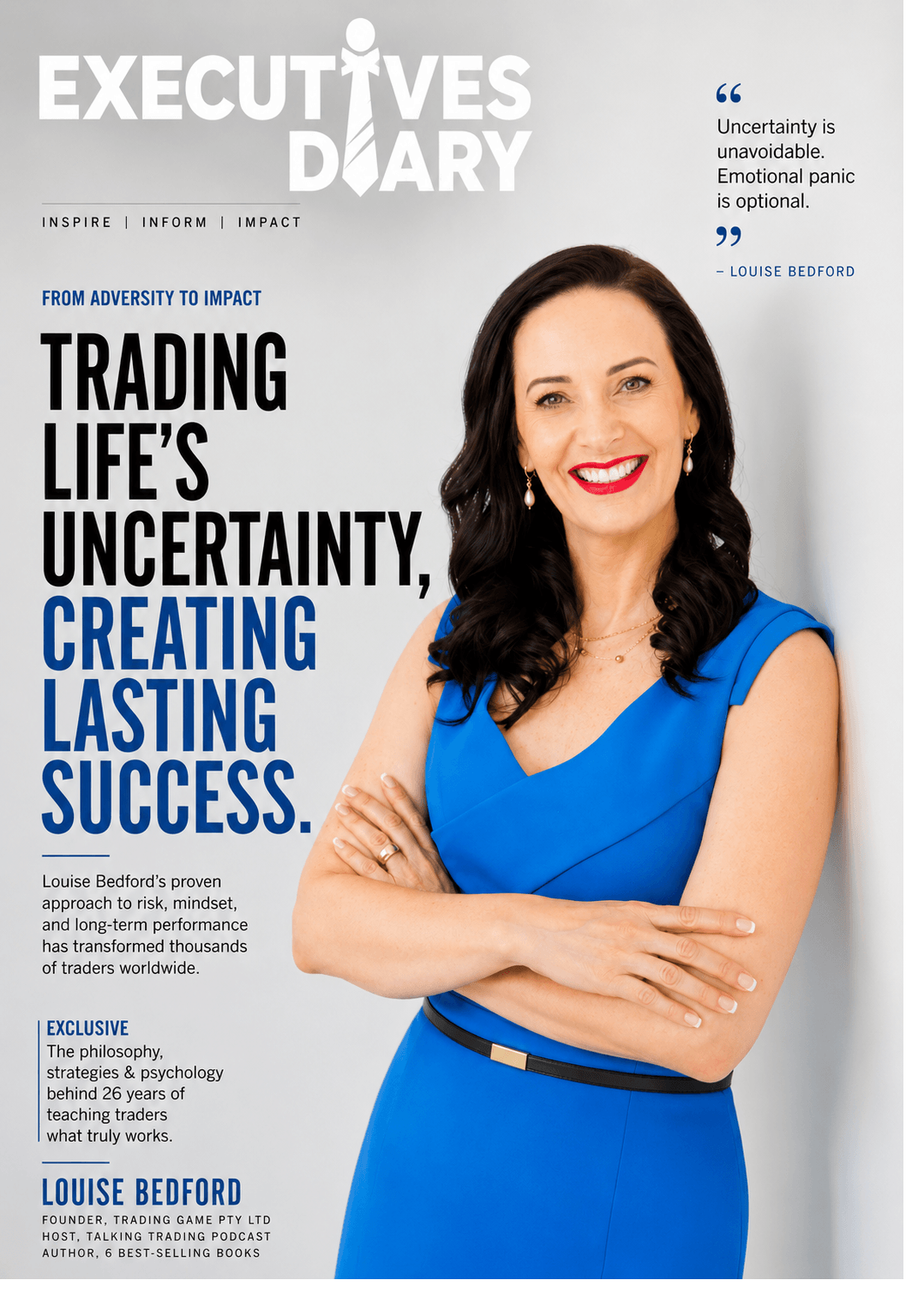
Louise Bedford is the Director of Trading Game Pty Ltd, host of the Talking Trading podcast, and author of six best-selling sharemarket books. She teaches traders to survive uncertainty rather than predict it, because she learned the hard way that survival is the only strategy that actually works.
Pen Between Teeth
Her foundation looked conventionally promising. A double degree from Monash University in Psychology and Marketing gave her analytical tools that would later prove far more relevant to trading than anyone could have anticipated. She entered the corporate world, advanced through the ranks, and by external measures was following exactly the trajectory expected of a capable, educated professional. Then her body stopped cooperating. She lost the use of her arms for several years.
The details of that period are not Bedford packages for dramatic effect. She references them with the matter-of-fact clarity of someone who processed the experience long ago and extracted every useful lesson from it. What she will tell you is what it taught her about markets, risk, and the psychology that determines whether traders survive their first year or their first decade. “That period taught me that uncertainty is unavoidable, but emotional panic is optional,” she explains. “When you’re physically vulnerable, you become acutely aware of the importance of preserving resources, financial, emotional, and psychological.”
She learned to trade with a pen gripped between her teeth. Not as a metaphor. Not as a motivational anecdote. As a practical necessity, because she needed income, had limited physical capacity, and the sharemarket did not care about either fact. Every trade she placed, literally written into existence with that pen, reinforced one crucial understanding. If she could remove emotional decisions from the process, she could last long enough for a sound strategy to work. That context is what makes her risk management philosophy different from anything taught in a classroom. It was not developed in theory. It was stress-tested under conditions where getting it wrong had immediate, personal consequences.
Building Traders Who Last
By 1996 she was coaching other traders. By 2000 she had launched the Trading Game Mentor Program, a repeat-for-free course that has been running continuously since. The repeat-for-free detail reveals how she thinks about mastery. Very few traders become consistently profitable in a single pass through any education. Markets change. Life happens. Minds wobble. Allowing people to return without paying again is a direct statement of priorities. The goal is not selling more content. The goal is creating more durable traders.
Six best-selling books followed, each arguing the same core premise from different angles. Trading Secrets, Charting Secrets, The Secret of Writing Options, The Secret of Candlestick Charting, Let the Trade Wins Flow, and most recently Investing Psychology Secrets all make one fundamental argument. If you do not understand your own thinking patterns, your trading rules will never save you. “The most common issue I see, even with experienced traders, is self-sabotage driven by fear of uncertainty,” she notes. “People try to eliminate uncertainty instead of learning how to operate effectively within it.”
More Losses, Better Results
That observation becomes concrete when you examine the traders who pass through her programs. She talks about couples who took thirty trades, lost seventeen of them, and still outperformed the market by nineteen percentage points because their risk management was coherent. She highlights students who recorded exceptional years not because they found magic setups, but because they finally accepted boring routines, strict position sizing, and emotional discipline. The numbers work because the losses are kept small and the winners are allowed to run. That is not an accident. That is the predictable output of a system designed around capital preservation first and profit second.
The trading landscape has transformed dramatically during her career. “Twenty-six years ago, traders struggled to access information,” Bedford observes. “Today they struggle to filter it. The ones who succeed now are the people who can simplify and follow a structured process despite all the noise.” That shift from scarcity to overwhelm sits at the center of her current work. Through the Talking Trading podcast, she brings in voices like Philippe Gijsels from BNP Paribas Fortis to examine macro trends, and Jacob Griffiths to dissect how scams exploit the same psychological vulnerabilities that destroy trading accounts. The focus is always the same. How do intelligent people get tricked by their own brains, and what can they do about it before it costs them money, memories, or both.
Beyond Trading Accounts
Her emphasis on real-world consequences extends beyond trading accounts. Through the Mentor Program, Bedford has raised significant funds for Opportunity International, directing money into microloans with 97% repayment rates that support entrepreneurs worldwide. “Financial education is not just about accumulation,” she explains. “It’s about creating choices, dignity, and independence.” That philosophy is not separate from her trading curriculum. It is the foundation of it.
Currently, Bedford is focused on scaling the Mentor Program and Talking Trading podcast while exploring how technology can support traders without replacing the human judgment she has always argued is irreplaceable. She is not interested in artificial intelligence that automates decisions. She is interested in tools that remove friction so traders can think more clearly about the decisions that actually matter.
Survival Strategy
The irony is unmistakable. In a field obsessed with predicting what comes next, Louise Bedford has built her influence by refusing to pretend she can see the future. She teaches traders to preserve capital, expect uncertainty, and stay calm when it arrives, because she learned under the most challenging conditions that there are variables you cannot control, including your own nervous system.
She started trading when she had no other choice. Today, thousands choose her guidance so that when their own choices narrow, they are prepared to survive whatever the market delivers.
Key Takeaways / Playbook
- 1. Capital Preservation First: She teaches traders to survive uncertainty rather than predict it, because survival is the only strategy that actually works.
- 2. Master Your Mindset: If you do not understand your own thinking patterns, your trading rules will never save you.
- 3. Strict Risk Management: Keep losses small and allow winners to run to systematically outperform the market despite high loss ratios.