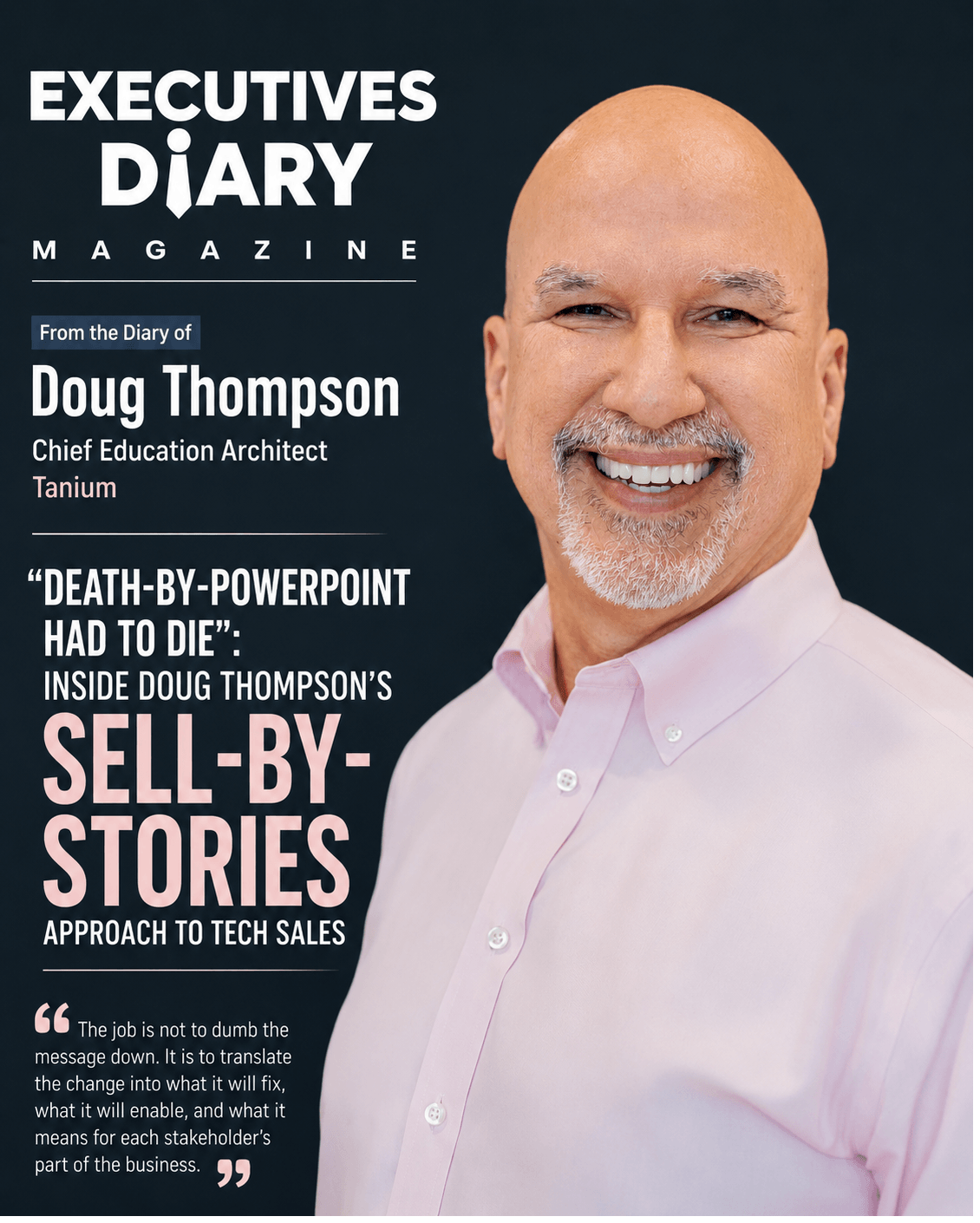
DOUG THOMPSON
“Death‑by‑PowerPoint Had to Die”: Inside Doug Thompson’s Sell‑By‑Stories Approach to Tech SalesThe Demo That Nobody Remembers
There is a specific kind of silence that falls over a conference room when a technical demo goes wrong. Not wrong in the sense of a crashed server or a frozen screen. Wrong in the quieter, more damaging sense: the prospect’s eyes go flat, their body language closes, and the sales team keeps talking anyway, filling the air with features nobody asked about and metrics nobody connected to anything real. Doug Thompson has sat in enough of those rooms to last several careers. He has also spent the better part of three decades figuring out exactly why it keeps happening and what to do instead.
The answer, it turns out, has almost nothing to do with technology.
Who Doug Thompson Is, and Why That Matters
Doug Thompson is the Chief Education Architect at Tanium and a keynote speaker, podcast host, and author whose upcoming book, Sell-By-Stories, arrives in late summer 2026. He has spent more than 35 years at the intersection of complex technology and human communication, first at Panasonic, then across two decades at Microsoft, and now at one of the most demanding frontiers in enterprise cybersecurity. One of the most consistent themes in his career is this: he is the kind of person organizations call when the technology is good but nobody in the room can explain why it matters.
From Lamar University to the Room Where It Clicked
Thompson’s career did not begin with a grand plan. It began in Beaumont, Texas, with an associate degree in industrial electronics from Lamar University and a job supporting the Panasonic dealer network across Texas, Oklahoma, Louisiana, and Arkansas. For eight years he was a regional field engineer, the person who showed up when something was broken and left when it worked. That kind of work teaches you things that no executive education program covers: how to read a room quickly, how to earn trust from people who are frustrated, and how to explain a technical fix to someone who does not care about the technical fix, only about whether their problem is solved.
He moved into training at Panasonic, eventually managing a team of seven technical trainers across the United States. Then came Microsoft, where he would spend 20 years moving through roles that each sharpened a different edge. As an OEM Presales Engineer, he built a Train the Trainer program for partners across Asia that ultimately reached thousands of customers. As a Director Technology Strategist, he worked with educational institutions as they navigated digital change, helping earn buy-in from stakeholders ranging from IT administrators to superintendents to C-suite leaders. In his final Microsoft chapter, he served as an AI Ambassador, translating machine learning concepts into strategies that business leaders could actually act on.
Each of those roles handed him the same core problem wearing a different coat. The technology kept changing. The human challenge never did. “Whether it was networking solutions in 1995 or artificial intelligence in 2019, the question was always the same,” Thompson has said. “Can you make someone who does not speak your language care enough to do something about it?”
That question followed him to Tanium.
Helping Education Teams Think Differently About Risk, One Conversation at a Time
When Thompson joined Tanium as Chief Education Architect in January 2021, he stepped into a market that the broader cybersecurity industry had long underestimated. K-12 schools and higher education institutions were not simply another vertical to be served with a standard sales motion. They were organizations carrying enormous responsibility, protecting sensitive data across a U.S. education market serving more than 50 million students, while operating with small IT teams, aging infrastructure, chronic budget pressure, and ransomware threats that had become a near-weekly headline.
One of the things Thompson focused on was changing the conversation. Not the product. The conversation. “In tech, we love to lead with what the thing does,” he said. “Education leaders are usually asking a different question: What are we exposed to, what can we fix, and how do we protect the people depending on us?”
That reframe shaped everything that followed. Thompson helped build sales plays and messaging that helped field teams speak to different people in the decision process with the specificity each role required. A CISO, a superintendent, an endpoint administrator, and an IT operations leader may all care about reducing risk. They do not all hear the same story. A key part of Thompson’s contribution was helping create a translation layer between Tanium’s technical capability and each stakeholder’s actual concern.
He also used thought leadership as a field tool rather than a marketing decoration. The articles he published gave account teams a point of view and a credible reason to start better conversations. He looked for practical signs of success: whether teams were using the plays, whether messaging was being reused, whether discovery conversations were improving, and whether pipeline activity was moving more naturally from awareness into technical validation. The results spoke in the language of pipeline, not press releases.
Alongside that work, Thompson launched the “Go Tanium Tech Stories” podcast, interviewing practitioners and pulling the human stories out from behind the technical ones. It was the same instinct he had been following for years, formalized into a format that reached further.
The Book That Caps 35 Years of Watching Demos Die
Thompson is looking toward the next chapter beyond corporate life, but he is not slowing down. Sell-By-Stories: Turn Technical Complexity Into Stories That Connect is scheduled for release in late summer 2026, and it represents the clearest articulation yet of ideas he has been developing and applying throughout his career. The book lays out a repeatable structure for technical communicators: identify the hero, anchor the scene, elevate the stakes, build tension, reveal the turning point, show the payoff, and close with a clear call to action. It is not a theory. It is a field manual built from hundreds of demos, years of technical sales conversations, a TEDx talk, contributions to three international bestselling books, and more conference rooms than Thompson cares to count.
After leaving corporate life, Thompson plans to expand his speaking, workshop, and coaching work with technical sales teams, product teams, and leaders who carry deep expertise but struggle to make non-technical audiences care. His advice on communicating complex change to executives is characteristically direct. “The job is not to dumb the message down,” he said. “It is to translate the change into what it will fix, what it will enable, and what it means for each stakeholder’s part of the business.”
He is also open to advisory board roles where technology, education, cybersecurity, or organizational change intersect, the same territory he has been working in for three decades, approached now from the outside rather than the inside.
The Silence He Is Trying to End
That flat-eyed silence in the conference room, the one that falls when a demo stops connecting to anything a human being actually cares about, is the problem Thompson has spent his career learning to prevent. He did not crack it by becoming a better technologist. He made progress by becoming a better storyteller and by helping others do the same.
The best moments, he says, are not when his own talks land well. They are when someone takes a story he helped them shape and does something with it that he could not have done himself. That is the measure he has chosen for the work that comes next.
Some people retire. Doug Thompson is just getting to the part where the story gets good.
Key Takeaways / Playbook
- 1. Identify the Hero: The focal point anchoring the foundation of your complex technical message.
- 2. Anchor the Scene: Establish a concrete setting or real-world situation that your audience can immediately visualize.
- 3. Elevate the Stakes: Highlight exactly what hangs in the balance and the potential cost of inaction.
- 4. Build Tension: Capture the challenges, operational hurdles, or internal friction that must be resolved.
- 5. Reveal the Turning Point: Introduce the breakthrough technical change, solution, or strategy.
- 6. Show the Payoff: Translate the technical metrics into a visual realization of what the solution explicitly fixes or enables.
- 7. Close with a Clear Call to Action: Propel your target stakeholder forward with an unambiguous path to immediate next steps.