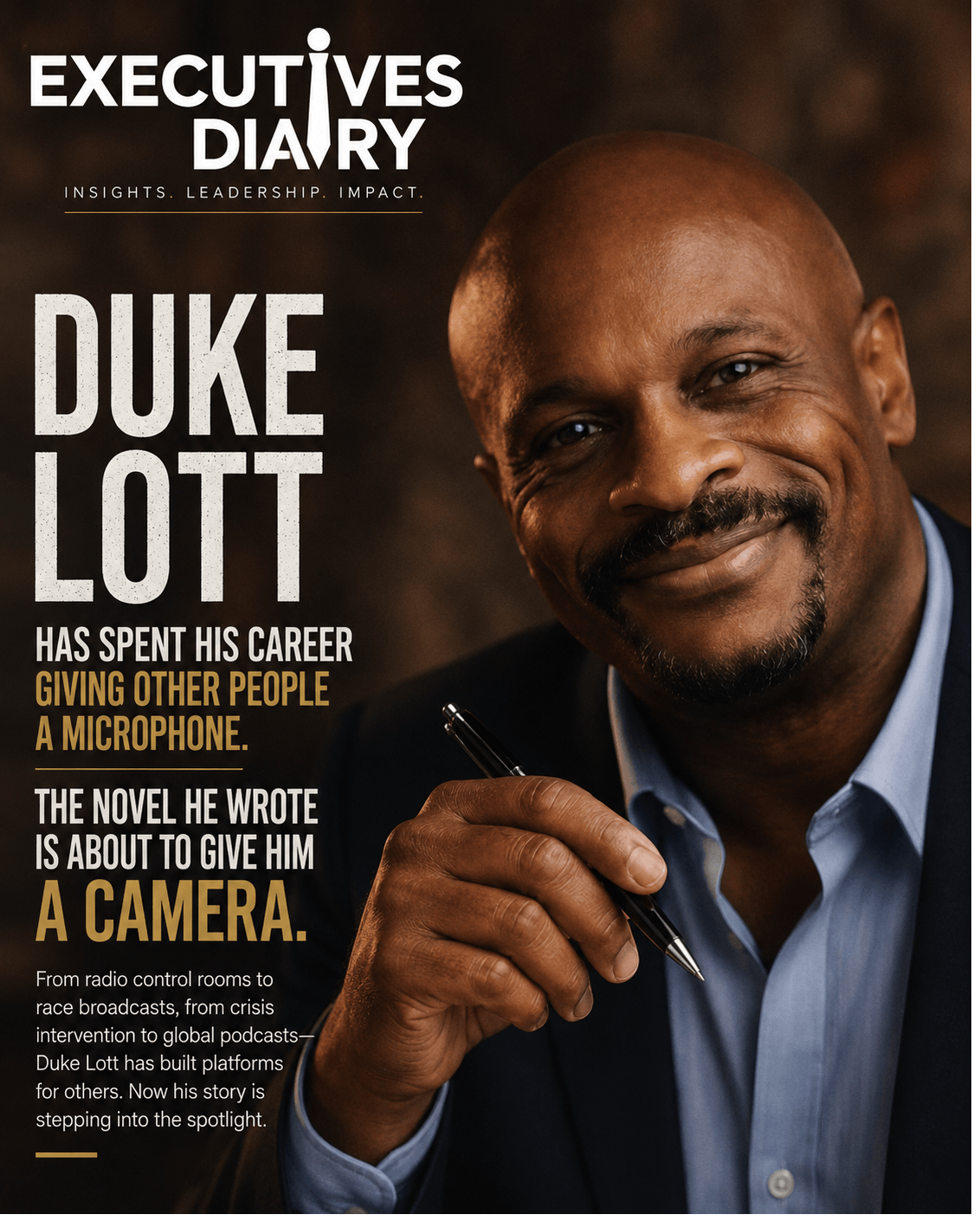
Duke Lott Has Spent His Career Giving Other People a Microphone.
The Novel He Wrote Is About to Give Him a Camera.There is a particular precision required to make sure someone else sounds perfect. To sit in a control room, manage the signal, and ensure the broadcast reaches every car radio and kitchen speaker without static or dead air. Duke Lott spent years mastering that discipline. He programmed NASCAR coverage, managed live sports remotes, and kept country music flowing across Michigan airwaves. The voices he amplified belonged to drivers, coaches, and musicians. His own voice stayed behind the glass. Today, the novel he wrote is about to change that equation completely.
The Man Who Builds Platforms for Others
Duke Lott is an author, podcaster, DEI consultant, and public speaker based in Michigan, best known as the host of The Duke Lott Show and the author of four books, including his debut novel, The Boardman Watches, now in active screenplay development for 2026 filming. His platform reaches listeners across all 50 states and 61 countries, built on a simple conviction that has defined every phase of his career: everyone deserves to be heard, and the right environment makes honest conversation possible.
From Radio Booths to Speaking Stages
The foundation for everything Duke Lott does today was laid in the technical precision of live broadcasting. He studied Recording Technology, Radio, and Music at Grand Rapids Community College, then Business Marketing at Ferris State University. That combination of sound craft and commercial understanding would prove essential later, when he needed to turn personal perspectives on relationships and inclusion into books, a global podcast, and now a film project.
For nearly six years, from 2016 to 2021, he worked as a Radio Programming Engineer at WMLMRA, handling programming for NASCAR coverage, country music, and live sports remotes, including football and basketball. The work taught him timing, audience awareness, and how to handle pressure when thousands of people are listening and everything has to work perfectly. It also showed him something else: the power that sits in whoever decides which voices go out over the air.
The shift came after he completed a Personal and Professional Development Program and began making guest appearances at youth programs and institutions across the United States. Standing in front of audiences felt different from sitting behind a console. Rooms responded to him. He realized he could do more than engineer messages. He could deliver them.
That realization opened new doors quickly. He became a Certified Crisis Intervener. He joined boards, including the F.I.A. Jim Casey Initiative. He wrote grants that secured serious funding, including multiple awards at $300,000, $500,000, and $30,000 levels. Each role pushed him further from the anonymity of technical work and deeper into direct responsibility for people and outcomes.
The crisis intervention training proved particularly valuable. When a client came to him desperate for after-school care for her child, Duke did not offer advice from a distance. “I felt her situation,” he explains. “I put her in contact with the right people, made sure all the paperwork was right for the enrollment process, and we made sure he had a ride back and forth.” The outcome was not a headline. It was a mother who could work without panic, and a child with reliable care. That is what his belief in giving everyone “a seat at the table” looks like when it moves from philosophy to practice.
Sixty-One Countries and One Unbreakable Rule
In May 2022, Duke launched The Duke Lott Show, which has grown into a Spotify Ambassador Qualified podcast with more than 30,000 downloads and listens. For a show built around DEI topics and what Duke openly describes as controversial conversations, that global reach represents something significant about his approach.
His guest selection is intentionally specific. He looks for people “on the verge of being discovered worldwide,” individuals who have something real to say but have not yet had the platform to say it properly. Then he does something most podcast hosts avoid: he sends them the questions in advance.
“Everyone deserves to be heard and seen, to a certain point. Your seat at the table matters,” Duke explains. “You will get the questions ahead of time. This allows for the freedom of a scripted and non-scripted conversation.”
That decision reveals everything about how he operates. In a media environment that often rewards gotcha moments and unexpected confrontations, Duke goes in the opposite direction. He believes preparation creates better conversations, not safer ones. A guest who is not afraid of being ambushed is a guest who will actually say something worth hearing. “Remember those who are listening. Give them a great show,” he says, and the numbers suggest his approach works.
The same philosophy drives his book writing. He has published four titles: 100 Lessons For A Successful Interracial Relationship, Never What We Wanna Say, London Visits London, and his debut novel, The Boardman Watches. His poetry has earned recognition as well, including the 2024 Rosalie Petrouske Poetry Award. Each book tackles subjects that many writers avoid, but Duke approaches them with the same commitment to creating a safe space for difficult conversations.
Now comes the biggest platform he has ever built. The screenplay adaptation of The Boardman Watches is nearly complete, with filming planned for 2026. He has secured initial partnerships and funding, and his stated goal is direct: “The vision is to partner with a major film company. Hello film world! Hi Netflix!”
That kind of stated ambition might sound like bravado from someone else. From Duke Lott, it reads as pattern recognition. He built a radio career, then left it for something larger. He built a consulting practice, then added books, then a global podcast. Each move extended his reach further than the one before. The film world is simply the next room, and Duke has spent his entire career figuring out how to make sure the right voices fill whatever room he is standing in.
The work ethic required for this trajectory is not accidental. “Learn to adapt. Work hard. Sixteen-hour days have to happen,” he says without romanticizing the process. “Stay consistent. Take care of yourself, sleep, but not too much. Learn how to grind it out. Everybody deserves a chance that’s willing to work for it.” The discipline that once kept NASCAR broadcasts running clean now keeps episodes publishing, pages written, and a film project moving forward, even when momentum would be easier to lose.
The Signal Finally Points Inward
The story that opened this article still holds its tension. Duke Lott spent years making sure other people’s voices reached their audiences at the right levels, with perfect clarity, on schedule. Today, he is still doing that work through his podcast and consulting. But he is also pointing the microphone at himself, writing the books he could not find elsewhere, and developing a film so the characters in his head can step into the light.
When the cameras roll on The Boardman Watches, the man who once lived behind the control room glass will finally be telling his story at the scale he has spent a career building for other people.
Published Works & Highlights
- 100 Lessons For A Successful Interracial Relationship
- Never What We Wanna Say
- London Visits London
- The Boardman Watches (Screenplay adaptation in development)