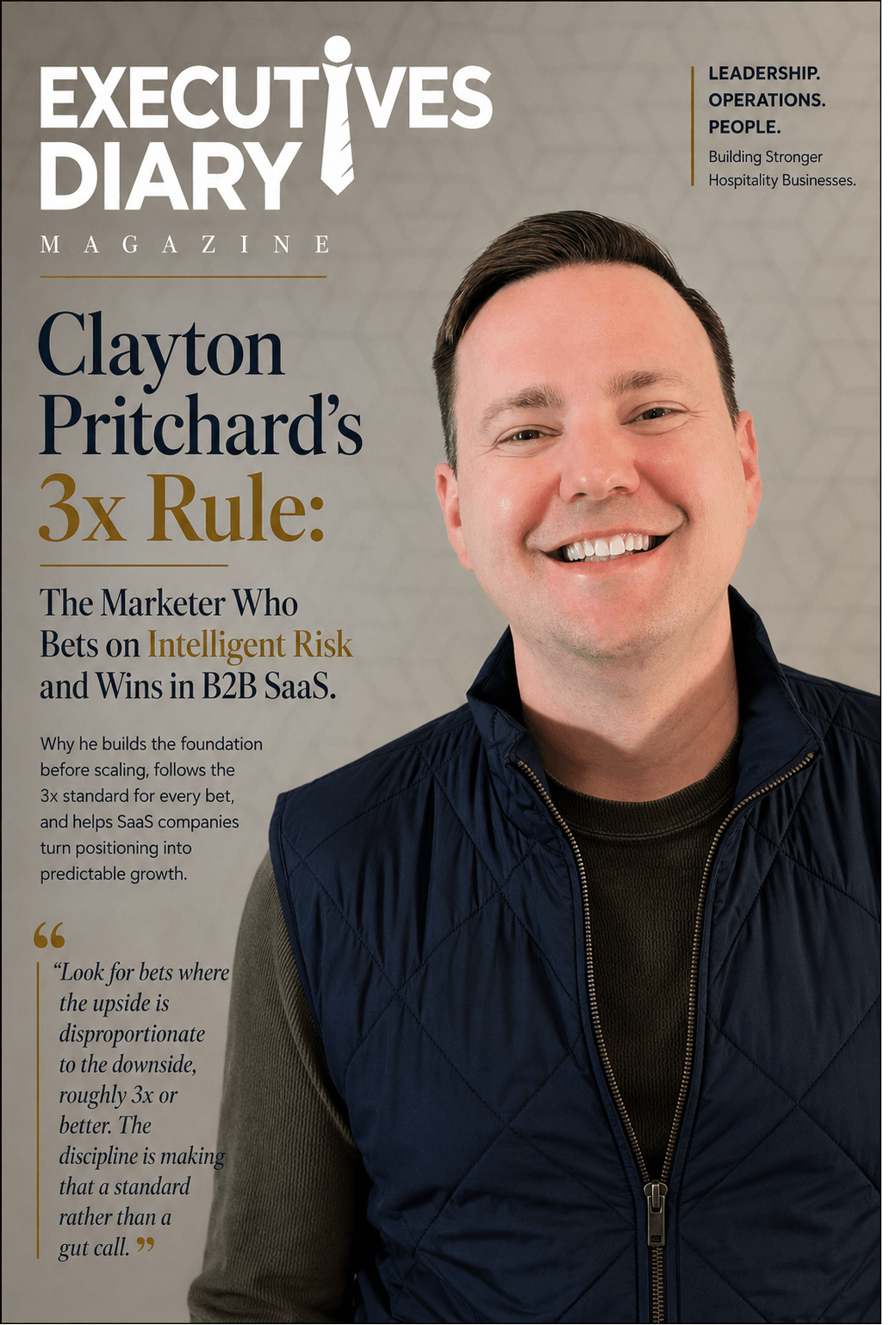
Clayton Pritchard
Clayton Pritchard’s 3x Rule: The Marketer Who Bets on Intelligent Risk and Wins in B2B SaaSThere is a specific kind of pressure that descends on a first marketing hire at an early-stage startup. No budget worth mentioning. No brand equity to borrow against. No team to absorb the mistakes. Just a blank calendar, a product that needs to find its market, and the knowledge that every dollar spent on the wrong thing is a dollar the company does not get back. Most marketers in that position reach for the familiar: more channels, a website redesign, a social media push. Clayton Pritchard did something different. He stopped, went back to the customer research, and refused to touch distribution until the messaging was worth distributing.
That instinct, to build the foundation before scaling anything on top of it, would eventually carry him to Meta, to LinkedIn, and to a company called Momentum.io that Salesforce decided was worth acquiring. It would also shape the philosophy he now runs at Olivine Marketing, the B2B product marketing agency he acquired in April 2026 and has been growing at nearly twice the rate he originally targeted.
The Man Running the Room
Clayton Pritchard is the CEO of Olivine Marketing, a full-service B2B product marketing agency helping tech companies from seed to post-IPO with market research, positioning, messaging, sales enablement, and go-to-market strategy. He is, at his core, a product marketer who has spent fifteen years learning exactly where messaging breaks down and why fixing it is almost always worth more than anything else a company could spend its budget on.
From Orlando to the Algorithm
The career did not begin with a grand plan. It began in Orlando, where Pritchard studied marketing at the University of Central Florida and started building things before anyone asked him to. He co-founded Google Plus Daily in 2012, a publication that grew to 310,000 visits in its first year and attracted a community of more than 165,000 members. The project was unpaid, self-directed, and required him to manage an international team, negotiate with Google’s public relations team, and produce content at volume. For a student, it was an unusual education in what it actually takes to build an audience from zero.
His early career ran through digital advertising. At E-Commerce Intelligence, he managed paid search and display campaigns for 45 clients, including a pair of short-term campaigns for Regal Cinemas that returned 4.5x and 7x on ad spend respectively. At Twitter, he became the first member of the SMB Sales team to surpass one million dollars in revenue and 150% quota attainment in a single quarter. These were not product marketing roles, but they were something more useful: a ground-level education in how money moves through a marketing funnel and what actually drives a buyer to act.
The shift into product marketing came at Highfive, a video conferencing company later acquired by Dialpad, where Pritchard moved from growth marketing into leading the full product marketing function. He managed the company’s move upmarket from SMB to enterprise, which required rewriting positioning, rebuilding pricing and packaging, and retraining sales, customer success, and support teams simultaneously. It was the first time he owned the entire go-to-market stack, and it gave him a working model he would carry into every role that followed.
LinkedIn came next. Over nearly three years, Pritchard worked on two distinct challenges: building out LinkedIn’s service marketplace and leading product marketing for Trust and Safety. The marketplace work was measurable and fast. Within six months of launch, demand for LinkedIn ProFinder had doubled. The Trust and Safety work was more nuanced, requiring him to translate complex platform integrity decisions into member-facing language that built confidence rather than confusion. Both experiences sharpened a belief that would become central to how he works: that the best product marketing is not about making something sound good. It is about making the right people understand why it matters.
He took that belief to Meta, where he spent two years supporting product marketing across WhatsApp Privacy, Ads Integrity, and the Llama generative AI team. His role, frequently, was to serve as the user advocate in rooms filled with product managers, engineers, legal teams, and communications leads. The work required him to hold a position on behalf of people who were not in the room, and to make that position legible to people who were thinking about entirely different problems.
The 3x Standard and the Company It Built
Between his time at the major platforms, Pritchard had been doing something else. He had been the first marketing hire at Momentum.io, a sales AI company where he arrived with no real budget and a mandate to build brand presence in a crowded space. His approach was deliberate.
He built SEO and content strategy into that positioning, ran a tight feedback loop off sales calls and site performance, and drove a 55% increase in LinkedIn followers alongside a 34% improvement in target keyword rankings. Momentum.io was later acquired by Salesforce in February 2026.
The work at Momentum crystallized something Pritchard had been developing for years: a personal standard for how to evaluate risk in marketing decisions. He calls it the 3x rule, and it traces back to an award he won at LinkedIn in just his second quarter on the Premium team.
The framework is not complicated, but applying it consistently is. It requires a clear-eyed assessment of expected value, an honest accounting of how much risk the organization can carry at once, and the willingness to commit fully to a decision and own whatever follows. A good decision and a good outcome, Pritchard is careful to note, are not the same thing.
That philosophy now runs through Olivine Marketing, the agency he acquired from founders Ashley Wilson and Raechel Lambert in April 2026. Olivine works with B2B SaaS companies at every stage of growth, helping them sharpen positioning, messaging, pricing and packaging, and go-to-market strategy. The client list includes ServiceNow, Meta, Twilio, and LinkedIn, alongside a steady stream of earlier-stage companies that need the same rigor applied to smaller, faster-moving problems, work that has earned the agency a 4.9 out of 5 rating on Clutch. Olivine has also been named a Top Product Marketing Agency by Clutch for 2026 and a Top Firm (Spring 2026) by 50Pros.
The Diligent engagement illustrates the kind of work Olivine does at its best. The company had acquired 14 businesses in under two years, and its sales team was still selling siloed point solutions while leadership was preparing to repackage everything into three new pricing tiers ahead of a major sales kickoff. The confusion was structural: there was no unified story connecting the acquisitions, and no clear language for what each tier was actually designed to do. Pritchard’s team worked through buyer personas, identified the jobs each customer was actually hiring the product to accomplish, and rebuilt the platform narrative from that foundation. The output included a new platform pitch deck deployed across the sales organization, verticalized decks for ten industries, and three revenue-driving campaigns. The company’s VP of Product Marketing credited the work with getting fast-growing commercial teams up to speed quickly.
Olivine set a target of 20% growth in Pritchard’s first year. The agency is currently tracking at nearly 40%.
The Clearest Signal
The original instinct that defined Clayton Pritchard’s approach to that first startup, the refusal to scale distribution before the message was worth distributing, turns out to be the same instinct that governs everything he does now. The tools are more sophisticated. The clients are larger. The stakes are higher. But the underlying logic has not changed: find the bet with disproportionate upside, build the foundation before you build anything on top of it, and commit to the outcome either way.
In a category crowded with agencies promising growth, the clearest signal of quality is still the one that requires the most patience to deliver. The best product marketing agencies are the ones that fix the message before they scale the spend, and prove with results rather than promises.
Key Takeaways / Playbook
- 1. Fix the Message First: Refuse to scale distribution or tactics on top of fuzzy messaging; building a foundation based on customer research is always paramount.
- 2. The 3x Standard: Look for strategic bets where the upside is disproportionate to the downside, roughly 3x or better, making risk management a disciplined framework rather than a gut call.